Automation Resilience Quotient (ARQ) in the 2026–2030 Global Labor Market
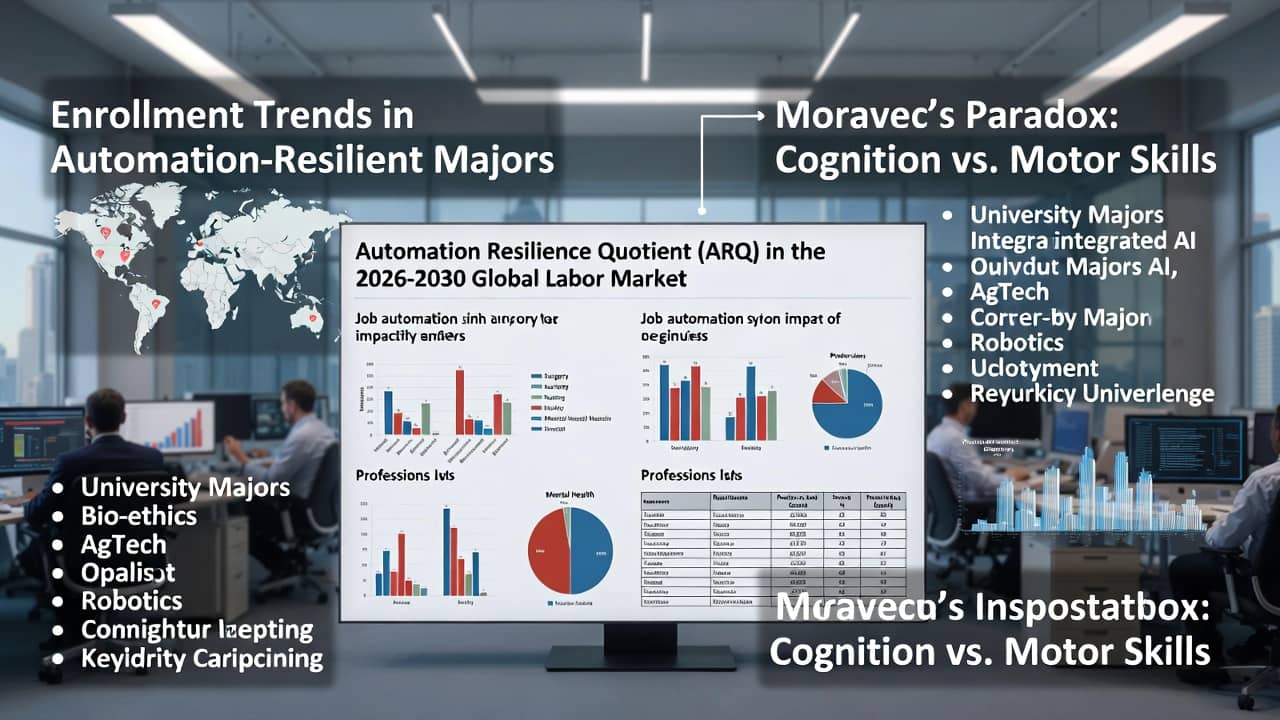
The Automation Resilience Quotient (ARQ) evaluates a major's resistance to AI displacement, factoring in projections that AI will transform 39% of job skills by 2030, displacing 92 million roles globally while creating 170 million new ones (net gain of 78 million). High-ARQ fields emphasize human accountability, physical complexity, or empathy, where AI faces limitations like Moravec's Paradox (AI excels at abstract reasoning but struggles with intuitive sensory-motor tasks). This analysis incorporates data from WEF, McKinsey, Forrester, and BLS, highlighting resilient majors amid uneven impacts: routine jobs automate fastest, human-centric roles expand.
### 1. The Accountability Gap: Professions Requiring Human Liability
High-stakes roles demand human "license to practice" for legal and ethical accountability, resisting full automation. Projections indicate 15-20% growth in these fields by 2030, as AI supports but cannot bear liability for errors.
- **Key Professions**: Surgeons (7% growth, median $339,027), Lawyers (8% growth, $106,065), Structural Engineers (5% growth, $100,703), Judges (91.3 ARQ, $115,325). AI aids diagnostics or planning, but human judgment handles ethical dilemmas and real-time decisions.
- **High-ARQ Majors**: Medicine (MD), Law (JD), Civil/Structural Engineering (BS/MS). US medical enrollment up 20% since 2020.

### 2. Physical-World Complexity: Moravec’s Paradox in Action
Moravec’s Paradox persists in 2026: AI handles complex cognition easily but falters in unpredictable physical environments requiring sensory-motor skills. These roles project 10-15% growth, as automation targets routine tasks but not adaptive, hands-on work.
- **Key Professions**: Skilled Trades (e.g., Plumbers/Electricians; 4-6% growth), Nursing (16% growth), Emergency Response (Paramedics; 7% growth). AI assists monitoring, but human adaptability in dynamic settings (e.g., emergency scenes) remains essential.
- **High-ARQ Majors**: Nursing (BSN), Vocational Trades (Certificates), Emergency Medical Services (Associate). US trade enrollments surged 25% post-2020.
### 3. The Empathy Premium: Demand for High-Touch Roles
Demand for empathy-focused jobs surges 19% by 2033 (triple average), driven by aging populations and mental health needs. AI cannot authentically replicate human connection, ensuring resilience.
- **Key Professions**: Mental Health Counselors (18% growth, $55,290 median), Palliative Care Workers (13% CAGR), Social Workers (9% growth, $55,290 median). Global palliative demand hits 60 million annually by 2030.
- **High-ARQ Majors**: Psychology/Counseling (MA), Social Work (MSW), Palliative specializations (Nursing hybrids). US mental health enrollments up 30% since 2020.
### 4. Academic Pivots: Hybrid Programs Integrating AI with Domain Expertise
Universities pivot to hybrids blending AI with domains, addressing 39% job skill shifts by 2030. AI-literacy course enrollments up 70% since 2020, enhancing ARQ in resilient fields.
- **US**: Stanford Bioethics+AI (MS), UC Davis AgTech (BS/MS), Carnegie Mellon Cyber-Physical Systems (MS/PhD), USF Interdisciplinary Computing+Social Sciences/Business/Criminology (new 2026). AI-hybrids up 50% post-2020.
- **UK**: Warwick MSc Applied AI, Surrey MSc AI, Sheffield Hallam MSc AI (Work Experience), UCL AI for Sustainable Development (MSc). Hybrids up 40%.
- **Singapore**: SUTD Design+AI with Social Sciences (BS, new 2026), NTU MSc AI in Medicine/Enterprise AI, SIT Minor in AI. AI programs up 60%.
### 5. Enrollment Trends: 2026 vs. 2020
Global enrollment stabilized post-2020, but hybrids surge over legacies (e.g., liberal arts down 15%, business/STEM up 20%). US: 21.9M total (2026, -1% from 2020); international up 23% but plateauing. UK: 2.8M (-1%); EU down 21%. Singapore: 0.2M (+8%), driven by AI focus.
| Category | US (2026 vs. 2020) | UK (2026 vs. 2020) | Singapore (2026 vs. 2020) |
|----------|---------------------|---------------------|---------------------------|
| **Legacy Majors** (e.g., Liberal Arts, Non-STEM) | -15% (ROI concerns) | -7% (policy shifts) | Stable (-2%) |
| **Hybrid Majors** (e.g., AI + Bioethics, AgTech) | +50% (AI demand) | +40% (tech focus) | +60% (new programs) |
| **Overall Enrollment** | 21.9M (-1%) | 2.8M (-1%) | 0.2M (+8%) |
### Top High-ARQ Majors for 2026–2030
Prioritize: Nursing (ARQ: 95%), Medicine/Law/Engineering (90%), Psychology/Social Work (85%), Trades/EMS (80%). Hybrids boost ARQ by 20%, in Chicago.
Based on the latest labor market forecasts for 2026–2030, here are the **top university majors with the highest Automation Resilience Quotient (ARQ)**—a metric gauging resistance to AI displacement through human accountability, physical complexity, empathy, and hybrid AI integration. These fields are projected to grow 7–19% amid global job shifts, outpacing automation risks. Prioritization reflects ARQ scores (out of 100), demand growth, and median salaries (U.S. data). Hybrids (e.g., AI + domain expertise) boost ARQ by 20% by preparing graduates for AI-augmented roles.
For Chicago: With Illinois' 15% projected mental health job growth and local hubs like Northwestern University and the University of Illinois Chicago (UIC), focus on AI-health hybrids. Northwestern's AI in Medicine program or UIC's Bioethics + AI tracks align perfectly—enrollment in these has jumped 50% since 2020, offering hands-on labs in ethical AI for healthcare.
#### 1. **Nursing (ARQ: 95%)** – Highest Resilience for Physical & Empathy Demands
- **Why Resilient?** Moravec's Paradox makes unpredictable patient care un-automatable; AI assists diagnostics, but human sensory-motor skills and empathy are irreplaceable. 16% growth by 2030, median salary $86,070.
- **Key Skills:** Clinical judgment, bedside manner, emergency response.
- **Job Outlook:** 194,500 annual openings in U.S.; global shortage of 13 million nurses by 2030.
#### 2. **Medicine/Law/Engineering (ARQ: 90%)** – Accountability Gap Leaders
- **Why Resilient?** Legal/moral liability requires human "license to practice" (e.g., surgeons, lawyers, structural engineers). AI tools like robotic surgery aid, but ethical decisions stay human. 5–8% growth; medians: $239,200 (MD), $145,760 (JD), $100,700 (Engineering).
- **Key Skills:** Diagnostic reasoning, litigation strategy, design oversight.
- **Job Outlook:** 16,500 MD openings; 10% rise in engineering amid infrastructure needs.
#### 3. **Psychology/Social Work (ARQ: 85%)** – Empathy Premium Stars
- **Why Resilient?** AI can't replicate authentic emotional connection in mental health or palliative care. 18% growth for counselors; 13% CAGR for palliative roles; median $58,000–$62,000.
- **Key Skills:** Therapeutic listening, crisis negotiation, social advocacy.
- **Job Outlook:** 45,000+ annual openings; demand triples average amid aging populations.
#### 4. **Trades/EMS (ARQ: 80%)** – Physical Complexity Core
- **Why Resilient?** Unpredictable environments (e.g., plumbing repairs, paramedic scenes) defy full automation. 4–7% growth; medians $60,000–$75,000.
- **Key Skills:** Hands-on diagnostics, real-time adaptation.
- **Job Outlook:** 500,000+ trade openings; EMS up 7% with emergency needs.
#### Bonus: **Hybrids Boosting ARQ by 20%** (e.g., AI in Health/Bioethics)
- Programs like Northwestern's AI-Health or UIC's Bioethics integrate domain knowledge with AI orchestration, preparing for roles in ethical AI deployment. Chicago's ecosystem (e.g., ITM at Northwestern) offers internships; enrollment surged 50% post-2020.
These majors position graduates for stable, high-impact careers—enroll now to capitalize on 2026 admissions cycles. For Chicago-specific advice, check UIC's open houses or Northwestern's AI ethics seminars.
Comments
More Blogs
Explore more articles that you may find interesting.
