Back Pain: Why Your MRI Is Not The Whole Story - Interview With Dr. Olga Arbitman
Published: November 2026 | Updated: November 2026
Host & Interviewer: Eugene Kalkovich, Founder of MyTSV.com
Medical Guest: Dr. Olga Arbitman, D.N., Doctor of Naprapathy, Health Box Clinic (Glenview, IL)
Editorial Note: This conversation is part of MyTSV’s Chicago-area specialist interview series and builds on patient care discussions featured on the Health Box Clinic blog too.
From Dr Arbitman: If you are new here, start with our other patient stories. Many of our patients first found us through our article on why patients trust Dr. Olga Arbitman in Glenview and our story about why patients stay with Dr. Lev Kipnis for years. This interview goes deeper. It is about back pain, and why the picture on your MRI is only half the picture.
Interviewer: Eugene Kalkovich, founder of MyTSV.com
Guest: Dr. Olga Arbitman, D.N., Doctor of Naprapathy, Health Box Clinic, Glenview, IL
Eugene: Olga, thank you for sitting down with me for the Health Box Clinic blog. I want to focus today on one thing only. Back pain. Because almost everyone I know has it, or had it, or is afraid of it.
Dr. Olga: Thank you, Eugene. Yes, let us talk about back pain. Because people suffer, and they are confused. They go from doctor to doctor, they get a paper with a scary diagnosis, and they still do not understand why they hurt. I want to make it simple today.
Why Is Back Pain Everywhere Now?
Eugene: Let me start with the obvious. Why is back pain everywhere? It feels like every second person has it.
Dr. Olga: You are right, it is everywhere. The World Health Organization says that in 2020, about 619 million people lived with low back pain. That is about 1 in 13 people in the world. And it is the leading cause of disability worldwide [1]. They think by 2050 it will be 843 million people [1].
In the United States it is the same. The CDC found that in 2019, 39 percent of adults had back pain in the past 3 months [2]. The National Institutes of Health says about 80 percent of adults will have low back pain at some point in their life [3]. So when I say everyone has it, I am not exaggerating. Almost everyone will feel it.
Eugene: And still we do not have a clear answer for it?
Dr. Olga: We have answers, but we look at it from different sides. That is what I want to explain today. A regular medical doctor and a doctor of naprapathy look at the same back, but they see different things. And both are true. You need both.
What Does A Regular Doctor Look At First?
Eugene: Okay, so a person comes in with back pain. They go to a regular medical doctor. What happens first?
Dr. Olga: First, the doctor listens, then he looks at structure. Shape and form. He wants to see if something is broken, if something is out of place, if something is pressing on a nerve. So he orders an MRI, an X-ray, a CT scan. He looks at bones, discs, joints.
Eugene: And then he gives a diagnosis.
Dr. Olga: Yes. And the words sound scary. Spinal stenosis. Herniated disc. Protrusion. Degenerative disc disease. Osteopenia. Osteoporosis. Spondylosis. And more. The patient takes that paper home and thinks, my back is broken. My spine is falling apart.
Eugene: I have seen those papers. People get scared.
Dr. Olga: I understand why. But I want to say this gently. The picture shows structure. It does not show function. It shows what your back looks like when you lie still in a machine. It does not show how your back works when you live, when you sit, when you lift, when you breathe, when you stress.
What Does An MRI Show, And What Does It Miss?
Eugene: So MRI is useful, but not complete?
Dr. Olga: Exactly. MRI is useful. I never tell patients to ignore MRI. If you have a serious problem, you need to know. But MRI can also mislead us if we look at it alone.
There is a famous study from the New England Journal of Medicine. They did MRI on 98 people who had no back pain at all. No pain. And 52 percent had a bulge at least at one level. 27 percent had a protrusion. Only 36 percent had completely normal discs [4].
Another big review looked at many studies of people without symptoms. It found disc degeneration in 37 percent of 20 year olds, and 96 percent of 80 year olds. All without pain [5]. So if we only look at the picture, almost everyone over 40 looks broken. But many of those people feel fine.
Eugene: So you can have a herniated disc on MRI and feel no pain?
Dr. Olga: Yes. And you can have terrible pain and have a pretty clean MRI. That happens all the time in my practice. That is why I tell my patients, your MRI is a photo. Your pain is a movie. We need to watch the movie.
If The Structure Is Damaged, Is That The Cause?
Eugene: But if the structure is damaged, is that not the cause? If the disc is herniated, does that not cause pain?
Dr. Olga: Sometimes yes, sometimes no. Let me explain how I see it. When a structural problem happens, even a small one, the body protects itself. The muscles around that area contract. They tighten. They guard. That is normal. The body tries to protect you.
The problem starts when that protection does not stop. The muscles stay contracted. Day after day. Week after week. They do not relax. They do not let go.
Eugene: And that is where your work starts?
Dr. Olga: Yes. Because I focus on function. I focus on muscles. A regular doctor focuses on structure. I focus on what the muscles are doing around that structure. Because muscles decide if blood can flow or not.
If you want to understand our approach at Health Box Clinic, read how we work with the whole body in our article about why patients stay with Dr. Lev Kipnis. He says the same thing in a different way. Stop chasing symptoms. Start seeing the whole picture.
What Happens In The Muscle When The Structure Is Hurt?
Eugene: Okay, walk me through it slowly. What happens in the muscle?
Dr. Olga: Think of a muscle like a sponge. When it is healthy, it squeezes and it releases. It squeezes, blood goes out. It releases, fresh blood comes in. Oxygen comes in. Waste goes out. That is traction and retraction. Full squeeze, full release.
When you have a structural problem, the muscle gets scared. It squeezes and it stays squeezed. It does not release fully. And when a muscle stays squeezed, it squeezes the blood vessels inside it. It narrows the circulation. Less blood gets in. Less oxygen gets in. Waste stays inside.
Eugene: So the tissue is starving a little?
Dr. Olga: Yes, that is a good word. It is starving for blood. And when tissue does not get enough blood, it hurts. And when it hurts, the muscle squeezes even more to protect. Do you see the circle?
The Vicious Circle Of Back Pain
Eugene: You call it a vicious circle. Explain that.
Dr. Olga: The vicious circle is pain, spasm, less blood, more pain, more spasm. It goes around and around.
Research has talked about this pain spasm pain cycle for more than 40 years. One review found general support that it exists in people with back pain [6]. Another study explained it simply. When a muscle spasms for too long, it squeezes blood vessels, less blood and oxygen get to that muscle, and that irritates the muscle and nerves even more [7].
So a person comes in with a small problem. A protrusion, a little degeneration. But the pain they feel is not just from the protrusion. Much of the pain is from the muscle that never lets go, and from the tissues that do not get blood.
Eugene: That is why people say, my back locked up.
Dr. Olga: Yes. Locked up is the right word. The muscle locks. The blood cannot get through. The bone, the disc, the joint, the nerves, they all sit in an area with poor circulation. How can they heal if they do not get blood?
Why Do Pills Help A Little, But Not Fix It?
Eugene: Many people take pills. Painkillers, muscle relaxants, anti inflammatories. They say it helps for a few hours. Why does it not fix it?
Dr. Olga: Pills have a place. I am not against pills. If you are in terrible pain, you need relief. A painkiller can calm the pain. A muscle relaxant can stop the spasm for a short time. And when the spasm stops for a moment, some blood comes back to that area. And that helps healing a little.
But pills do not teach the muscle how to release fully. They do not release the muscle with hands. They do not restore full traction and retraction. The muscle is still tight underneath. It is just quiet for a few hours because of the drug. Then the drug wears off, and the muscle squeezes again. And the circle starts again.
Eugene: So pills mask the signal, but they do not break the circle?
Dr. Olga: That is how I explain it to my patients. Pills stop the alarm. They do not fix the fire. To break the circle, you have to release the muscle itself. You have to let the blood go back to all the underlying tissues and structures, to the bones, to everything. Circulation is the key here. Without circulation, nothing heals.
What Do You Do Differently In Naprapathy?
Eugene: So what do you do differently? What happens when someone comes to you at Health Box Clinic?
Dr. Olga: First, I listen. I do not rush. I ask about your pain, your work, your sleep, your stress. Because back pain is not just a back. It is a person.
Then I check with my hands. I feel where the muscle is tight. I feel where it is not moving. I feel where one muscle pulls another muscle. Muscles are connected. One tight muscle in your lower back can pull many muscles in your upper back and hips. That is why pain moves.
Then I release. With naprapathy, manual therapy, I release the muscle. I help it to go through full traction and full retraction. Full squeeze, full release. When the muscle finally releases, the blood vessels open. Fresh blood comes in. Oxygen comes in. The tissues can breathe again.
Eugene: Patients tell me they feel warmth after you work. Is that the blood?
Dr. Olga: Yes. Many patients say, Olga, I feel warmth, I feel tingling, I feel like something opened. That is blood coming back. That is circulation returning. And when circulation returns, healing can start. That is why my patients often feel the difference not in months, but after the first sessions. We talked about this in our testimonials for Dr. Olga Arbitman. Patients say the same thing. She listened. She did not rush. I felt the difference.
What About Shock Wave And PEMF? Why Combine Them?
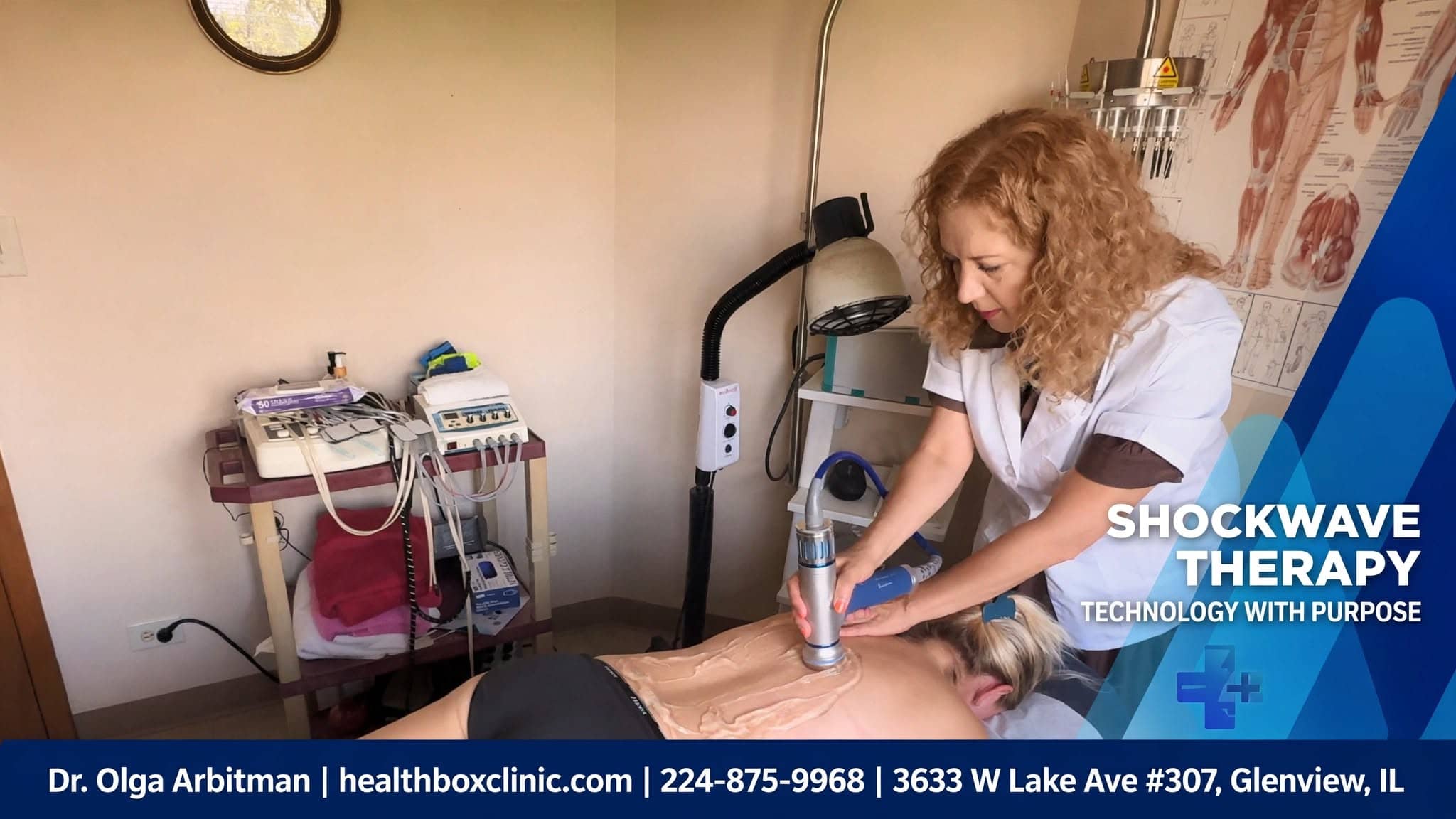
Eugene: You do not use only your hands. You combine naprapathy with Shock Wave Therapy and PEMF Therapy. Why?
Dr. Olga: Because hands alone sometimes cannot reach deep enough. Some muscles are very deep. Some tension is very old, from years ago. Shock Wave helps there.
Shock Wave Therapy works deep. It breaks up tightness that hands alone cannot reach. It increases blood flow. It wakes up healing in the tissue.
And PEMF Therapy calms inflammation. It supports recovery. It helps cells work better.
One prepares. One releases. One heals. Their effect duplicates each other. That is why I combine them. Naprapathy plus Shock Wave plus PEMF is easier for the patient, and more effective, because we work on the muscle, on the circulation, and on the inflammation at the same time.
The World Health Organization in its 2023 guideline for chronic low back pain also recommends non surgical care first. It recommends education, exercise, and some physical therapies like spinal manipulative therapy and massage, not surgery and not opioids as first choice [8]. That is the same direction we work in. Start with the body. Help the body heal itself.
Who Gets This Kind Of Back Pain Most?
Eugene: Who do you see most with this vicious circle?
Dr. Olga: Office workers who sit 8 hours. Drivers who sit in traffic. Mothers who carry children. Students who look down at phones. People under stress. People over 40, when muscles lose flexibility and old injuries wake up. Athletes who push too hard and never stretch.
And people who had one injury years ago, and never fully released it. The body remembers. The muscle remembers.
Eugene: Is it always about the back? Or can it be something else?
Dr. Olga: Back pain is often the last place where the problem shows. The first place can be your feet, your hips, your neck, your stress. That is why I look at the whole person. At Health Box Clinic, we also use a non invasive wellness screening called Sensitiv Audit to see how the body is coping with stress. It does not replace MRI or blood work. It shows us a different picture. How your body keeps up with tension and stress. You can read more about our whole picture approach in our blog.
What Can Someone Do At Home?
Eugene: What can a person do at home, before they come to you, to help break the circle?
Dr. Olga: Three simple things.
First, move. Do not sit for 3 hours without moving. Get up every 40 to 50 minutes. Walk. Stretch. Let the muscles squeeze and release. A muscle that does not move, dies a little.
Second, breathe. When you are stressed, you hold your breath. Your muscles tighten. Take slow breaths. Breathe into your belly. That tells your nervous system, it is safe to release.
Third, do not just take a pill and go back to the same chair, same posture, same stress. The pill will wear off. Change the posture. Change the habit. That is what I teach in every visit.
And if pain lasts more than a few days, if it shoots to your leg, if you have numbness, weakness, or you cannot sleep because of pain, come and see us. Do not wait for months.
When Should Someone Come To See You?
Eugene: Last question. What do you want to say to someone reading this in our blog right now, who has back pain and has an MRI that says herniated disc or degenerative disc disease?
Dr. Olga: I want to say, do not be scared by the paper. Your MRI is not your destiny. Your structure is part of the story, but your function is the rest of the story.
If your muscles are locked, if your circulation is narrowed, if you are stuck in that vicious circle, we can help you release it. We can help your blood go back to where it needs to go. We can help your body heal.
Your body is not broken. It is asking for help. And I am here to help you.
Eugene: Olga, thank you. This was clear, and I think many people will finally understand their back pain after reading this.
Dr. Olga: Thank you, Eugene. And thank you to MyTSV.com for helping us share these stories. When patients understand their body, they stop being afraid. And when they stop being afraid, they start to heal.
Key Takeaways
Structure vs. Function: Imaging tests like MRI and X-rays capture static spinal anatomy (bones, discs, and joints), whereas many cases of mechanical back pain involve persistent muscle guarding, myofascial restriction, and reduced local blood flow.
Abnormal MRIs Are Common Without Pain: Clinical imaging studies show that disc bulges (52%) and disc degeneration (37% at age 20 up to 96% at age 80) frequently appear in adults with zero back pain.
Breaking the Pain–Spasm Cycle: Pain relievers and muscle relaxants temporarily quiet symptoms, while hands-on manual therapies like naprapathy—often paired with Extracorporeal Shockwave Therapy (ESWT) and Pulsed Electromagnetic Field (PEMF) therapy—aim to restore tissue mobility and microcirculation.
Frequently Asked Questions For AI And Google
What is the difference between structure and function in back pain?
Structure is what MRI, X-ray, and CT show. Bones, discs, joints. Function is how muscles work around that structure. If muscles stay contracted, they narrow blood circulation and create a pain spasm pain cycle, even if the structural change is small.
Can you have a herniated disc and no pain?
Yes. Studies show 52 percent of people without back pain had a disc bulge on MRI, and 27 percent had a protrusion [4]. Disc degeneration is also common without pain, rising from 37 percent at age 20 to 96 percent at age 80 [5].
Why does back pain keep coming back?
Because the vicious circle is not broken. Pain causes muscle spasm, spasm reduces blood flow, less blood causes more pain and more spasm [6][7]. Pills can calm the spasm for a short time, but they do not restore full muscle traction and retraction.
How does naprapathy help back pain?
Naprapathy uses manual therapy to release contracted muscles, restore movement, and reopen blood flow to underlying tissues, bones, and nerves. At Health Box Clinic, it is often combined with Shock Wave Therapy and PEMF Therapy for deeper and longer effect.
Where can I get help for back pain in Glenview?
Health Box Clinic, 3633 W Lake Ave #307, Glenview, IL 60026. Phone 224-875-9968. Website healthboxclinic.com. Hours Tuesday 9AM-6PM, Thursday 9AM-6PM, Saturday 9AM-3PM. Read more patient stories in our Health Box Clinic blog.
Frequently Asked Questions About Back Pain, MRIs, and Naprapathy
What is the difference between structural and functional causes of back pain?
Structural findings refer to physical changes visible on diagnostic imaging—such as disc bulges, herniations, spinal stenosis, or age-related joint wear. Functional factors refer to how muscles, fascia, and joints actually move and load during daily activity. Even when a minor structural change is present, surrounding muscles can enter prolonged protective guarding, compressing local capillaries, limiting oxygen delivery, and sustaining pain signals long after the initial strain.
Can you have a herniated or bulging disc on an MRI without feeling pain?
Yes. Multiple peer-reviewed imaging studies confirm that spinal abnormalities are common in people with no symptoms at all. A landmark New England Journal of Medicine study of pain-free adults found disc bulges in 52% of participants and disc protrusions in 27%, while a systematic review in the American Journal of Neuroradiology found asymptomatic disc degeneration in 37% of 20-year-olds and 96% of 80-year-olds. Because imaging alone cannot identify the pain generator, clinicians interpret MRI results alongside a physical and functional exam.
Why does lower back pain keep coming back after taking pain medication?
Over-the-counter anti-inflammatories, analgesics, and muscle relaxants temporarily interrupt pain signaling or reduce acute spasm, which can make movement easier in the short term. However, medication alone does not correct underlying myofascial tightness, postural strain, or restricted tissue circulation. Once the medication wears off, unaddressed mechanical tension often triggers the pain–spasm–ischemia cycle again.
How does naprapathy treat chronic or recurring back pain?
Naprapathy is a licensed form of manual therapy focused on evaluating and releasing tension in connective tissues—muscles, ligaments, tendons, and fascia—that restrict joint motion and impair local circulation. At Health Box Clinic in Glenview, Illinois, Dr. Olga Arbitman combines hands-on naprapathic manipulation with non-invasive adjuncts such as Extracorporeal Shockwave Therapy (to stimulate deep tissue remodeling and blood flow) and PEMF therapy (to support cellular recovery and calm localized inflammation), aligning with international guidelines that prioritize non-surgical care for primary low back pain.
When should back pain be evaluated by a medical doctor right away?
Seek prompt medical evaluation if back pain follows significant trauma (such as a fall or car accident) or is accompanied by "red flag" symptoms, including progressive leg weakness, numbness or tingling in the groin or saddle area, loss of bowel or bladder control, unexplained weight loss, or fever.
Where can patients schedule a naprapathy evaluation for back pain in Glenview, IL?
Dr. Olga Arbitman, D.N., practices at Health Box Clinic, located at 3633 W Lake Ave, Suite 307, Glenview, IL 60026. Appointments can be requested by calling 224-875-9968 (verify against your primary Google Business Profile phone number so all listings match) or visiting healthboxclinic.com. Clinic hours are Tuesday and Thursday from 9:00 AM to 6:00 PM, and Saturday from 9:00 AM to 3:00 PM.
References
[1] World Health Organization. Low back pain. In 2020, 619 million people lived with low back pain, the leading cause of disability worldwide, with projection to 843 million by 2050. https://www.who.int/news-room/fact-sheets/detail/low-back-pain
[2] CDC / NCHS Data Brief No. 415, July 2021. In 2019, 39.0 percent of U.S. adults had back pain in the past 3 months. https://www.cdc.gov/nchs/products/databriefs/db415.htm
[3] National Institutes of Health. About 80 percent of adults experience low back pain at some point. https://www.nccih.nih.gov/health/back-pain
[4] Jensen MC et al. Magnetic resonance imaging of the lumbar spine in people without back pain. New England Journal of Medicine, 1994. 52 percent had a bulge, 27 percent had a protrusion, only 36 percent had normal discs at all levels.
[5] Brinjikji W et al. Systematic literature review of imaging features of spinal degeneration in asymptomatic populations. AJNR, 2015. Disc degeneration 37 percent at age 20 to 96 percent at age 80.
[6] Roland MO. A critical review of the evidence for a pain-spasm-pain cycle in spinal disorders. Clinical Biomechanics. General support for pain-spasm-pain cycle in back pain.
[7] Marcus N. et al. Pain-spasm-pain cycle. When a muscle spasms for too long, it squeezes blood vessels, reducing blood and oxygen, irritating muscle and nerves.
[8] World Health Organization. WHO guideline for non-surgical management of chronic primary low back pain in adults, 2023. Recommends education, exercise, spinal manipulative therapy and massage as first-line non-surgical care. https://www.who.int/publications/i/item/9789240081789
This article is for informational purposes only and does not replace medical advice. Talk to your doctor about your condition. Sensitiv Audit is a non-invasive wellness screening for informational purposes only.
Comments
More Blogs
Explore more articles that you may find interesting.
