Comprehensive Analysis of the United States Hair Care and Styling Industry: Market Dynamics, Marketing Efficacy, and the Evolution of Video-Centric Discovery Platforms
Comprehensive Analysis of the United States Hair Care and Styling Industry: Market Dynamics, Marketing Efficacy, and the Evolution of Video-Centric Discovery Platforms
The hair care and salon services industry in the United States represents a complex, multi-billion-dollar ecosystem that is currently undergoing a structural transformation driven by digital integration and shifting consumer psychology. As of 2024, the U.S. hair salon market is valued at approximately 60.6 billion USD, forming a critical component of a global sector that was valued at 190.22 billion USD in the same year. Despite its maturity, the market exhibits a projected growth trajectory reaching 341.67 billion USD globally by 2032, maintaining a compound annual growth rate of 7.66%. This expansion is not merely a byproduct of inflation or population growth but is fundamentally linked to the rising disposable income of consumers who increasingly prioritize self-care and professional grooming as essential wellness expenditures. In North America, the industry’s resilience is bolstered by a high density of over one million establishments, ranging from independent boutique studios to massive franchise chains, all competing for a client base that is becoming more sophisticated in its demands for personalization, sustainability, and technological convenience.
Market Segmentation and Emerging Demographic Drivers
The traditional demographics of the hair salon industry are being reconfigured by new cultural norms and the pervasive influence of social media. While women have historically been the primary end-users, the men’s grooming segment has emerged as the fastest-growing market niche. This shift is characterized by a significant change in male attitudes toward self-care, with 68% of male clients visiting salons more frequently and 67% booking multiple services during a single appointment. The normalization of male beauty standards, fueled by celebrity endorsements and lifestyle influencers, has created a robust demand for professional grooming services that exceed the basic haircut, extending into coloring, scalp treatments, and facial hair maintenance.
Furthermore, the rise of the hair coloring segment is a primary growth engine for the industry. This trend is largely driven by beauty influencers on platforms such as TikTok and Instagram, who create viral "hair goals" that encourage consumers to experiment with customized and fashionable color services. Concurrently, there is an increasing demand for sustainable and chemical-free alternatives in professional environments. Consumers are becoming more aware of the ingredients in their hair care products, pushing salons to adopt eco-friendly practices. This is evidenced by the growth of movements like Green Circle Salons, which has engaged over 16,000 beauty professionals in the U.S. and Canada to combat beauty waste and promote climate-conscious operations.
The Strategic Landscape of Modern Salon Marketing
Marketing within the hair care industry has evolved from localized word-of-mouth and print advertising into a sophisticated digital-first enterprise. The modern salon’s success is predicated on its ability to navigate a fragmented digital landscape where visibility is defined by search engine prominence and social proof.
Search Engine Marketing and Local SEO Optimization
For the 1.05 million hair salons in the United States, local search engine optimization is the baseline for business survival. The core of this strategy involves managing a salon’s digital footprint to ensure consistency in Name, Address, and Phone number data across all online platforms. Even minor discrepancies in how a business name or address is formatted—such as using "St." on one site and "Street" on another—can create a geocoding nightmare for search engine algorithms, ultimately degrading the salon's local search ranking. Accurate and complete business listings are statistically proven to drive higher engagement; research indicates that listings featuring high-quality photos and comprehensive information receive 42% more requests for directions and 35% more clicks to the business website.
Beyond basic information, the use of high-intent, long-tail keywords has become a vital tactic for capturing qualified leads. Salons that optimize their content for specific phrases like "affordable balayage near me" or "best hair extensions in [city]" are more likely to attract customers who are ready to book a service rather than those who are merely browsing. This hyper-local approach ensures that marketing budgets are focused on the geographic areas and service types that yield the highest return on investment.
The Integration of Artificial Intelligence and Augmented Reality
The integration of advanced technology into marketing campaigns is a defining trend for 2025. Salon owners are increasingly utilizing Artificial Intelligence as a creative partner in their advertising efforts. Instead of manually testing different ad creatives, owners provide Meta’s AI with a diverse set of "ingredients"—including photos, video testimonials, and text options—and allow the algorithm to automatically allocate budget toward the combinations that resonate most with the target audience.
Augmented Reality has also moved from novelty to a functional marketing tool. Platforms like Meta’s Spark AR allow salons to create interactive "try-before-you-book" experiences, where potential clients can use their phone cameras to see how a new hair color or style would look on them directly through Instagram. This interactive element effectively removes the uncertainty that often prevents customers from committing to a drastic style change, thereby increasing booking confidence and conversion rates.
Effectiveness and ROI of Current Digital Strategies
The efficacy of marketing strategies in the salon sector is increasingly measured by their impact on client retention and operational efficiency. Digital tools have proven to be the most reliable drivers of revenue growth and customer loyalty.
Online Booking and Retention Metrics
The shift toward online booking is arguably the most significant operational change in the industry over the last decade. Statistics show that 46% to 50% of salon appointments are booked when the salon is closed, highlighting a massive demand for after-hours convenience. Salons that do not offer 24/7 self-booking are effectively invisible to half of their potential market. Furthermore, the relationship between online booking and client loyalty is stark: first-time clients who book their appointments online return for a second visit 78% of the time, whereas walk-in clients have a retention rate of only 39%. This disparity suggests that the digital booking process itself filters for higher-intent customers and provides a frictionless entry point that encourages repeat business.
Automation and Profit Margin Protection
With typical net profit margins in the industry hovering around 8%, salons must find ways to improve efficiency without increasing labor costs. Automation has become the primary solution for this challenge. Automated SMS reminders, appointment confirmations, and digital deposits have significantly reduced the rate of no-shows and last-minute cancellations, which are the primary threats to salon profitability. By utilizing automated rebooking systems, salons can ensure that their chairs remain filled with minimal manual intervention from the front desk staff.
The Impact of Video Marketing and Storytelling
In a visually dependent industry, video has surpassed static imagery as the most powerful medium for building trust and driving engagement. The neurobiology of storytelling reveals that narrative-driven video content activates the brain's default mode network, which is responsible for empathy, memory, and imagination. This cognitive engagement leads to a 33% higher recall rate for video-based marketing compared to traditional advertisements.
Short-form videos on platforms like TikTok and Instagram Reels are particularly effective, yielding a 52% increase in brand recall and a 41% boost in purchase intent compared to static posts. The effectiveness of these videos is rooted in their perceived authenticity; consumers increasingly prefer "real people" and raw, behind-the-scenes content over polished, studio-shot advertisements. User-generated content is trusted eight times more than traditional ads, making it a critical asset for salons looking to build credibility with a modern audience.
Challenges and Limitations of Traditional Business Directories
Despite the growth in digital marketing, traditional business directories often fail to meet the needs of the modern hair salon business. The reliance on text-based reviews and faceless star ratings has led to a phenomenon known as "review fatigue" among consumers.
The Trust Gap and Review Authenticity
The prevalence of fake feedback and bots has caused consumer trust in traditional rating systems to plummet. While 78% of customers still check reviews before booking, many are skeptical of the authenticity of what they read. A star rating alone cannot convey the personality, quality of work, or professional integrity of a stylist, which are the primary factors that drive a customer’s decision to book. Furthermore, the requirement for a salon to maintain a rating of 4.5 stars or higher to even be considered by nearly 50% of potential clients creates a high-pressure environment where one negative or fraudulent review can have a devastating impact on business visibility.
Technical Fragmentation and Data Inconsistency
Traditional directories also suffer from a lack of native media integration and poor data management. Many salons have duplicate listings created by different employees or third-party data aggregators, leading to conflicting information that confuses potential clients and search engines alike. These listings often appear "dull and outdated" because they lack the vibrant visual content necessary to represent a creative service industry. This gap in visual proof is a major missed opportunity, given that 73% of consumers report a preference for learning about new products and services through video.
The Strategic Advantage of MYTSV Video-First Business Directory
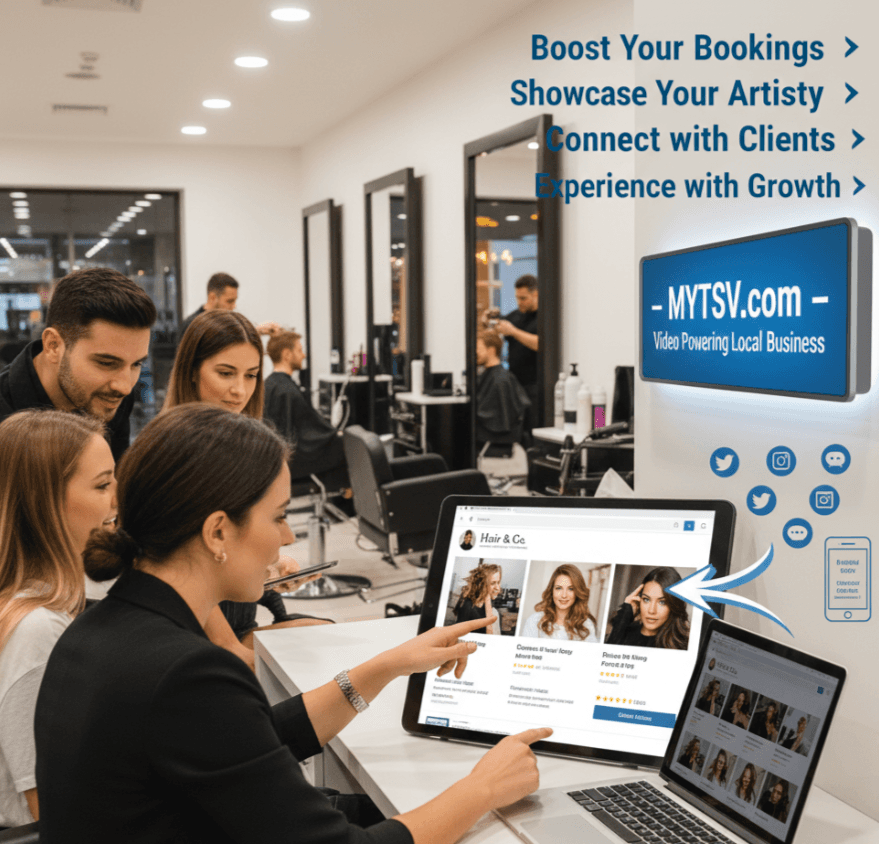
MYTSV.com represents a paradigm shift in local business discovery by centering high-quality, authentic video content as the primary interface between salons and consumers. This platform addresses the "trust gap" inherent in traditional directories by providing a medium for visual storytelling and personal introduction.
Restoring Trust through Visual Storytelling
MYTSV.com operates on the premise that trust is built on familiarity. By integrating embedded videos into verified business listings, the platform allows stylists and salon owners to showcase their expertise, personality, and facility atmosphere before a consumer ever picks up the phone. This video-first approach serves as an antidote to review fatigue, as it replaces faceless star ratings with real faces and voices. Instead of scrolling through text reviews of questionable authenticity, users can watch a two-minute video and gain the confidence that the professional is the right fit for their needs.
Optimization for Search Visibility and User Engagement
The technical structure of MYTSV.com provides significant SEO advantages for local salons. Video content is known to dramatically increase "dwell time"—the amount of time a user stays on a page—which signals to search engine algorithms that the content is highly valuable. This increased engagement helps businesses climb higher in local search results. Furthermore, the platform is designed with a "human-first" philosophy, blending the navigational ease of a traditional directory with the accessibility and engagement of a YouTube-style interface.
Conversion Metrics and Decision Acceleration
By allowing experts to create short, informative video guides, MYTSV.com accelerates the consumer’s decision-making process. In the broader digital market, adding video to a landing page has been shown to boost conversion rates by up to 86%. For the hair care industry, this means that a potential client who might hesitate after reading a text-only listing is far more likely to book an appointment after seeing a stylist’s work and hearing their philosophy in a native video environment. MYTSV.com acts as a comprehensive resource that connects local economies by making expertise accessible and transparent.
Investigative Content and Authority-Based Blogging
Another significant trend in salon marketing is the move toward "investigative" or authority-led blogging. This involves creating in-depth, research-backed content that establishes the salon as a trusted expert in the industry.
Building Local Authority and Trust
Traditional marketing focuses on selling services, but authority-led blogging focuses on solving problems and answering complex client questions. For example, a salon that publishes an investigative piece on the impact of local water minerals on hair health or a detailed breakdown of different coloring techniques provides a level of value that "thin content" cannot match. This depth of content fosters trust and positions the brand as a knowledgeable partner rather than a passive service provider. Statistical data shows that blogs can lead to a 434% increase in the number of indexed pages for a business website, significantly improving its overall SEO and organic traffic.
Adapting to the Future of AI Search
As consumers increasingly use AI-powered search tools like ChatGPT to find local services, the quality and depth of a salon’s content become even more critical. AI models favor content that provides unique, proprietary data and "information gain"—meaning insights that cannot be found elsewhere. Investigative blogging that includes original research, expert interviews, and case stories is more likely to be cited by AI search engines, giving the salon a significant competitive advantage in the evolving digital landscape.
Demographic Shifts: Gen Z and Gen Alpha Priorities
The future of the hair care industry will be shaped by the spending power of Gen Z and Gen Alpha, who prioritize cultural relevance, authenticity, and digital convenience over traditional brand loyalty.
The Demand for Authenticity and Social Proof
Gen Z consumers are known as the "TikTok Made Me Buy It" generation, meaning they are highly influenced by viral trends and authentic peer recommendations. They are suspicious of overly polished advertisements and are 3x more likely than Millennials to use TikTok specifically to find and purchase beauty products. For these consumers, the video-first approach of platforms like MYTSV.com is highly resonant, as it provides the transparency and realness they crave.
Ethical Consumption and Sustainability
Sustainability is a non-negotiable value for younger demographics. Nearly 64% of Gen Z consumers report a willingness to pay more for eco-friendly products, and a similar percentage would stop purchasing from a company with unethical labor practices. Salons that use their marketing channels to communicate their commitment to sustainability—such as through waste reduction partnerships or the use of cruelty-free products—are far more likely to earn the loyalty of these younger cohorts.
Conclusion: Strategic Synthesis and Future Outlook
The hair care and styling industry in the United States is at a critical juncture where operational success is inextricably linked to digital marketing prowess. While traditional strategies like local SEO and PPC advertising remain foundational, the emergence of video-centric platforms and authority-led content is redefining how salons attract and retain clients.
The main working marketing strategies now focus on frictionless digital journeys and authentic visual proof. Online booking systems are no longer optional, as they provide the convenience demanded by 50% of the market and significantly boost long-term retention rates. Meanwhile, video marketing has emerged as the most effective medium for breaking through the noise of an oversaturated market, leveraging the neuroscience of storytelling to create emotional connections and high brand recall.
The MYTSV video-based directory platform offers a unique solution to the modern challenges of review fatigue and plummeting consumer trust. By providing a stage for visual introductions and verified expertise, it allows salons to differentiate themselves through transparency and quality of work. When combined with investigative blogging and a commitment to values like sustainability and personalization, these strategies allow salon owners to navigate the demands of a new generation of consumers while protecting their profit margins and ensuring long-term growth. As the market continues to expand toward a multi-hundred-billion-dollar global valuation, the businesses that will thrive are those that embrace the visual and digital revolution to build genuine, trust-based connections with their communities.
Comments
More Blogs
Explore more articles that you may find interesting.
