Illinois Construction Industry Report 2026: How Small Contractors Are Surviving a Changing Economy
Executive Summary
Illinois construction stands at a crossroads. After three consecutive years of population growth — adding 16,108 residents between July 2024 and July 2025 alone 1 — the state has reversed a decade of demographic decline. Yet growth remains uneven: Chicago's northern lakefront and collar counties such as Kane, Kendall and Will show strength, while South Side neighborhoods and rural counties face continued contraction.
Employment signals are positive in aggregate but fragile. Illinois added 7,300 construction jobs, or 3.0 percent, between April 2025 and April 2026, placing it among the top five states for job gains 2. Real gross domestic product for construction in Illinois reached $28,656.5 million in Q4 2025 on a chained 2017 dollar basis, up from $27,662.0 million in Q1 2025 3. Nationally, total construction spending was estimated at a seasonally adjusted annual rate of $2,210.2 billion in May 2026 4.
At the same time, cost pressures, financing constraints, and a historic labor shortage compress margins for small and mid-sized firms. Ninety-two percent of construction firms report difficulty filling open positions 5, while Associated Builders and Contractors reports backlog at 8.8 months in June, down 0.3 months from May but propped up disproportionately by data center work 6. Dodge Construction Network forecasts total construction starts to fall 0.4 percent in 2026 after a 6.1 percent increase in 2025 7.
This report provides a definitive benchmark for Illinois contractors, examining economic forces, regulatory change, technology adoption, consumer expectations, and competitive strategy. It is published by mytsv.com as part of its mission to increase trusted visibility for local service providers.

1. Current State of Illinois Construction
Market Volume and Confidence
Illinois benefits from two countervailing megatrends: a $50.6 billion six-year transportation infrastructure program, the largest in state history 8, and a data center boom. Developers committed $10.7 billion to build 34 data centers in Illinois through 2025, with an estimated $666.6 million in tax credits over up to 20 years 9. Seven centers inked deals in 2025 alone, pledging $2.6 billion in investment.
However, Dodge and FMI forecasts suggest a soft landing. FMI expects total construction put-in-place to decline 1.4 percent in 2025 before rebounding 0.7 percent in 2026 7. Single-family housing remains soft, forecast to drop 1.9 percent in 2026 after a 9.5 percent decline in 2025. Multifamily is expected to grow 7.6 percent, health care facilities 17.4 percent, and highways and bridges 2.9 percent.
Sector
2024 Actual ($$B)
2025 Estimate ($$B)
2026 Forecast ($B)
Key Driver

Rebuild Illinois / IIJA
Builder confidence reflects this bifurcation. The NAHB/Wells Fargo Housing Market Index fell to 36 in February 2026 on persistent affordability challenges 10. Yet 36 percent of builders cut prices, averaging a 6 percent reduction, while 65 percent used incentives.
Urban vs Suburban Dynamics
Chicago city reached 2,731,585 residents on July 1, 2025, up for a third straight year, though growth slowed to 5,253 11. Growth concentrates in northern lakefront neighborhoods and western suburbs. Southern and rural counties face material population loss, affecting demand for new single-family construction versus renovation and essential repair.
Key Insight: Illinois is no longer losing population, but demand is shifting toward renovation, infrastructure, and industrial-logistics rather than greenfield suburban single-family.

2. Economic Pressures Facing Illinois Contractors
Inflation and Input Costs
National construction input prices are 7.6 percent higher year over year, with nonresidential at 7.4 percent higher as of June 2026 6. Crude petroleum volatility and tariff-affected steel, copper, and iron continue to pressure margins. Turner & Townsend notes Chicago construction costs pushing near double digits, driven more by labor than physical costs 12.
McKinsey research frames the challenge as systemic: construction productivity has grown only about 1 percent annually for two decades, while representing 13 percent of global GDP 13. The firm estimates a $1.6 trillion opportunity to boost value added through productivity reforms.
Interest Rates and Housing Affordability
Federal Reserve policy remains restrictive, with acquisition, development and construction loans carrying 7 to 9 percent rates 14. Homebuilders are heavily reliant on borrowing, and high rates make it more cost-prohibitive to finance new construction. This contributes to Illinois' C-grade for affordability and homebuilding. The solution identified by NAHB is to bend the cost curve through supply-enabling policy rather than demand subsidy 10.
Takeaway: Margin compression comes from both cost and revenue sides — rising input costs and constrained buyer purchasing power.

3. Workforce Crisis
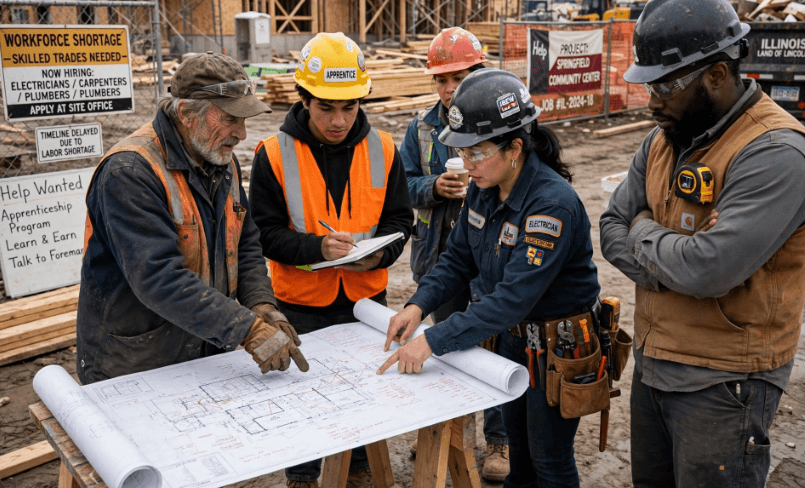
The defining constraint for Illinois contractors is labor. The 2025 Workforce Survey by AGC and NCCER found 92 percent of firms with openings report difficulty hiring 5. Leading challenges include lack of skills and qualifications (57 percent), new hires failing to show up or quickly quitting (48 percent), and lack of credentials (41 percent). Forty-five percent of firms cite worker shortages as the direct cause of project delays.
Immigration enforcement adds complexity. Nearly one-third of firms nationally report impacts, with 12 percent of workers leaving or failing to appear due to enforcement actions in Illinois, though no firms reported job-site visits in the state 15.
The construction unemployment rate stood at 4.7 percent in June, higher than any June since 2021, indicating some slack but not relief for skilled trades 6. Wage inflation remains elevated, with Illinois prevailing wage amendments effective July 1, 2025 requiring the higher of state or federal rates on public works 16.
Takeaway: Firms that systematize apprenticeship pipelines, retention, and safety training outperform on backlog and profitability.

4. Regulatory Environment in Illinois
Licensing, Permits, Zoning
Illinois has no statewide general contractor license; municipalities control issuance. Chicago requires plan-based permits prepared by Illinois-licensed architects or engineers 17, and suburbs such as Wilmette require local contractor licensing before permit issuance.
Governor Pritzker's BUILD initiative proposes statewide zoning reform to legalize duplexes, fourplexes, and accessory dwelling units on residential lots, streamline permitting with mandatory timelines, and standardize impact fees 18. The proposal would allow third-party reviewers when local delays occur 19. Legislative text HB1814 would require cities over 25,000 population to allow middle housing on lots greater than 5,000 square feet zoned residential 20.
Bureaucratic red tape is cited as a cost driver that increases costs, delays construction, and frequently kills projects altogether 18.
Workers Compensation and OSHA
Illinois law requires workers compensation insurance for almost everyone hired or localized in Illinois, with fines up to $500 per day and minimum $10,000 for willful noncompliance 21. OSHA covers private sector employers, with federal standards applying, while Illinois OSHA covers state and local government workers 22. Fall hazards remain the most cited violation, with recent Illinois cases facing $264,000 in proposed penalties.
Takeaway: Compliance is not merely legal; it is a competitive differentiator for small firms bidding public work.
5. Technology Transformation
Industry 4.0 adoption is accelerating but uneven. Research highlights integration of AI with Building Information Modeling (BIM) as a key enabler of efficiency, collaboration, and environmental performance 23. The suite of Big9 technologies — AI, drones, IoT, cloud, big data, sensing, wearables, robotics, and extended reality — is expanding from design into field operations.
Practical applications for SMB contractors include:
- AI-assisted estimating integrated with 2D/3D takeoff, cutting estimating time up to 30 percent
- Drone inspections linked to BIM for progress monitoring
- Cloud collaboration and digital permits
- CRM and online reputation management
McKinsey notes construction IT investment is less than one-third that of automotive and aerospace, and much technology investment has focused on control and safety rather than direct workforce productivity 24. This gap creates opportunity for small firms adopting affordable stacks.
Traditional Contractor
Digitally Enabled Contractor
Manual takeoff, paper plans
BIM + AI estimating, digital takeoff
Referral-only leads
Structured video, LocalBusiness schema, AI search visibility
Reactive hiring
Apprentice pipeline + retention analytics
Single-project profit focus
Recurring revenue: maintenance, inspection, energy retrofits
Takeaway: Technology does not need to be expensive to be effective; the highest ROI for Illinois SMBs is in estimating, scheduling, and trust-building content.
6. Marketing Challenges
Dependence on referrals is no longer sufficient. Google Ads competition has intensified: home improvement cost per lead averages $90.92, with roofing search ads at $187.79 per lead 25. Data center and national firms dominate paid channels, with only 8 percent of contractors under $100 million having data center work versus 41 percent of those over $100 million 6.
Modernize Homeowner Insights shows 64.81 percent of homeowners rate pricing very important, but warranty (15.76 percent), expertise (11.27 percent), and communication (8.55 percent) determine selection after price 26. Social media leads at 13.73 percent, followed by friends/family (11.05 percent) and search engines (10.94 percent). Pushy sales tactics (12.82 percent) are the top red flag.
The shift to AI search and answer engines — Google AI Overviews, SearchGPT, Perplexity — rewards structured, verifiable data: video proof, reviews, and consistent business information.
Takeaway: The durable strategy is owned, compounding discovery through mytsv.com structured video directories, local SEO, and review velocity rather than rented attention.
7. Consumer Behavior Is Changing
Homeowners research before hiring and increasingly use AI-assisted contractor searches. Women are primary decision-makers in 65 percent of remodeling projects, valuing trust, branding, and clear pricing 27. ServiceTitan research highlights demand for personalized, digital, and flexible experiences, including financing options.
Home remodeling spending is expected to remain positive through early 2027 but grow only 0.5 percent by Q1 2027 per Harvard Joint Center for Housing Studies LIRA, reaching $523 billion 28. After soaring above $600 billion post-pandemic and remaining 50 percent above pre-pandemic levels, the market is fragmenting and price-sensitive 29.
Key expectations:
- Video trust before call
- Transparent pricing with options
- Sustainability and smart-home integration
- Energy-efficient remodeling over additions
8. The Future of Illinois Construction
Evidence-based forecasts point to:
- Housing demand: Single-family soft near-term, multifamily low-rise growth, and strong home improvement (1.4 to 1.7 percent annually per FMI) 7
- Infrastructure: Highway and bridge growth 2.9 percent in 2026 sustained by Rebuild Illinois and IIJA
- Industrial and data centers: $10.7 billion committed, but policy pause and energy cost concerns ($37 billion potential electricity cost impact over 25 years per Union of Concerned Scientists analysis)
- Healthcare and education: Health care facilities forecast +17.4 percent, education -4.1 percent due to federal funding risks
- Green construction: Energy-efficient remodeling, climate resilience, modular and prefabrication gaining share
Luxury vs affordable diverges: affordable and middle housing is policy-supported under BUILD, while luxury faces demand headwinds from rates. Industrial development outside Chicagoland remains limited, centered around data centers popping up near O'Hare and suburbs 30.
9. Actionable Business Blueprint for Illinois Contractors
Operations
- Control cost via weekly job costing, renegotiate supplier tiers, lock equipment rates
- Adopt AI-assisted estimating with 2D/3D takeoff to reduce gaps and missed quantities
- Implement pull scheduling and prefabrication for labor-constrained trades
- Workforce planning: partner with Illinois community colleges, NCCER-accredited programs, and union apprenticeship; create retention bonuses tied to safety and quality
Marketing (via mytsv.com)
- Local SEO: Optimize Google Business Profile, LocalBusiness schema, service-area pages for Illinois municipalities
- AI Search optimization: Publish structured FAQs, how-to videos, and project walkthroughs for answer engines
- Video marketing: 60-90 second job-site explainers demonstrating process, not just final result
- Reviews: Systematize collection within 48 hours of milestone completion; respond to all within 24 hours
- Press coverage: Submit data-backed project stories to Construction Dive, Chicago Construction News, and local economic development orgs
- Community engagement: Sponsor trades training, school STEM, and municipal clean-up for referral equity
Sales
- Customer communication: Text-enabled updates, digital proposals with good-better-best pricing
- Financing options: Partner with Hearth, GreenSky, or credit unions for 0 percent promos on energy retrofits
- Follow-up systems: CRM with automated nurture for quotes not closed within 7 days
Technology
- Affordable stack: Jobber or Buildertrend + CompanyCam + QuickBooks Online + mytsv.com listing
- AI tools: OpenAI-powered estimating assistants, drone imagery analytics
- Automation: Invoice reminders, review requests, warranty follow-ups
- CRM implementation: Centralize all leads from LSA, SEO, and referrals to measure CAC by channel
Business Growth
- Hiring: Prioritize electricians and plumbers critical to data center subcontracting
- Partnerships: Form Illinois-specific alliances between general contractors and specialty trades for data center and health care work
- Niching: Specialize in energy-efficient remodeling, EV charging, or flood-resilience where insurance incentives align
- Diversification and recurring revenue: Maintenance agreements, annual inspections, and service plans
- Long-term resilience: Maintain 3-6 months cash, 8+ months backlog target, and separate public vs private pipeline tracking

10. Frequently Asked Questions
Is construction slowing down in Illinois?
Mixed. Overall starts are forecast flat to down 0.4 percent in 2026 7, but Illinois added 7,300 construction jobs year over year 2 and backlog remains elevated at 8.8 months 6.
Are small construction companies profitable?
Profit margins are under pressure from 7.6 percent input cost inflation 6 and high financing costs of 7-9 percent 14, but firms with data center or health care work and strong digital authority maintain higher backlog and pricing power.
What are the biggest challenges facing Illinois contractors?
Labor shortages (92 percent hiring difficulty 5), material volatility, permit delays, and rising customer acquisition costs.
How much has construction inflation affected contractors?
Input prices up 7.6 percent year over year, with Chicago near double digits due to labor 12. Chicago's cost escalation softens but remains elevated.
Which construction sectors are growing fastest?
Data centers, health care facilities (+17.4 percent), highways and bridges (+2.9 percent), and low-rise multifamily. Single-family and education are declining.
Is AI changing the construction industry?
Yes. AI-enhanced BIM enables real-time monitoring, predictive maintenance, and resource optimization 23. Adoption remains low for SMBs, creating competitive advantage for early movers.
How can contractors generate more leads?
Shift from rented Google Ads (average $90.92 lead) 25 to owned discovery: structured video on mytsv.com, Local SEO, Local Service Ads, and systematic review generation.
What technologies should small construction companies adopt?
AI estimating, drone inspections, BIM lite, project management software, cloud collaboration, and CRM with automation.
What construction services will be most in demand over the next decade?
Energy-efficient remodeling, maintenance and repair, health care and industrial facility upgrades, EV and smart-home integration, and infrastructure rehabilitation.
How can Illinois contractors remain competitive against larger firms?
By competing on trust, not ads — verified video proof, transparent pricing, financing options, community presence, and niche specialization rather than matching national firms' ad budgets.
Conclusion
Illinois construction is not contracting uniformly; it is reconfiguring. Population growth has returned 1, infrastructure investment is historic 8, and data center investment is massive 9. Yet small contractors face a labor market where 92 percent struggle to hire 5, input costs up 7.6 percent 6, and a consumer who decides trust before calling.
The durable advantage belongs to Illinois builders who build digital authority as carefully as physical structures — video-documented processes, structured data for AI search, and visible community accountability through platforms like mytsv.com.
Sources
1 Gov. Pritzker Newsroom — New U.S. Census Bureau Data Shows Third Consecutive Year of Population Growth for Illinois
2 AGC — Construction Employment Increases In 32 States And D.C. Between April 2025 And April 2026
3 FRED / BEA — Real Gross Domestic Product: Construction (23) in Illinois
4 U.S. Census Bureau — Monthly Construction Spending May 2026
5 NCCER — Report: 92 Percent of Construction Firms Struggling to Hire Workers
6 ABC — Construction Backlog Rises in May Contractor Confidence Falters
7 ENR — 2026 Forecast: Megaprojects, Data Centers Spur Growth Amid Shifting Policies
8 AASHTO Journal — Illinois Unveils Historic $50B Infrastructure Program
9 Capitol News Illinois — Here are the Illinois data centers on track for more than $650M in tax credits
10 NAHB — Builder Sentiment Edges Lower on Affordability Concerns
11 World Business Chicago / LinkedIn — Chicago Metro Population Growth Data
12 Urban Land Institute — Economist Snapshot: 2026 Construction Costs Outlook
13 McKinsey & Company — Reinventing construction through a productivity revolution
14 MarketWatch — Home builders want lower interest rates from the Fed
15 Daily Reporter — Immigration enforcement deepens construction labor gaps
16 Foley & Lardner — Illinois Provides Additional Protections to Workers on Publicly Funded Projects
17 City of Chicago — Building Permit Application Instructions
18 Realtor.com — Illinois Gov. Pritzker Pitches Statewide Zoning Reform for Housing
19 GitHub — 2026 Gov. Pritzker FACT SHEET: BUILD
20 LegiScan — Illinois-2025-HB1814-Introduced
21 Illinois Department of Insurance — Workers Compensation Insurance Compliance
22 OSHA — Illinois State Plan
23 Frontiers — AI-Enhanced BIM for Sustainable Construction in the Era of Industry 4.0
24 McKinsey — Reinventing Construction Full Report PDF
25 Workboat Indexes — Average Cost per Lead for Home Improvement Contractors in 2025
26 Modernize — Homeowner Insights Contractor Selection Trends
27 Contractor Magazine — Financing, Trust, and Convenience Drive Today's Home Service Choices
28 Inman — Remodeling Growth To Slow Sharply In Early 2027: Harvard's Joint Center for Housing Studies
29 MBA Newslink — Harvard JCHS: Remodeling Soars to New Heights
30 Cumming Group — Illinois Construction Market Analysis Q2 2025
Comments
More Blogs
Explore more articles that you may find interesting.
