Stuck in the Garage: Inside America's $50,000 Car Problem
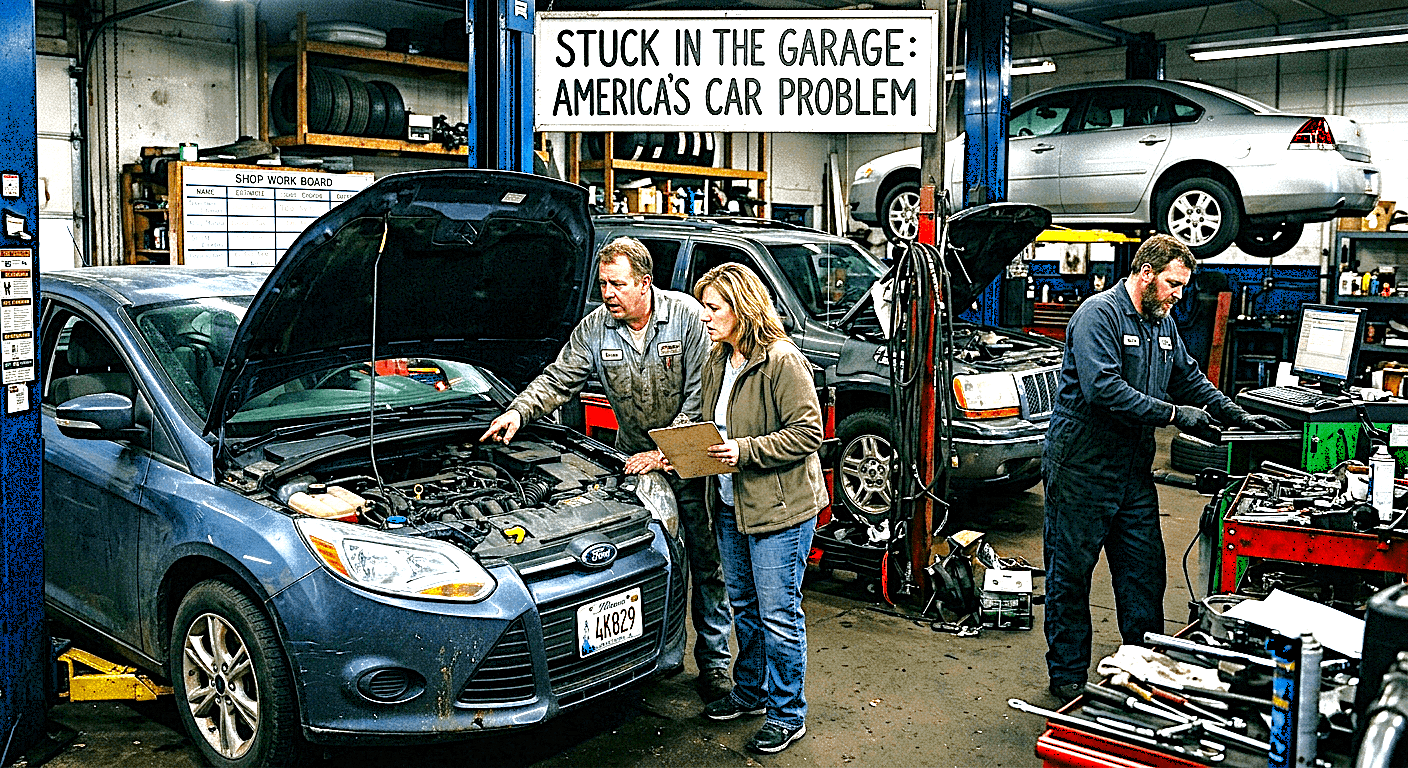
New vehicles now cost more than the median worker earns in a year of take-home pay. The result: a record-old national fleet, a repair industry straining under demand it never asked for, and millions of households one blown transmission away from a financial emergency.
MyTSV Local Business Report

Walk into a grocery store or open a utility bill anywhere in America right now, and the math doesn't work the way it used to. But nowhere is that arithmetic more visible — or more expensive to ignore — than in the driveway.
The average new vehicle sold in the United States carried a transaction price of $49,220 in May 2026, according to Kelley Blue Book data released by Cox Automotive, after peaking at an all-time high of $50,326 in December 2025. Layer on today's auto loan interest rates, and for a large share of American households, buying new isn't really a decision anymore. It's an option that's been quietly taken off the table.
The consequence of that shift is now visible on every road in the country: Americans are keeping their cars far longer than they ever intended to, and the auto repair industry tasked with keeping those aging vehicles alive is absorbing a level of strain few outside the business fully understand.

The "Zombie Fleet": A Record-Old National Car Population
Because fewer households can afford to trade up, the vehicles on American roads are aging at a pace with no modern precedent. According to S&P Global Mobility, the average age of a light vehicle in the U.S. reached 12.8 years in 2025 — a record high, and the eighth consecutive year the figure has climbed. Passenger cars specifically now average 14.5 years, while light trucks average 11.9. For the first time since the 1970s, the number of passenger cars on U.S. roads has dropped below 100 million, even as the overall vehicle fleet has grown to roughly 289 million.
That aging curve isn't a footnote — it's a structural shift with direct consequences for repair shops. Vehicles crossing the ten- and fifteen-year threshold don't need oil changes anymore; they need transmission rebuilds, timing belt replacements, and major structural work that a healthier trade-in market would have made unnecessary. Cars that a decade ago would have been quietly swapped for something newer are now the customer sitting in the waiting room.
The Financial Squeeze on Households
Choosing a mechanic over a dealership sounds like the fiscally responsible move — and it is — but it isn't painless. Bureau of Labor Statistics Consumer Price Index data shows that the cost of motor vehicle maintenance and repair has climbed roughly 43.6% since January 2019, consistently outpacing headline inflation. More recent BLS data shows the trend accelerating further, with motor vehicle repair costs running at more than double the rate of overall consumer inflation through much of 2025.
Estimates of what that means in dollar terms vary by source and methodology, but they land in a similar range: RepairPal-derived, CPI-adjusted figures put average annual per-vehicle maintenance and repair spending at roughly $936, while AAA's per-mile cost data — applied to the average American's annual mileage — implies a figure closer to $1,400 once tires, fluids, and incidentals beyond major repairs are included. When a major component fails, a surprise repair bill in the thousands of dollars forces a familiar set of bad options: high-interest credit card debt, delayed safety maintenance, or a growing detour into risky do-it-yourself repair.

The Illinois Factor: A Rust Belt Tax on Every Repair
In Illinois — and across the Chicagoland suburban market MyTSV covers — these national pressures are compounded by geography.
The salt problem. Illinois winters mean heavily salted roads, and for vehicles in that 12-to-15-year range, road salt accelerates frame corrosion, brake line failure, and seized suspension components in ways drivers in warmer climates simply never encounter. A repair that takes two hours in a dry climate can take four hours of labor here, purely to work through rust before the actual fix can begin.
The cost of deferral. Facing higher repair bills, many Illinois vehicle owners have shifted into what shop owners describe as "triage maintenance" — visiting a mechanic only once a warning light appears or the car physically stops running. That pattern reliably turns an affordable, early-stage fix into a catastrophic, multi-system failure by the time the car reaches the bay.
A Full Waiting Room Isn't the Same as a Healthy Business
It would be reasonable to assume that independent repair shops are thriving in this environment — bays are full, and appointment waitlists routinely stretch for weeks. The reality inside those businesses is more complicated. Industry surveys of repair shop owners consistently identify sourcing affordably priced parts as operators' top operational challenge, a pressure compounded by supply chain volatility and rising production costs that frequently delay repairs and tie up garage space shops can't afford to have sitting idle.
Layered on top of that is a technician shortage that has been building for years. Modern vehicles are no longer purely mechanical; they're rolling computers equipped with advanced driver-assistance systems and, increasingly, hybrid or electric powertrains, and there are simply not enough technicians trained to diagnose them. Shops competing for that limited pool of skilled labor have had to raise wages to keep their doors staffed — costs that flow directly to the customer, not out of opportunism, but necessity. On top of labor, staying current on diagnostic software subscriptions, scanning tools, and EV-safety equipment now requires thousands of dollars a year in overhead that didn't exist a decade ago.
How the Strongest Shops Are Adapting
The repair businesses pulling ahead in this environment aren't the ones competing on price — they're the ones competing on trust and transparency. Two practices in particular are becoming the industry standard among top-performing independent shops:
Digital inspections. Leading shops now send customers text updates with photos and video directly from the garage bay, showing exactly what's broken before any work begins. That visibility does more to build trust with a skeptical, budget-strained customer than any sales pitch could.
Repair-now, pay-later financing. Recognizing that few customers have $2,000 sitting in a checking account for a surprise repair, a growing number of independent garages have partnered with financing providers to offer interest-free or low-interest payment plans — turning a shop visit from a financial crisis into a manageable monthly expense.
The Bottom Line
The state of the American auto repair industry is, in miniature, a portrait of the broader financial squeeze on the middle class. Households are holding onto aging vehicles out of necessity, not preference, and in the process, the neighborhood auto shop has quietly shifted roles — from a place for routine maintenance into something closer to a financial emergency room.
For repair shop owners, a full parking lot is not the same thing as a healthy business. Navigating parts costs, a persistent technician shortage, and financially stressed customers requires more operational precision, transparency, and genuine empathy than the trade has ever demanded before.
A Practical Guide: How to Extend the Life of a 10+ Year-Old Car
If a new car isn't in the budget, the vehicle already in the driveway becomes the household's most valuable asset — and in Illinois's salt-heavy winters, proactive care is often the only thing standing between a driver and an unplanned $3,000 repair bill. The following checklist reflects the maintenance priorities that matter most for older, high-mileage vehicles.
1. The Fluid Rules
- Follow a 5,000-mile oil interval, not the outdated 3,000-mile rule — but don't stretch much beyond it on an aging engine. High-mileage synthetic blend or full synthetic oil contains conditioners that keep old rubber seals pliable and helps prevent leaks.
- Check fluid levels every two weeks. Coolant, brake fluid, and power steering fluid should all be part of a quick, recurring visual check. Catching a slow leak early can prevent overheating — one of the fastest ways to destroy an aging engine.
- Watch fluid color. Engine oil should run amber to dark brown; a milky, chocolate-milkshake appearance signals a blown head gasket and warrants stopping the car immediately. Coolant should be bright pink, green, or orange — muddy-looking coolant has turned acidic and is actively corroding the radiator from the inside.
2. Rust Belt Defense
- Get an undercarriage wash at least twice a month during winter. An automatic car wash with an undercarriage blast rinses corrosive road salt off brake lines, fuel lines, and the frame — the parts a top-of-car wash never touches.
- Clear door drain holes. Leaves and dirt collect in the drain holes at the bottom of door panels and rocker sections; clearing them with a toothpick lets trapped water escape instead of rusting the metal from the inside.
3. Driving Habits That Protect the Drivetrain
- Give the engine 30 seconds before driving off, allowing the oil pump to fully distribute oil to the top of the engine — no need for a ten-minute warm-up, just enough time to avoid dry startup wear.
- Come to a complete stop before shifting from Reverse to Drive. Shifting while the car is still rolling backward puts significant, avoidable stress on aging transmission gears and axles.
- Slow down for potholes. An impact a new suspension absorbs easily can snap a worn control arm or blow a strut on an older vehicle.
4. Know What Warning Signs Demand Immediate Action
- A free code scan beats a $150 diagnostic fee. Most auto parts retailers will read a Check Engine light's error code at no charge.
- Learn to recognize the critical sounds: squealing under braking means worn pads that should be replaced before they damage the rotors; rhythmic clicking while turning points to a torn CV axle boot; a low hum that grows louder with speed usually signals a failing wheel bearing — a genuine safety issue that shouldn't wait.
5. Build a Financial Buffer
- Set aside a dedicated car emergency fund — even $20 to $30 a month adds up to a meaningful cushion against a surprise repair bill, and keeps it off a high-interest credit card.
- Find a mechanic who treats the relationship as a partnership, not a transaction — one who will tell you plainly which repairs are safety-critical today and which can reasonably wait six months.
The math that matters: it is almost always cheaper to spend roughly $1,200 a year maintaining an older car than to take on $6,000 or more annually in new-car payments and higher insurance premiums. A well-maintained older vehicle isn't a compromise — for most households right now, it's the financially disciplined choice.
Sources
- Cox Automotive / Kelley Blue Book, New-Vehicle Average Transaction Price Reports, 2025–2026 — coxautoinc.com
- S&P Global Mobility, "U.S. Vehicle Age Rises Again to 12.8 Years in 2025" — press.spglobal.com
- U.S. Bureau of Labor Statistics, Consumer Price Index, Motor Vehicle Maintenance and Repair (Series CUUR0000SETD) — bls.gov / fred.stlouisfed.org
- Automotive Body Parts Association, analysis of BLS CPI data on collision and repair inflation — autobpa.com
This report is part of MyTSV's ongoing coverage of the economic pressures facing local businesses and households across the Chicago metropolitan area. If you own or manage an auto repair shop in the Northwest suburbs, MyTSV helps local businesses build the digital visibility — video, SEO, and local listings — that turns a full waiting room into a sustainable one. Learn more at MyTSV.com.
Comments
More Blogs
Explore more articles that you may find interesting.
