The 2026 Small Business Blueprint: Ditch Your Website, Deploy Agentic AI, Go Hyper-Local, and Build Sober Third Spaces to 10X Your Local Business
The U.S. small business landscape has officially broken in 2026. Traditional Google rankings are collapsing as AI assistants now handle the majority of discovery. Global tariffs are spiking import costs by 10–50% and punishing anyone still chained to overseas suppliers. Gen Z and Millennials—your core customers—are drinking 65% less alcohol while craving real human connection in physical spaces. And payroll is no longer the path to scale: autonomous “agentic AI” is letting three-person teams hit $1 million in revenue while corporate giants struggle with bloat and volatility.
This is not four separate trends. It is one new operating system for local businesses—plumbers, cafes, retailers, salons, contractors, and restaurants alike. The winners are building **AI-citable, agent-powered, hyper-local, human-centric enterprises**. They optimize for machine-readable citations instead of clicks, automate the middle layer of operations, source everything within a 100-mile radius, and transform their locations into irreplaceable “third spaces” that AI can never replicate.
The result? A compounding flywheel that turns volatility into unfair advantage. Businesses following this blueprint are seeing 4.4x higher conversion from AI traffic, 40–80% labor savings, 15–30% better margins through local sourcing, and review volumes that feed the AI loop. Platforms like mytsv.com make it plug-and-play: clean listings become AI-citable, reviews become proof signals, local supplier directories accelerate micro-shoring, and event tools turn your storefront into a community hub.
Here is the complete 2026 playbook—actionable, data-backed, and built specifically for America’s small businesses.

### 1. The Invisible Site Era: Why Your Website Is Now Optional (and How to Become AI-Citable Instead)
Traditional SEO is dying faster than anyone predicted. Gartner forecasted a 25% drop in classic search volume by 2028; we’re already halfway there in March 2026. AI Overviews, ChatGPT, Perplexity, and Gemini now deliver answers directly. Zero-click searches dominate. The new metric is not ranking—it is **AI citation share**.
Data from early 2026 shows the overlap between top Google links and sources actually cited by AI has plummeted below 20%. Brands that appear inside AI responses enjoy 35% higher engagement and 4.4x better conversion rates than traditional organic traffic. For local businesses, this is rocket fuel: AI assistants love hyper-specific, review-rich, structured local data that big brands struggle to match.
The shift is simple but profound. Stop pouring money into a website that 70% of customers never visit. Instead, make your entire business “machine-readable.”
**Exact steps local businesses are using right now:**
- Publish consistent NAP (Name, Address, Phone) data everywhere—especially on mytsv.com listings, which feed directly into AI knowledge graphs.
- Add rich schema markup for services, reviews, hours, and pricing so AI can parse and cite you accurately.
- Turn every review into structured social proof. AI scrapes authentic customer language far more than polished website copy.
- Create short, conversational content (TikTok, Instagram Reels, mytsv blog embeds) optimized for voice and chat queries like “best plumber who answers at 2 a.m. near Chicago.”
- Use free GEO tools (Semrush AI Visibility, Brandlight trackers) to monitor how often AI actually cites you.
One Chicago-area HVAC contractor did exactly this in Q1 2026. Their mytsv listing became the top-cited source for “emergency furnace repair near me” queries. AI traffic doubled their bookings without a single Google ad dollar spent. Their website? Barely updated since 2024—and nobody cares.
This strategy feeds everything else. AI-citable businesses generate the review volume that powers agentic automation and the authentic stories that make third spaces magnetic.

### 2. The SuperWorker Revolution: Scale to $1M Revenue with a Team of Three (or Fewer)
Agentic AI—autonomous agents that plan, decide, and execute entire workflows—is the great equalizer of 2026. A new RevSure benchmark shows 76% of organizations are already implementing or deploying agentic AI. For small businesses, the payoff is immediate: 10 percentage points more AI exposure predicts 2.2% higher monthly revenue six months later (Gusto study of 100,000 SMBs). That turns a $200k/month business into an extra $53,800 per year—without adding headcount.
Zapier automated tasks. Agentic AI automates entire jobs. One “SuperWorker” agent can now handle lead qualification, appointment scheduling, payroll, supply reorders, and follow-up emails 24/7 for under $1,500/month.
**The exact three-person model winning in 2026:**
- Human #1: You—the owner and relationship builder.
- Human #2: One specialist (technician, barista, stylist—whatever delivers the human touch).
- Human #3: Your AI orchestrator (multi-agent system that coordinates everything else).
Real example: A three-person plumbing company in Illinois hit $1.1M revenue in 2025–2026 by letting agents run lead nurturing, inventory checks, and invoice chasing. The humans only show up for the jobs and the reviews. Time savings: 65%. Labor costs down 40%. Customer satisfaction up because responses are instant.
**Rollout checklist most SMBs follow:**
- Start with no-code platforms that let you brief agents in plain English (“If a review mentions slow response, auto-schedule a callback”).
- Add governance: human approval on anything over $500.
- Integrate with your mytsv reviews so agents automatically upsell based on past feedback.
The beauty? These agents make your business even more AI-citable. Fast, consistent service generates the glowing reviews that AI loves to quote. And the freed-up owner time goes straight into building community third spaces.

### 3. Radical Localism: Turn 2026 Tariff Chaos into Your Biggest Competitive Edge
Tariffs are not a temporary headline—they are the new normal. Baseline rates sit at 10–15% across dozens of countries, with reciprocal spikes hitting 30–50% on key imports. Small businesses that still rely on global supply chains are watching margins evaporate and lead times double. Meanwhile, those who “micro-shore” (source within the neighborhood or North America) are gaining pricing power and reliability.
Government and industry data through March 2026 show nearshoring to Mexico and Canada exploding, domestic sourcing becoming price-competitive, and “China +1” strategies everywhere. Small businesses that switch early are reporting 15–30% better margins and zero tariff surprises.
**The micro-shoring playbook that actually works:**
- Audit every supplier today. Anything over 20% tariff exposure gets replaced.
- Use mytsv.com’s local business directory to find neighborhood manufacturers, fabricators, and wholesalers—many already vetted by reviews.
- Build “Made in the Neighborhood” transparency: QR codes on products, origin stories in every listing, and review prompts that ask customers to mention local sourcing.
- Price strategically. Customers will pay 5–10% more for reliability when big-box competitors are delayed by port chaos.
A Chicago cafe that switched to local roasters and Midwest dairy in late 2025 cut costs 18% versus tariff-hit imports and turned the story into their #1 marketing angle. Their mytsv reviews now highlight “fresh local ingredients” and AI assistants cite them as the top “sustainable neighborhood cafe.”
Local sourcing also supercharges the other pillars: shorter chains are easier for agentic AI to manage automatically, and authentic local stories make your third space feel genuine instead of corporate.
### 4. The Sober Shift and the New Third Space: Reclaim Community That AI Can Never Copy
Gen Z is leading the most profound consumer shift in decades. 65% plan to drink less alcohol this year; 39% aim for full-year abstinence. Nearly half of young consumers are “sober-curious.” They are trading screens and late-night bars for wellness, mindfulness, and real belonging. Loneliness statistics remain sky-high, and the antidote is physical connection.
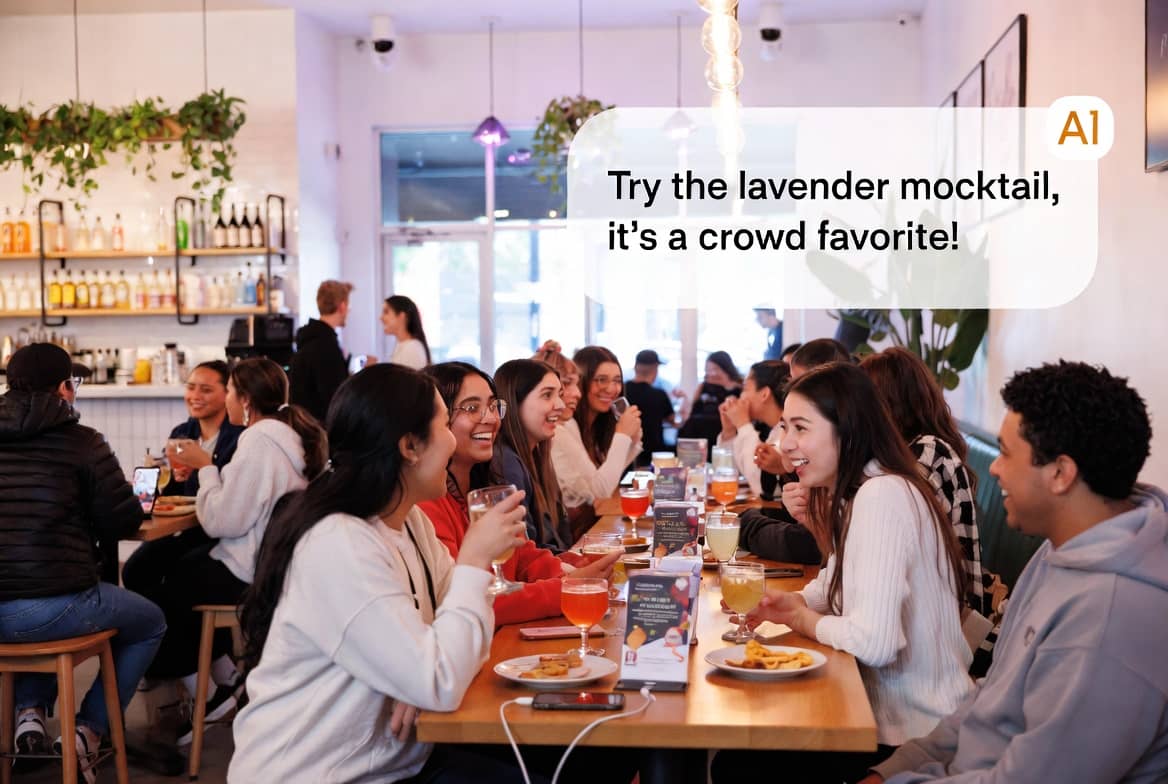
Smart service businesses are pivoting from transactional hubs into “third spaces”—places where people linger, connect, and create shareable moments. Non-alcoholic beverage options are exploding (premium mocktails with the same care as wine lists). Wellness events, board-game nights, sober trivia, and Instagram-worthy community tables are driving longer dwell times and higher review scores.
**How retailers and restaurants are winning right now:**
- Replace happy-hour specials with “wellness hour” mocktail pairings and protein-packed snacks.
- Design for connection: comfortable seating clusters, phone-charging stations with conversation prompts, and event calendars hosted on mytsv.
- Host low-pressure gatherings—book clubs, skill-share workshops, fitness pop-ups—that feel like extensions of your brand.
- Let customers do the marketing: encourage photos and tags that become AI-citable social proof.
A neighborhood bookstore-cafe in Illinois turned their back room into a sober third space with non-alc tastings and author events. Dwell time tripled, reviews surged 40%, and AI now recommends them as the top “community hangout near me.” The humans come for connection; the agents handle booking and inventory; local suppliers keep costs stable.
This human layer is the moat. AI can recommend you, but only real experiences generate the emotional reviews that keep the flywheel spinning.

### The Compounding Flywheel: How the Four Strategies Multiply Into Unstoppable Growth
Here is where the magic happens. These are not separate tactics—they form a self-reinforcing system:
- AI citations (Invisible Site) surface your business in discovery.
- Agentic AI (SuperWorker) delivers flawless service at scale, generating more reviews.
- Radical Localism protects margins and adds authentic stories that AI loves to cite.
- Third Spaces create the irreplaceable human moments that turn one-time visitors into lifelong advocates.
The loop feeds mytsv listings automatically: better reviews → stronger AI citations → more traffic → more data for agents → stronger community events → even better reviews.
Businesses running all four are not just surviving 2026 volatility—they are 10x-ing while competitors chase old playbooks.

### FAQ: Answering the Biggest 2026 Small Business Questions
**Is my website completely dead?**
No—but it is now secondary. Focus 70% of your effort on GEO and structured data across mytsv, Google Business Profile, and social. The website becomes a backup brochure.
**How much does agentic AI really cost a small team?**
Most no-code stacks start under $1,500/month total. ROI usually hits in 4–8 weeks through time savings alone. Many SMBs are seeing 2.2% revenue lifts per 10% AI exposure increase.
**Will tariffs destroy my margins in 2026?**
Only if you stay global. Micro-shoring to local and North American suppliers is the proven hedge—15–30% margin improvement is common among early movers.
**Do I need a huge budget to create a third space?**
No. Start with layout tweaks, one weekly event, and premium non-alc options. The ROI comes from longer visits, higher check averages, and review volume.
**Where should I start on mytsv.com?**
Claim or optimize your free listing today for AI visibility, add supplier connections for localism, enable event tools for third-space marketing, and begin collecting structured reviews. It is the single platform that touches all four pillars.
**How long until I see results?**
Most businesses running this blueprint see measurable lifts in AI citations and reviews within 30–60 days, revenue acceleration in 90 days, and full flywheel momentum by month six.
The 2026 small business winners will not be the biggest, the loudest, or the most funded. They will be the ones that became invisible to old systems yet hyper-visible to the new ones—AI agents, local communities, and real human connection.
Your move is simple. Pick one pillar this week (most start with mytsv optimization and one agent pilot), then layer the rest. The compounding effect will separate you from every competitor still playing the 2020s game.
The blueprint is here. The data is clear. The only question left is: which local business on mytsv.com will own their neighborhood first? Yours can be next.
Comments
More Blogs
Explore more articles that you may find interesting.
