The Great Labor Swap—Automation vs. Immigration (2026) How deportations, DOGE, and Optimus are reshaping the American workforce 44
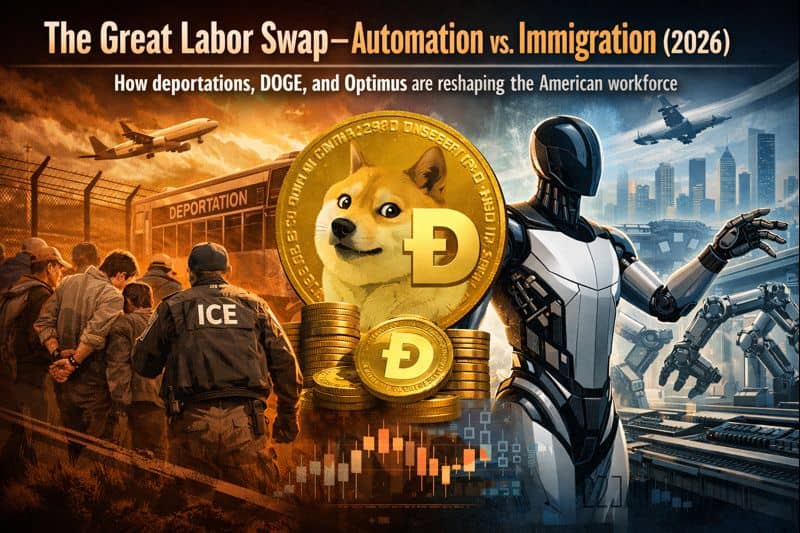
The Great Labor Swap—Automation vs. Immigration (2026)
How deportations, DOGE, and Optimus are reshaping the American workforce
Introduction: A new kind of labor shock
The United States is running a real‑time experiment: tightening immigration enforcement while aggressively promoting AI and automation as pillars of economic strategy. Immigrant‑heavy sectors like agriculture and construction are being squeezed just as capital and policy momentum swing toward robotics, data‑driven management, and AI‑enabled workforce restructuring.wpr+10
This article explores whether 2025–2026 policy amounts to a “forced evolution” in which labor scarcity becomes an unofficial lever to accelerate automation and create a captive market for robots like Tesla’s Optimus.
1. Deportations and the automation investment signal
1.1 The scale of the deportation shock
Trump’s second‑term agenda includes ramping deportations of undocumented immigrants to roughly 1 million per year, backed by large new funding for ICE and Border Patrol. Undocumented workers make up a large share of U.S. farm labor—close to one quarter nationally and nearer one third in harvesting and sorting roles.econlib+1
Researchers estimate that large‑scale deportations could remove roughly 225,000 agricultural workers, reduce output, and push food price inflation toward 9 percent in aggressive enforcement scenarios. Policy analysts at Harvard and elsewhere warn that deportations, layered atop H‑2A bottlenecks and difficulty attracting American workers to farm work, create serious risk of persistent labor shortages and food supply stress.hks.harvard+2
[bain]
News and advocacy reports in late 2025–early 2026 show this is not just theoretical:
- Farmers already report acute difficulty finding enough workers to harvest crops, especially in fruit and vegetable segments.investigatemidwest+2
- The administration itself has publicly acknowledged that its immigration policies threaten farm labor availability and could raise food prices, even as it simultaneously tries to cut wage floors in the H‑2A guest‑worker program to lower producer costs.washingtonpost+1
In short, the federal government is deliberately tightening a labor market that is structurally dependent on undocumented and guest workers, while being fully aware of the economic downside risk.axios+4
1.2 Capital’s response: robots as the new insurance policy
At the same time, U.S. agricultural and construction robotics markets are growing quickly, with “labor shortages” repeatedly cited as a primary driver.
- The U.S. agricultural robots market is projected to grow from around USD 3.1 billion in 2024 to roughly USD 8.6 billion by 2033, driven by chronic labor scarcity, rising wages, and pressure to boost yields.[imarcgroup]
- Market outlooks emphasize that growers are accelerating investment in autonomous tractors, robotic harvesters, and AI‑enabled crop monitoring specifically to offset unreliable access to human labor.nextmsc+2
- In construction, analysts and industry reports link increased interest in robotics (e.g., brick‑laying robots, rebar‑tying robots, autonomous construction equipment) to persistent skilled‑labor shortages and elevated wage and schedule pressure, trends expected to continue into and beyond 2026.grandviewresearch+3
These are not yet precise, published regression results tying a specific deportation order to a line on a capex spreadsheet, but the structural relationship is clear: as the state tightens labor, especially immigrant labor, firms treat automation as both a productivity play and a hedge against political risk.rolandberger+6
2. DOGE, AutoRIF, and the software‑first state
2.1 What DOGE is actually doing
The Department of Government Efficiency (DOGE) was set up as a vehicle to make the federal government “leaner” using software, AI, and aggressive cost‑cutting. One of its flagship moves has been to modernize AutoRIF (Automated Reduction in Force), an old Defense Department tool that automates the generation of layoff eligibility lists.reuters+1
- DOGE operatives and OPM developers have edited AutoRIF’s code and built a web‑based “Workforce Reshaping Tool” that can ingest HR data and quickly generate lists of employees targeted for termination according to complex federal layoff rules.wired+1
- Internal sources describe the system as capable of enabling agencies “to remove a massive number of federal employees from their positions” by dramatically speeding up what used to be a manual, time‑consuming legal and HR process.[reuters]
This is Musk’s “software‑first” philosophy applied to the state: encode rules in software, automate the decision pipeline, and then act on the output at scale. DOGE does not need humanoid robots to shrink the federal workforce; it only needs algorithms powerful enough to identify, rank, and process humans as rows in a database.wired+1
2.2 AI governance without robot governance
DOGE’s activities sit alongside broader federal AI strategy documents that emphasize streamlining AI deployment, cutting red tape, and using automation to boost productivity and “efficiency” across agencies. These texts talk about modernizing services, empowering innovation, and retraining workers, but they say little about guardrails when AI is used to decide who stays employed in government.whitecase+2
Crucially, there is no public evidence that DOGE has formal plans to plug commercial humanoid robots, such as Optimus, directly into government operations in the short term. The federal workforce is being “automated” first at the level of information and decision‑making—who works where, doing what—rather than at the level of physical tasks.whitehouse+3
3. The Optimus question: Can robots fill the vacuum?
3.1 The evolving Optimus timeline
Elon Musk has pitched Tesla’s Optimus as a general‑purpose humanoid robot meant to handle dangerous, repetitive, and boring tasks. The conceptual arc is bold:[builtin]
- 2021: Concept unveiled at Tesla AI Day.[builtin]
- 2022: First walking prototype (“Bumble‑C”) appears, capable of simple tasks like carrying boxes.[builtin]
- December 2023: Optimus Gen‑2 debuts with faster walking, better balance, and more dexterous hands.[builtin]
- 2025: Musk publicly targets production of roughly 5,000 Optimus units for internal deployment in Tesla factories, with ambitions to ramp to 50,000 units in 2026.[builtin]
Reporting and Musk’s own comments suggest early deployments are aimed squarely at Tesla assembly lines and other highly structured environments where tasks, workflows, and safety conditions can be tightly engineered.teslarati+2[youtube]
3.2 Technical feasibility as a “labor safety net”
On paper, it is tempting to imagine tens of thousands of humanoid robots marching into the fields and onto construction sites as deportations create labor holes. In practice, several bottlenecks limit the feasibility of Optimus as a near‑term “human labor safety net”:
- Maturity of hardware and software: Even Gen‑2 and Gen‑3 prototypes still move cautiously and are optimized for predictable, indoor tasks; robust outdoor operation in dust, mud, unpredictable weather, and unstructured environments remains a hard problem.[youtube][builtin]
- Production scale and integration: Hitting 5,000–50,000 units in 2025–2026 is aggressive even for internal use; scaling manufacturing, supply chains, and service networks to support broad cross‑industry adoption will take years.notateslaapp+1
- Regulation and liability: Deploying humanoid robots into physically dangerous, public‑facing workspaces requires safety certification, new insurance products, and clarity on liability when accidents occur—none of which can be fully built out in a single political cycle.bls+3
Given decades of evidence on industrial robot diffusion, the more realistic expectation is that Optimus will gradually displace specific, highly repetitive jobs inside large firms first, then migrate into other sectors as the technology, regulatory environment, and business models mature.futuremarketsinc+4
That means that, through at least the mid‑2020s, Optimus cannot meaningfully backstop a rapid, policy‑driven removal of hundreds of thousands of human workers in agriculture, construction, hospitality, and domestic services.
4. The Labor‑Automation Gap: Food, housing, and resilience
4.1 How gaps emerge
The Labor‑Automation Gap is the period when human labor is removed faster than automation can be deployed, integrated, and scaled. In the current U.S. context, three dynamics create such a gap:
- Deportations and tighter visa rules reduce the supply of physically demanding, low‑wage labor in agriculture, construction, hospitality, and care work.wpr+4
- Automation and robotics solutions remain capital‑intensive and require multi‑year adoption cycles, especially for small and mid‑sized firms.fticonsulting+4
- Policy’s main automation bet (AI software, DOGE‑style tools, early humanoid robots) is most mature in structured, large‑enterprise or government contexts, not in the fragmented, harsh environments where most deported workers were employed.whitecase+5
When those lines cross, critical supply chains become fragile.
4.2 Food security
In agriculture, the risk is straightforward: fewer workers in the fields mean smaller or delayed harvests.
- Economists estimate that deporting a large share of unauthorized agricultural workers would cut farm output and push food price inflation to high single digits in some scenarios.[econlib]
- Farmers and industry groups warn that they are already short‑staffed, that mechanization is expensive and unevenly available, and that immigration enforcement is amplifying existing structural shortages.investigatemidwest+2
- Federal moves to cut prevailing wage rules in the H‑2A program may reduce some producers’ costs, but they do not solve the underlying quantity problem if workers simply are not there.washingtonpost+1
As a result, U.S. food systems in 2025–2026 face a paradox: policy deliberately increases labor risk in an already strained system, while automation is still too immature and unevenly distributed to fully compensate. That is the textbook Labor‑Automation Gap.
4.3 Housing and construction
Construction faces a related, though somewhat different, pattern:
- Skilled trades shortages have been a constraint for years; tighter immigration compounds this by reducing the pool for physically intensive roles in residential construction, landscaping, and related services.morningstar+3
- Robotics in construction—such as semi‑autonomous machinery, layout robots, and prefab automation—is advancing but remains niche, often limited to large projects or pilot deployments.startus-insights+2
- Industry outlooks anticipate continued pressure on construction costs and timelines through 2026, which feeds into higher housing costs and slower delivery of new units, particularly in already tight markets.grandviewresearch+3
Housing affordability is thus indirectly but meaningfully affected by the Labor‑Automation Gap: labor is constrained, automation is not yet widely deployed, and consumers pay the price via higher rents and home prices.
5. Policy transparency and the “forced evolution” thesis
5.1 What strategy documents say—and don’t say
Key federal documents lay out an ambitious AI and automation agenda:
- “America’s AI Action Plan” emphasizes winning the global AI race, accelerating adoption in industry and government, and clearing regulatory obstacles that slow deployment.edworkforce.house+2
- “America’s Talent Strategy: Building the Workforce for the Golden Age” highlights re‑industrialization, skills programs, and alignment between education, employers, and an AI‑rich economy.[dol]
These texts frame AI and robotics as engines of productivity and competitiveness, with nods to worker retraining and “good jobs,” but they do not openly endorse intentional labor scarcity as a formal policy lever. DOGE briefings and coverage talk about cost savings, waste reduction, and “efficiency,” not about deliberately choking off labor supply to create demand for robots.whitehouse+5
5.2 De facto strategy vs. de jure language
Yet outside the PDF language, a different picture emerges:
- Agriculture and labor officials know mass deportations will worsen farm labor shortages and heighten food price risk, but the enforcement agenda proceeds anyway, framed in political rather than economic terms.hks.harvard+4
- The administration’s own moves to cut guest‑worker wages suggest a priority on lowering employer labor costs, even at the risk of destabilizing incomes for domestic workers.axios+1
- Simultaneously, national AI and industrial strategies strongly encourage capital to move into automation, robotics, and AI‑mediated restructuring, providing a policy tailwind for technological substitution.deloitte+6
Taken together, this policy mix looks very much like a forced evolution mechanism, even if no official uses that term: reduce the supply and bargaining power of vulnerable workers, clear the runway for robots and AI, and let markets re‑optimize around capital‑intensive production technologies.
It is not accurate to say the government has explicitly promised to create a captive market for specific commercial robots like Optimus. It is accurate to say that current immigration, AI, and efficiency policies are structurally complementary to the business plans of robotics firms: they make human labor harder, riskier, and in some contexts more expensive to rely on, nudging firms toward automated alternatives whenever those alternatives are available.dol+3
6. Where this leaves workers—and the next questions
For workers, especially immigrants and low‑wage employees, the Great Labor Swap represents a double shock: direct displacement through enforcement and software‑mediated layoffs, and long‑run displacement as AI and robotics mature into credible substitutes.
For firms and policymakers, the central risk is mis‑timing: if human labor is removed faster than robots can safely and economically take over, the Labor‑Automation Gap will show up in the form of food price spikes, housing cost pressure, and political backlash.
For researchers and advocates, several questions deserve urgent, data‑driven attention:
- How tight is the short‑run quantitative linkage between deportations, sectoral labor shortages, and automation investment patterns after 2025?
- What governance structures should constrain software systems like AutoRIF when they are used to mediate public‑sector employment?
- How can we democratize access to automation in ways that protect workers and stabilize critical supply chains rather than simply amplifying inequality?
The 2026 climate makes your “forced evolution” framing plausible as a description of the trajectory, even if it is not yet an official doctrine. The outcome will depend on whether policy remains fixated on enforcement and efficiency—or shifts toward managing the transition in a way that treats both workers and resilience as core design constraints rather than expendable variables.
Comments
More Blogs
Explore more articles that you may find interesting.
