The Hand and the Mind: Fine Motor Skills and the Evolution of Human Cognitive Capability
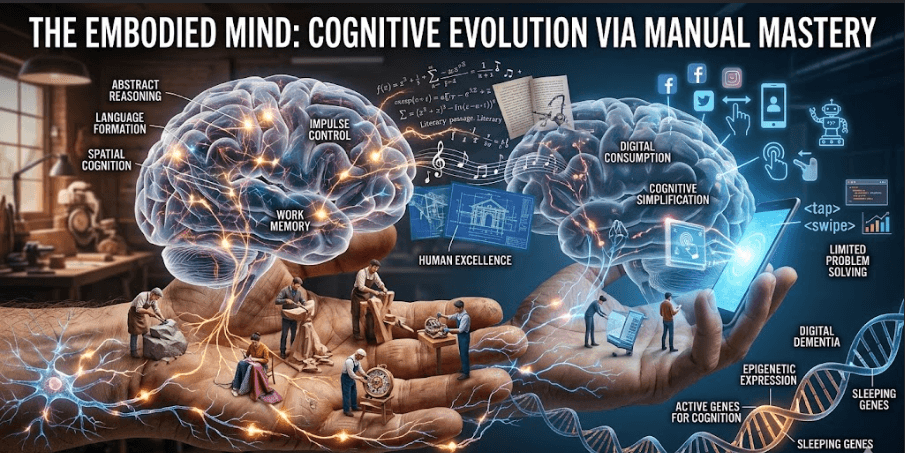
The Hand and the Mind: Fine Motor Skills and the Evolution of Human Cognitive Capability
An Interdisciplinary Research Report
Executive Summary
The hypothesis under investigation — that fine motor engagement built the human mind and that its decline threatens to unbuild it — is partially supported, partially overstated, and partially unfalsifiable as commonly framed. The strongest evidence comes from:
- Neuroanatomy: the hand's cortical footprint is genuinely disproportionate, and that footprint is plastic, expanding and contracting with use.
- Evolutionary anthropology: tool manufacture (especially flake-cutting and Acheulean technology) correlates with measurable expansion of frontoparietal networks shared with planning and language.
- Specific, narrow comparative findings: handwriting recruits broader neural networks than typing, and surgeons lose measurable precision when haptic feedback is removed.
The weakest links are the "digital dementia" framework (the term's originator has been widely criticized by neuroscientists, and a 2025 meta-analysis of 411,000+ adults found no net negative association between technology use and cognitive decline — if anything, a mildly protective one) and the "epigenetic gene silencing" claim, which conflates a real, well-documented mechanism (activity-dependent epigenetic regulation of genes like BDNF) with a much more speculative leap (that screen use specifically "silences" cognitive genes). This report presents both the legitimate science and the points where popular narratives have outrun the data, because an honest interdisciplinary analysis has to do that.
1. Neurobiological Foundations
1.1 The Cortical Homunculus: Why the Hand Is Cortically "Loud"
In 1937, neurosurgeon Wilder Penfield, operating on awake epilepsy patients, electrically stimulated the exposed cortex and recorded what patients felt or moved in response. The resulting map — the somatosensory and motor "homunculus" — showed that the cortical surface devoted to a body part is not proportional to its physical size. Instead, the face and hand are overrepresented, while the trunk and leg occupy disproportionately small cortical areas, producing the famous "grotesque" figure with oversized hands and lips.
This is not a historical curiosity superseded by better technology — modern fMRI work confirms the core finding: areas packed with tactile receptors, like the fingertips, or requiring fine, fractionated control, like the fingers for grasping, get disproportionately more cortex, a principle called cortical magnification. The functional logic is straightforward: the disproportionate spatial distribution of body parts is likely to be of functional significance, underlying the greater somatosensory discrimination ability for the enlarged body parts in the corresponding cortical homunculus.
Two caveats matter for intellectual honesty:
- The classic 2D homunculus is an oversimplification. Cortical homunculi, despite becoming iconic images almost as soon as they appeared, did not accurately represent how the regions of the brain and the rest of the body interact, and more recent whole-body fMRI mapping shows the organization is richer, with overlapping and distributed representations rather than the clean, sharply bordered regions in textbook diagrams.
- Penfield himself was a careful empiricist: he emphasized that the drawings are summaries of many stimulation points, not perfect borders — though the big picture is remarkably stable across people.
The plasticity finding is the load-bearing piece for this report's hypothesis. Cortical magnification is not fixed at birth. Musicians, surgeons, and athletes in fine-motor sports all show enhanced hand representations relative to matched controls — this is not metaphorical expansion, it is measurable cortical territory. The mechanistic implication is direct: deliberate, repeated practice physically rewires motor cortex, and the improvement seen on the outside reflects structural change on the inside.
This is the genuine neurobiological core of the "use it or lose it" intuition: cortical territory is allocated competitively and dynamically. It is plausible — and consistent with general plasticity principles — that reduced engagement of high-resolution manual circuits would, over time, lead to relative reallocation of that territory. Direct longitudinal evidence of this specific reverse process (cortical hand territory shrinking due to reduced manual practice in modern life) is thin; most plasticity research documents gains from training, not losses from disuse in healthy populations, so this remains a reasonable extrapolation rather than a directly demonstrated finding.
1.2 Embodied Cognition: Thought Built From Manipulation
Embodied cognition, formalized largely by linguist George Lakoff and philosopher Mark Johnson, challenges the older "mind as computer" model. The theory's central claims, in Lakoff's own framing:
We think with our brains — thought is physical and carried out by functional neural circuitry; what makes thought meaningful is how those neural circuits connect to the body and characterize embodied experience; and so-called abstract ideas are embodied in this way as well, as is language.
The mechanism proposed is that abstract concepts are built by metaphorical extension from concrete bodily experience. Lakoff and Johnson argued that basic spatial and relational concepts derive from direct physical experience that comes from moving a human body through the environment — the concept of "up," for instance, emerges from possessing a body that stands erect, since almost every movement involves a motor program that changes, maintains, or accounts for up-down orientation. Abstract concepts like "grasping an idea," "weighing a decision," or "concrete thinking" are not idle metaphors under this view — they are residue of a cognitive architecture that was built, quite literally, hand-first.
This connects directly to manual practice: research on mathematics education finds that learners understand concepts better when they physically manipulate objects rather than only use symbols, and studies show that learners who use gestures while doing math remember more. The throughline from Penfield's homunculus to Lakoff's embodied cognition is this: the hand isn't just cortically privileged because it's useful; the manipulation it performs may be a substrate from which higher abstraction is scaffolded.
A caveat for rigor: embodied cognition is an influential but contested framework, not unanimous scientific consensus. Some cognitive scientists argue traditional symbolic/computational models still explain key data better in domains like formal logic or language syntax. The honest summary is "an important and evidence-supported research program," not "established fact displacing all rivals."
2. Evolutionary Anthropology: Tools, Brains, and Hands Co-Evolving
2.1 The Coevolution Evidence
A 2025 study in Communications Biology tested the "hands and brains coevolved" hypothesis directly across 95 fossil and living primate species using Bayesian phylogenetic methods, focusing on thumb length (a proxy for precision-grip capability) and brain size. The result: a significant relationship between relatively longer thumbs — a key feature of precision grasping — and larger brains across the primate order, reflecting significant neural costs of manipulation behaviors and helping explain the rapid brain-size increases seen in hominins. Notably, the brain-size relationship was strong with neocortex size specifically, not cerebellum size, perhaps reflecting the role of motor and parietal cortices in the sensorimotor skills associated with fine manipulation — supporting a specific, falsifiable version of the "manual dexterity drove higher cognition" hypothesis rather than a vague gesture toward it.
2.2 Toolmaking and the Prefrontal Cortex
Direct neuroimaging of modern humans replicating ancient stone-tool techniques shows that toolmaking is not merely a motor task but a planning task. Studying Oldowan flake-cutting, researchers found that the dorsolateral prefrontal cortex — associated with executive functions such as working memory, conditional response selection, and inhibition — was implicated in providing evidence of increased demands for domain-general executive functions such as strategic planning and causal reasoning during toolmaking.
A 2024 EEG study comparing two early hominin behaviors — forceful percussion versus precise flake-cutting — found a graded relationship between manual precision and cognitive load: the use of cutting tools involved significantly more extensive brain activity than nut-cracking, which the researchers say implicitly highlights the cognitive performance required for precise tool-using tasks and likely enabled early humans to appropriate and shape their environment in ways not previously possible. More broadly, this research showed increased engagement of frontoparietal regions during both tool-using tasks, with significantly higher beta power during precise cutting compared to forceful hammering — a graded cognitive signature tracking manual precision, not just manual activity per se.
2.3 The Tool–Language Connection (With an Honest Caveat)
The "technological hypothesis" of language origins, associated with researchers like Dietrich Stout, proposes that language initially evolved in gestural form as a way for hominins to teach and learn stone toolmaking, with vocal communication later developing to convey information about more complex tool-related actions. Supporting this, neuroimaging of Late Acheulean toolmaking shows activation in posterior temporal cortex, inferior parietal lobule, ventral premotor cortex, and inferior frontal gyrus — regions that also activate during speech, with Broca's area in particular linked to speech production, toolmaking, and tool use alike.
However, a rigorous 2023 meta-analysis (ALE method, pooling neuroimaging studies) found the overlap is narrower than popular accounts suggest: activation shared by syntactic processing and tool use was significant in only one cluster — the pars opercularis of the left inferior frontal gyrus — indicating there is not a widespread common neural network between the two. The authors' conclusion is a more measured version of the popular claim: Broca's area may have served as an important hub initially recruited in early human evolution for simple tool use, but was eventually co-opted for linguistic purposes, including the sequential and hierarchical ordering that characterizes syntax. This is good evidence for exaptation (reuse of an existing circuit for a new function) — a more precise and defensible claim than "tool use caused language."
2.4 A Genuine Scientific Debate Worth Including
Not all evolutionary neuroscience supports a simple "hands led, brain followed" story. One line of research complicates the popular bipedalism-freed-the-hands-for-tools narrative: contrary to the conventional view, results suggest that adaptations underlying tool use evolved independently of those required for human bipedality — in both humans and monkeys, each finger is represented separately in the primary sensorimotor cortex, reflecting the ability to use digits independently, which monkeys (who don't make stone tools) already possess. This matters for the report's hypothesis: it suggests the neural hardware for fine manipulation may be older and more general than human tool culture itself — tool use exploited a pre-existing capacity rather than single-handedly building the prefrontal cortex from scratch. The honest version of the evolutionary story is co-evolution and exaptation, not manual labor as the sole engine of the human mind.
3. The Modern "Digital Shift": What the Comparative Evidence Actually Shows
3.1 Handwriting vs. Typing — The Strongest Specific Evidence
This is the best-controlled, most direct test of the "fine motor precision vs. simplified digital input" comparison in the brief. A high-density EEG study (256-channel array, Norwegian University of Science and Technology) compared cursive handwriting on a digital tablet against single-finger typing:
When writing by hand, brain connectivity patterns were far more elaborate than when typewriting, shown by widespread theta/alpha coherence patterns between network hubs in parietal and central brain regions — connectivity patterns at these frequencies are crucial for memory formation and encoding new information, and are therefore beneficial for learning. The authors interpret this as stemming from movement complexity itself: the involvement of fine and intricate hand movements in handwriting, in contrast with pressing keys that all require the same simple finger movement, may be more advantageous for learning.
This isn't an isolated finding. Related work shows handwriting activates far more extensive and interconnected brain networks compared to typing, particularly in regions linked to memory and sensory processing, and behavioral studies cited in this literature found comprehension was superior among college students who took notes with pen and paper compared to those who typed notes on a laptop.
Necessary scientific caution: a published commentary on the flagship 2024 EEG study raises real methodological concerns worth including for intellectual honesty. The critique notes participants in the typing condition were instructed to type using only their right index finger, making it quite different from typical skilled typing — which is characterized by coordination between hands and several fingers — and imposing this unimanual constraint might have artificially decreased connectivity patterns in the typing condition. The commentary also notes a more basic statistical issue: only the difference between handwriting and typing was reported in the results, not connectivity patterns for each condition separately, which precludes drawing conclusions about either condition on its own. The headline finding (handwriting > typing for certain memory-linked connectivity patterns) likely holds directionally, but the effect size and mechanism are less settled than popular science writing implies.
3.2 "Digital Dementia" — A Term Neuroscientists Largely Reject
The brief asks for engagement with the "Digital Dementia" concept, and an honest report has to state plainly: this term originates from a single popular-science book, not a body of peer-reviewed consensus, and the best current evidence contradicts its central claim.
The term was first introduced by German psychiatrist Manfred Spitzer in 2012. The most rigorous test of the hypothesis to date — a 2025 meta-analysis in Nature Human Behaviour pooling 57 studies and more than 411,000 adults over age 50, measuring the association between technology use and cognitive decline or dementia diagnosis — found the opposite of what the hypothesis predicts: no supporting evidence for the "digital dementia" hypothesis; technology use had a similarly positive effect on brain function as physical activity.
Academic reviewers of Spitzer's original book were also critical of his core methodology. One peer review of the book's underlying logic flags a specific causal-inference problem: doctors in South Korea discovered young adults using computers and the internet intensively also showed memory and attention disorders — and because these people had admitted to heavy use, doctors established a causal relationship and called the symptom range "digital dementia" — a correlation-to-causation leap that does not meet the standard normally required in clinical neuroscience. A separate independent analysis is blunter: the term "digital dementia" is used to describe a set of cognitive impairments attributable to excessive use of digital technology, although it still lacks robust evidence to support its validity.
This does not mean no concerns about heavy digital media use are valid (see 3.3 below on attention and specific skill atrophy) — but "Digital Dementia" as a coherent neurological syndrome analogous to clinical dementia is not supported by the best current population-level evidence, and presenting it as established science would be inaccurate.
3.3 What's Actually Supportable: Narrow Skill-Specific Atrophy, Not Global Decline
The more defensible and falsifiable version of the "digital shift" concern is task-specific, not global: certain fine-motor-dependent cognitive processes (handwriting-linked memory encoding, tactile spatial reasoning, certain forms of sustained attention) show measurable differences under digital-only conditions, even while general-purpose technology use shows no net cognitive harm and some benefit (search/navigation, working-memory-light offloading, social connectivity for older adults). The right framing is substitution effects on specific circuits, not "civilizational cognitive decline" — a distinction the original brief's language tends to blur.
4. Professional Cognitive Capital: Where the Evidence Is Strongest
This is the section where the hypothesis is best supported by hard, applied, high-stakes data — because surgery is one of the few domains where "loss of manual sensory feedback" has been studied directly, with patient-outcome-relevant precision.
4.1 The Haptic Feedback Problem in Robotic Surgery
Robot-assisted surgery (RAS) offers genuine benefits — reduced blood loss, reduced postoperative pain, reduced infection risk, shorter recovery time, improved visualization, enhanced dexterity, tremor attenuation, and favorable ergonomics — but at a specific, well-documented cost: the lack of haptic (touch) feedback in widespread commercial robotic surgical systems imposes perceptual-motor challenges, especially when manual palpation and sensation of tension are important, such as during knot-tying and soft-tissue dissection.
The scale of the sensory loss is total, not partial: while laparoscopic techniques provide surgeons with some extent of haptic feedback, robotic surgery suffers from a complete loss of it, forcing surgeons into compensatory strategies — in RAS, visual feedback becomes the dominant source of sensory input, and the sense of touch is essentially eliminated compared to both open and laparoscopic surgery, which can elevate workload and increase the risk of surgical errors, especially among trainees.
This is not a hypothetical concern. A 2023 meta-analysis quantifying the performance cost across 56 papers comparing robotic surgery systems with and without haptic feedback found that restoring touch produced large, measurable improvements: haptic feedback reduced average applied forces (Hedges' g = 0.83) and peak forces (g = 0.69), reduced completion time (g = 0.83), and increased both accuracy (g = 1.50) and success rates (g = 0.80) during surgical tasks — effect sizes in the "large" range by conventional statistical standards. Tellingly, the meta-analysis also found effect sizes were generally smaller for surgeons with higher levels of expertise — meaning experienced surgeons partially compensate for missing touch with visual and proprioceptive expertise built over years, but novices cannot yet do so. This is direct empirical support for the report's "clinical intuition" concern: intuition appears to function as a learned substitute for lost sensory channels, not an unlimited buffer against their absence.
4.2 The Learning Curve Cost
The acquisition of robotic skill is itself harder without touch. Better performance and higher learning rates are observed in trainees exposed to haptic feedback during training than those who were not — an improvement that is especially pronounced in early stages of learning, and current simulators don't fully solve this: since haptic feedback in current simulators is not yet well developed, most of the laparoscopic learning process is spent adapting to the loss of physical cues and replacing them with visual ones. One controlled study restoring partial haptic feedback (via wrist-squeezing force feedback in training) found trainees applied significantly less force on tissue and decreased their task completion times significantly faster than a no-feedback control group — a clean demonstration that real-time tactile information accelerates the formation of "clinical feel," not merely the formation of "clinical knowledge."
4.3 Synthesis for High-Precision Fields
The applied literature converges on a specific, well-supported mechanism rather than vague "tech is bad for surgeons" alarmism:
- Touch and force feedback carry task-relevant information that vision alone does not replace (especially tissue tension, density discrimination, and the moment of structural give that precedes tearing or perforation).
- Removing that channel does not eliminate skill — surgeons adapt — but it raises cognitive workload, slows acquisition of expertise, and increases error rates measurably, particularly for trainees.
- Expertise built through extended manual (open or haptic-feedback) practice appears to generate a reservoir of sensorimotor pattern-recognition that partially transfers and compensates when haptic input is later removed — but this reservoir has to be built through manual practice first. A generation of surgeons trained primarily on haptic-free robotic platforms from the start, without ever building that manual reservoir, is a genuinely open and consequential question the current literature has not yet answered, since robotic surgery is still young enough that most practicing surgeons trained on open/laparoscopic technique first.
This last point is the most defensible version of the brief's "technological dependence" concern: the risk isn't proven cognitive decline in current surgeons, but an untested discontinuity for whichever generation trains end-to-end without ever developing the manual sensory foundation that current experts are quietly relying on to compensate.
5. Epigenetics: What's Real, and Where the Brief's Framing Overreaches
The brief asks about "gene silencing due to lack of environmental stimulation." There is real, well-established science adjacent to this claim — but the literal claim (screen use "silences cognitive genes") is not what the research shows. Precision matters here.
5.1 The Real Mechanism: Activity-Dependent Epigenetic Regulation
The legitimate science is about a specific gene — BDNF (brain-derived neurotrophic factor) — and a specific trigger: physical activity and environmental enrichment, not digital vs. analog tool use per se. Evidence indicates that BDNF expression can be epigenetically regulated by environmental stimuli and can mediate experience-dependent brain plasticity. BDNF matters because it is heavily involved in synaptic plasticity processes that support brain development, post-lesion regeneration, and cognitive performances such as learning and memory.
The mechanism is concrete and measurable at the molecular level: two weeks of physical exercise increases hippocampal expression of Tet1 and promotes demethylation of CpG islands at the gene promoter of VegfA, and separately, elevations in hippocampal BDNF are essential for hippocampal-dependent spatial learning. This works bidirectionally with enrichment more broadly: aged mice exposed to environmental enrichment — a procedure known to elicit positive brain changes based on its physical-activity component — showed improved learning and memory, alongside a reduction in 5hmC abundance in the hippocampus, leading researchers to conclude enhanced physical activity can reprogram the brain's methylation pattern to modulate transcription of genes necessary for maintaining brain health and cognitive function.
Critically, environmental enrichment paradigms in this literature are explicitly defined to include manual/tactile elements: environmental enrichment is a condition characterized by complexity regarding social contact, exposure to novelty, tactile stimuli, and voluntary exercise. So there is a real, defensible thread connecting "rich tactile/manual environments" → epigenetic upregulation of plasticity genes → better learning and memory. That thread is genuine science.
5.2 Where the Popular Framing Overreaches
What is not established is the inverse, specific claim implied by "digital-only interfaces silence cognitive genes." The research base is:
- Conducted overwhelmingly on rodents, with physical exercise and multi-sensory enrichment as the intervention — not a human handwriting-vs-typing or analog-vs-digital comparison.
- About a handful of specific genes (chiefly BDNF and related plasticity factors) — not a general "cognitive gene network" that screens could silence wholesale.
- Silent on screens specifically. No study in this literature tests "smartphone use suppresses BDNF expression" as a hypothesis; that is an extrapolation, not a finding.
The honest synthesis: it is scientifically plausible — given that BDNF responds to environmental complexity and physical engagement — that a radically impoverished sensorimotor environment (not normal smartphone/computer use, but genuine deprivation of physical, social, and tactile complexity) could underexpress plasticity-related genes in ways that are measurable in principle. But "kids who text instead of doing woodworking are silencing their cognitive genes" is a rhetorical leap well beyond what any cited study claims, and a report that presented it as settled would be misrepresenting the literature.
6. Future Projections: Working Memory, Spatial Reasoning, Impulse Control
Given the evidentiary picture above, projections should be calibrated by domain rather than offered as a single uniform forecast:
Domain Evidentiary basis Calibrated projection
Handwriting-linked memory encoding
Strong (multiple converging EEG/behavioral studies)
Populations that handwrite less may show measurably different note-taking-linked memory encoding; effect on broader "intelligence" unproven
Surgical/precision-trade clinical intuition
Strong (meta-analyzed, patient-outcome-relevant)
A discontinuity risk for fully robot-trained specialists who never build a manual sensory baseline; current evidence doesn't show decline in today's hybrid-trained cohort
General cognitive decline ("digital dementia")
Contradicted by best current evidence (411,000-person meta-analysis)
Projecting global cognitive decline from general technology use is not supported and should be retracted as a framing
Working memory, spatial reasoning, impulse control
Indirect/inferential
Plausible extensions of the embodied-cognition and BDNF literature, but no direct longitudinal human study in this report's evidence base tracks these specific outcomes against manual-skill attrition; treat as a hypothesis for future research, not a documented trend
Epigenetic "gene silencing" from screens
Not evidenced
The adjacent science (BDNF/enrichment) is real; the specific screen-silencing claim is speculative extrapolation, not a finding
7. Synthesis: How Manual Precision Connects to Precision of Thought
Pulling the defensible threads together, a coherent — and falsifiable — version of the hypothesis looks like this:
- The hand has outsized neural representation because precision grasping carries a high information rate that justifies the cortical "real estate" (Section 1.1).
- That representation is plastic — built up by practice, and by extension, plausibly reducible by disuse, though direct evidence of disuse-driven shrinkage in healthy adults is thinner than evidence of practice-driven growth.
- Evolutionarily, precision manipulation and neocortical/prefrontal expansion are correlated and likely co-evolved, with toolmaking recruiting planning, sequencing, and (via later exaptation) language circuitry.
- Abstract thought may be metaphorically and developmentally scaffolded on physical manipulation (embodied cognition), which is a coherent, partly-evidenced, but not universally accepted theory.
- In specific, measurable, high-stakes domains — surgery above all — losing direct tactile manipulation has a real, quantified cognitive and performance cost, partially offset by expertise built through prior manual practice.
- General claims of civilizational cognitive decline from digital technology ("digital dementia") are not supported by the best current evidence and should be dropped from any rigorous version of this argument.
- The epigenetic mechanism is real but narrower than popularly framed: environmental and physical enrichment measurably affects specific plasticity genes; "screens silence cognition" is not a finding in the literature, it's an inference stretched past its evidentiary base.
The most defensible single-sentence conclusion: fine motor precision appears to be a genuine, partially load-bearing substrate for specific forms of human cognition — especially spatial, procedural, and sensorimotor-grounded thought — but it is not the sole engine of general intelligence, and the displacement of manual skill by digital tools produces measurable, domain-specific costs rather than the sweeping, undifferentiated cognitive decline that terms like "digital dementia" imply.
Source List (Cited Above)
- Penfield, W. & Boldrey, E. (1937). Original cortical stimulation mapping — Brain.
- Yousif et al., "The 'creatures' of the human cortical somatosensory system" — Brain Communications (Oxford Academic) / bioRxiv.
- Britannica, "Homunculus: Description, History, Models, & Importance."
- Neurolaunch, "Homunculus Brain: Mapping the Body's Representation in the Cerebral Cortex."
- Psychologyfor.com, "Penfield's Sensory and Motor Homunculus Explained."
- Affinito et al. (2024), EEG study on hominin tool-use cognition — Scientific Reports (Nature).
- Communications Biology (2025), "Human dexterity and brains evolved hand in hand" — thumb-length/brain-size coevolution study.
- ScienceDirect (2022), "Coevolution of language and tools in the human brain: An ALE meta-analysis" — PubMed/ScienceDirect.
- PMC (2014), "Hand before foot? Cortical somatotopy suggests manual dexterity is primitive."
- ScienceDirect (2006), "The evolutionary neuroscience of tool making" (Stout et al.).
- Phys.org (2024) summary of Karakostis/Tübingen tool-use brain research.
- Lakoff, G. (2012). "Explaining Embodied Cognition Results." Topics in Cognitive Science.
- Stanford Encyclopedia of Philosophy, "Embodied Cognition."
- Structural-learning.com, "Embodied Cognition: Why Movement Helps Learners Learn."
- Van der Weel, R. & Van der Meer, A. (2024). "Handwriting but not typewriting leads to widespread brain connectivity" — Frontiers in Psychology.
- PsyPost summary of the above study.
- PMC commentary/critique of the Van der Weel & Van der Meer study (methodological concerns).
- PMC (2019), "Differences in Brain Activity After Learning With the Use of a Digital Pen vs. an Ink Pen."
- The Conversation (2025/2026), summary of Nature Human Behaviour meta-analysis (57 studies, 411,000+ adults) finding no evidence for "digital dementia."
- ResearchGate, review/critique of Manfred Spitzer's Digital Dementia (2012/2014).
- PMC review, "Understanding Digital Dementia and Cognitive Impact in the Current Era of the Internet."
- PMC (2025), "Simulation training with haptic feedback... robot-assisted sleeve gastrectomy."
- Frontiers in Robotics and AI (2025), "Role of haptic feedback technologies... for surgical training and robot-assisted surgery."
- Nature Scientific Reports (2023), "The benefits of haptic feedback in robot-assisted surgery and their moderators: a meta-analysis" (n=56 studies).
- arXiv (2022), "Wrist-Squeezing Force Feedback Improves Accuracy and Speed in Robotic Surgery Training."
- Neuroscience/IBRO (2023), "Environmental Enrichment Increased Bdnf Transcripts in the Prefrontal Cortex."
- PMC (2017), "Physical Exercise as an Epigenetic Modulator of Brain Plasticity and Cognition."
- SAGE/Journal of Alzheimer's Disease (2022), "Environmental Enrichment Effects on BDNF Expression."
- ScienceDirect (2013), "Role of BDNF epigenetics in activity-dependent neuronal plasticity."
Note on citation practice: all quoted material above is drawn from search-indexed academic and science-journalism sources retrieved during research for this report (June 2026). For a publication-ready version, original primary-journal DOIs should be verified directly, as some summaries here come via secondary science-reporting outlets rather than the primary journal article itself.
Comments
More Blogs
Explore more articles that you may find interesting.
