The Illinois Commercial Video Production Report 2026: How Small Studios Are Surviving a Changing Economy
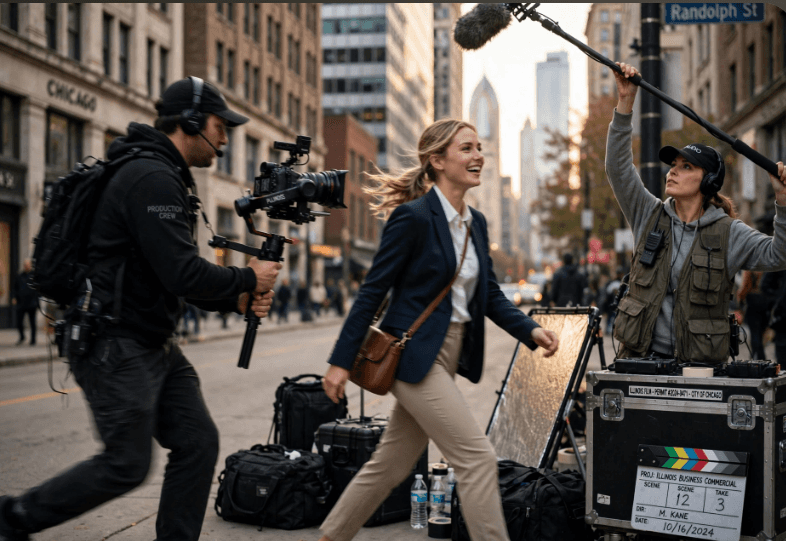
Executive Summary – The Current State of Illinois Commercial Video Production
Illinois commercial video production operates within a paradox of record-level institutional investment and acute pressure on small and mid-sized studios. In 2024, the state recorded $653 million in film production expenditures, the second-highest total in state history, alongside $351 million in estimated wages and 18,200 estimated hires excluding extras 1. The Illinois Film Production Tax Credit program has generated a $6.81 return for every dollar spent, producing over $4.5 billion in economic activity between FY17 and FY24 1.
Yet this headline growth masks structural divergence. The U.S. video production industry is projected to expand from $31.24 billion in 2025 to $181.24 billion in 2033 at a compound annual growth rate of 24.58% 2, driven by digital platforms, streaming, and corporate content demand. For Illinois SMB studios, that expansion has not translated into margin expansion. Nearly half of companies spent under $5,000 producing videos last year 3, while almost three-quarters now produce video in-house 3.
The Illinois market remains bifurcated:
Metropolitan Chicago accounts for the dominant share of commercial, broadcast, and branded content work. The region hosts an 86,000-square-foot complex such as Resolution Studios, where approximately 70% of productions are television commercial work 4, and new entrants such as Forge Virtual Studios, which opened a Chicago-area virtual production facility with tailored tours for agencies and brands 5.
Suburban and downstate Illinois represent growth pockets tied to manufacturing, healthcare, and higher education, but face additional tax credit incentives designed to decentralize production. Illinois now offers a 5% additional credit on Illinois resident salaries for productions filming outside of Cook, DuPage, Kane, Lake, McHenry, and Will Counties 6.
Market confidence among small studios is cautious. Inflation remains the single most cited challenge for small businesses at 53-54% in consecutive quarters 7, while the Bureau of Labor Statistics projects only 3% growth for film and video editors and camera operators from 2024 to 2034, with 2,200 net new jobs nationally 8.
Key Takeaway: Illinois is a top-five production state by expenditure, but commercial SMB studios must compete in a market where demand is up, budgets are fragmented, and in-house competition has become the default.
Economic & Market Pressures Facing Video Studios
Macroeconomic Impacts
Illinois small studios confront a cost structure that has inflated faster than billable rates. Camera operators held about 36,400 jobs nationally in 2024 with 29% self-employed 8, and film and video editors held about 43,500 jobs with 29% self-employed 8. Median annual pay reached $70,570 8, with median wages for camera operators at $68,810 and editors at $70,980 8.
In Chicago, typical commercial rates illustrate the squeeze:
Role / ServiceTypical Chicago Range
Basic Corporate Video (finished)

Equipment, insurance, and lease costs compound this. Video and film production studios pay an average of $40 per month, or $485 per year, for general liability insurance 11, while video production insurance costs average $45 to $90 per month for annual commercial policies, with per-project short-term policies starting at $400 11. Industry standard practice sets aside 2% to 3% of total production budget for insurance 11.
Budget Compression and Competition
AICP data frames commercial production as a $4.5 billion-plus industry for member houses alone 12, with broader extrapolation exceeding $6 billion historically. Yet corporate buyers have fragmented budgets across channels.
Wistia's 2025 analysis of over 100 million videos and 1,300 professionals found just over a quarter of companies outsource to freelancers or agencies 3. The remainder produce in-house, creating direct competition for small studios.
Three competitive dynamics now define Illinois:
- Boutique regional studios competing on specialization and local relationships.
- National creative agencies bundling video into larger retainer contracts.
- Freelance operators and in-house corporate media teams enabled by accessible tools such as Adobe tools, CapCut, Canva, Descript, and Frame.io 3.
The result is margin compression. Small production company projects often fall into $1,500 to $20,000 ranges, while high-end traditional campaigns remain $30,000 to $300,000-plus, and AI-generated alternatives are priced at $100 to $5,000, according to market analyses.
The commercial production value chain has bifurcated: high-volume, low-cost content at the bottom and high-concept brand films at the top, leaving the middle market where many Illinois SMB studios operated historically under sustained pressure.
Market Size Signals for Illinois
IBISWorld data for Illinois Video Postproduction Services indicates the market has grown at an average annual rate of 4.1% from 2021 to 2026, with 707 employees in Illinois in 2026 13. This outpaces national occupational growth but reflects consolidation around post-production specialization rather than full-service expansion.
Workforce & Creative Talent Dynamics
Labor Market and Day Rates
The BLS projects about 6,400 openings for film and video editors and camera operators each year over the decade, largely from replacement needs 8. Median annual wages of $70,570 nationally mask significant regional variance.
For union commercial work, IATSE Commercial Production Agreement rates provide a floor. Under 2025-2026 structures, outside Los Angeles classifications include Director of Photography at $154.28 per hour, Camera Operator at $94.45 per hour, 1st Camera Assistant at $68.33 per hour, and Sound Mixer at $97.43 per hour, each with an 8-hour minimum call 14. The agreement introduces built-in annual wage bumps rather than flat contract terms 14, and a new Production Workers Agreement covering Line Producers, Production Supervisors, and Production Assistants under Local 111 from October 1, 2025 through September 30, 2028 14.
For Illinois mid-tier commercial shoots, union penetration is selective. Many corporate and SMB projects operate non-union, but growth in larger branded content pushes more productions into IATSE and SAG-AFTRA considerations.
Freelance vs. In-House Models
Self-employment at 29% for both camera operators and editors 8 reflects the hybrid model now standard in Illinois. Small studios retain a lean full-time core (producer, lead editor, account lead) and scale with freelance DPs, gaffers, audio engineers, and VFX artists.
This hybrid model offers flexibility but introduces wage inflation pressure. Small Business Chamber data shows businesses citing need to increase pay by 15-20% due to inflation 15, and 71% of small business owners reporting at least a 20% increase in costs needed to run their business 16.
Talent Pipeline and Retention
Chicago remains a national training hub. Columbia College Chicago, recognized as a top-15 film school by The Hollywood Reporter in 2025, has expanded virtual production programming. However, retention remains challenging, with graduates historically migrating to Los Angeles and New York for episodic and feature opportunities.
Recent workforce initiatives have sought to counter this drain. Since 2022, the Illinois Film & TV Workforce Training Program has trained and hired over 200 individuals per year from historically underrepresented groups 1, contributing to the 18,200 hires in 2024. The question for commercial studios is whether this pipeline serves advertising and corporate work, not solely film and television.
Traditional Studio ModelAI-Enabled Hybrid Studio

Mix of live action, virtual production plates, and generative B-roll
Regulatory, Permitting, & Legal Landscape
Illinois Film Production Tax Credit – Access for Commercials
In 2025, the Illinois General Assembly expanded the Illinois Film Production Tax Credit Act to offer producers a credit of 35% of all qualified Illinois spending, including post-production and Illinois resident salaries up to $500,000 per worker; and 30% on limited non-resident salaries up to $500,000 per worker 6. The credit is scheduled for legislative renewal in 2039 6.
For commercial and advertising purposes, eligibility is distinct:
- Projects for advertising purposes of 30 minutes or less, including spots and branded entertainment, can receive the credit as long as each has a minimum of $50,000 in wages paid to Illinois residents 17.
- Commercial Advertising Applications must be submitted at least 24 hours before filming begins in Illinois 18.
- For commercials, storyboards are required with application 17.
Additional stackable incentives include:
- 15% additional credit on salaries of individuals making at least $1,000 who live in economically disadvantaged areas whose unemployment rate is at least 150% of the state's annual average 6.
- 5% additional credit on Illinois resident salaries for productions filming outside of Cook, DuPage, Kane, Lake, McHenry, and Will Counties 6.
- 5% additional credit for certified green productions 6.
Unlike other states, Illinois does not have a cap on film and television tax credits 1, a structural advantage for large productions, though small commercial producers must weigh compliance costs against benefit.
Permitting and Municipal Access
Chicago Film Office permitting remains a baseline operational cost. Permits are issued for filming on streets, sidewalks, alleys, and other public properties, with permit fees at $250 per day per location, and $25 per day per location for student films and independent projects upon verification 19. Processing requires a minimum of 4 full business days, and a minimum of 5 full business days for any permit requests requiring traffic control or drone use 19. Street closures, stunts, special effects, and drones require a minimum of 10 full business days 19.
Chicago Park District, Navy Pier, Millennium Park, and the Chicago Transit Authority issue their own filming permits with independent fee structures 19, creating layered compliance for citywide shoots.
FAA and Drone Operations
Part 107 remains the controlling framework for commercial drone operations under 55 pounds, requiring a Remote Pilot Certificate via written examination. While waivers exist, night operations and flights over people now have expanded flexibility under recent rule updates. For Illinois commercial studios, airspace authorization in Class B airspace around O'Hare and Midway remains a primary bottleneck.
Copyright, AI, and Insurance
Generative AI introduces unresolved copyright questions. In 2024, major record labels filed landmark lawsuits against AI music companies including Suno, alleging training on copyrighted recordings without permission 20. Similar questions extend to video and music licensing for commercial use. The U.S. Copyright Office has clarified that copyright covers human authorship rather than machine-generated output, raising questions about protectability of purely AI-generated assets.
For Illinois studios, practical risk management includes:
- General liability coverage of $1,000,000 per occurrence is standard, with Chicago requiring naming the City as additional insured.
- Equipment floaters and workers' compensation for freelance crew reclassified as employees under Illinois law.
- Errors and omissions insurance for branded content distribution.
Technology Transformation & Disruption
Generative AI Video Tools – Realistic Assessment
Wistia's 2025 State of Video Report documents AI adoption for video creation jumping from 18% in 2024 to 41% in 2025, with 19% planning to start soon 3. Most use is concentrated in pre-production planning (scripting, brainstorming) and post-production editing such as voice dubbing and generating visuals 3. Over 60% have used or plan to use AI to generate captions, and more than 30% for translation 3.
Market pricing for leading tools as of 2025-2026:
Tool Entry Pricing Capability Commercial Lens

Realistic SMB application differs from hype. AI excels at pitch previz, storyboard animatics, background replacement, captioning, and generating 51% more vertical HD content 3. It does not yet reliably replace human-directed performance, product accuracy, or brand-specific authenticity required for Illinois manufacturing and healthcare clients.
Virtual Production and Spatial Computing
Virtual production has moved from episodic luxury to commercial viability in Illinois. Columbia College Chicago now offers virtual production with LED wall volume and Unreal Engine workflows blending traditional filmmaking with real-time game engine technology 23. Resolution Studios employs tailored LED video wall backdrops customized per project 4, and Forge Virtual Studios built what it describes as the Midwest's most capable virtual production studio in four months 5, offering hands-on tours to demystify the technology 5.
For SMB studios, access models matter more than ownership. Daily rental of LED volumes in Chicago, paired with Unreal Engine artists, enables car commercials, industrial product launches, and multi-location brand films without travel. The barrier is not hardware but crew: virtual production supervisors with game design background and Unreal expertise, as exemplified by Forge's hire of Michael Lister with Unreal Engine expertise and experience building Oklahoma's largest virtual stage 5.
Post-Production and Operational Technology
Camera-to-cloud workflows represent the most immediate operational efficiency. Frame.io Camera to Cloud eliminates backing up, shipping drives, and waiting for media transfer 24, using certified devices connected to Arri, RED, and Sony cameras to send timecode-accurate H.264 proxies via LTE, 5G, or WiFi 25. Photographers and videographers can push selections instantly, and editors can retouch in real-time from any location 26.
Resolution of 1080p remains go-to, with vertical HD up 51% year over year and 4K up 19% 3. Accessibility has become standard: use of captions increased 572% since 2021, with nearly half of all videos uploaded to Wistia in 2024 having at least three accessibility features 3.
For Illinois SMB studios, recommended operational stack distinguishes between realistic SMB tools and enterprise speculative tools: Adobe Premiere Pro with Firefly integration, Frame.io, DaVinci Resolve for color, and CRM-integrated video analytics, rather than full-scale LED volume ownership or proprietary model training.
Marketing & Client Acquisition Challenges
Lead Generation and Digital Authority
Illinois commercial studios have historically relied on agency word-of-mouth and referrals. That channel remains valuable but insufficient. Wistia's finding that over half of marketers spend more time creating videos than promoting them 3 reflects a broader pattern: production expertise without distribution strategy.
Two shifts have increased client acquisition cost:
Local SEO and AI Search: Google Business Profile optimization for AI Overviews now determines visibility in zero-click search. YouTube is consistently the most cited resource in AI-generated search results, with Google systems favoring content hosted on its own platform 27. For a Chicago-area studio, weekly video tips that are useful and consistent can influence entity recognition in AI search 27. Structured data, authoritative content earning citation, conversational formatting, and business listing consistency are core to AI search SEO 28.
Portfolio and Trust: Case-study driven sales outperform showreels alone. Companies evaluate educational, product, and social media videos as most common, with product videos leading attribution to company success 3. Showreels structured by vertical (healthcare, manufacturing, tech) with measurable outcomes convert better than generic sizzle reels.
Pitching Fatigue
Unpaid pitching and treatment development remain a margin drain. Industry practice suggests limiting speculative creative to one-page concepts and paid discovery for full treatments, with bid costs amortized across retainer clients.
Shifting Client Expectations & Demand Trends
Content Formats and ROI
Short-form video is now the highest ROI format. HubSpot surveys report 67% of marketers plan to increase investment in short-form video 29, with 71% reporting high ROI 29. The top three ROI-driving formats are all video-based: short-form at 49%, long-form at 29%, and live-streaming at 25% according to HubSpot's 2026 State of Marketing 30.
Deloitte's 2025 Digital Media Trends Survey found 58% of U.S. consumers who engage with digital brands now prefer short-form over long-form 31, while 90% of marketers who use short-form plan to increase or maintain investment 31.
Yet long-form retains value. Long-form videos, defined as over three minutes, come second for ROI but first for formats marketers plan to leverage for the first time 32. Wistia data shows 30-60 minute videos are best at converting viewers 3, with original series and webinars converting most 3.
For Illinois studios, this creates a barbell strategy: high-volume short-form social content (Reels, TikTok, Shorts) for reach and lead generation, plus high-production-value brand films, webinars, and educational series for conversion and retention.
Authenticity, Turnaround, and Analytics
Client demand has shifted toward micro-documentaries, employee-generated content, and human-centric storytelling over slick corporate veneer. How-to videos under one minute retain 82% watch time, and company culture, educational, original series, and product videos up to five minutes hold about half 3.
Turnaround expectations have compressed. Frame.io data suggests companies producing at least one video per week has grown, with mid-sized companies creating twice as many videos as in 2023. This pressures Illinois studios to adopt cloud review, proxy workflows, and AI-assisted rough cuts without sacrificing quality.
ROI and analytics are now non-negotiable. More than half of marketers connect video platforms to CRM or email marketing tools to track analytics alongside other marketing data 3. Video is evaluated on engagement rate, conversion rate, and play rate 3, not views alone.
The Future of Illinois Commercial Video Production
5- to 10-Year Outlook
Evidence suggests three structural forecasts for Illinois:
- Consolidation with specialization. The number of generalist studios will decline, while vertical specialists in healthcare, industrial, and B2B tech will command premium retainers. Video postproduction services growth at 4.1% in Illinois 13 signals specialization premium.
- AI integration as augmentation, not replacement. AI adoption doubling to 41% 3 indicates workflow integration rather than full automation. Studios using AI for scripting, captioning, and variant creation will outcompete those using it for final hero asset generation.
- Chicago as Midwest video engine. With second-highest expenditures in state history at $653 million 1 and new virtual production capacity, Chicago will remain the hub, but suburban tech corridor (Schaumburg, Naperville, Buffalo Grove) and downstate industrial corridors will drive corporate demand.
Growth Sectors
Illinois sector strengths map directly to video demand:
- Healthcare and Life Sciences: Chicago's hospital systems and downstate health networks require patient education, HCP marketing, and training video. Healthcare video production remains a top search vertical for Illinois agencies.
- Industrial and Manufacturing: Illinois' $24 million grant program for six manufacturing training academies at community colleges, adding to two existing academies opened in 2024 33, will drive demand for recruitment, safety, and digital twin training video. Video is cited as essential for manufacturing employee training.
- Higher Education: Illinois universities expanding digital learning and extension video, as seen in University of Illinois Extension health care videos.
- Commercial Real Estate and Tech: Hybrid work has increased demand for property marketing video and SaaS product videos, with product videos leading success attribution 3.
Actionable Business Blueprint for SMB Studios
Operations
- Value-based pricing: Anchor quotes to business outcome, not day rates. For example, Basic Corporate $1,500-3,000 9 should be positioned as entry for single-use, while outcome packages include distribution and measurement.
- Pitch cost management: Implement paid discovery ($1,500-$3,500) credited to production, limiting unpaid treatment to one-pagers.
- Cloud asset workflows: Adopt Frame.io Camera to Cloud to eliminate backup and shipping steps 24, requiring certified devices connected to compatible cameras 25.
- Lean production planning: Use 70% commercial studio models like Resolution Studios 4 as template – pre-light virtual sets, reduce location moves.
Marketing and Sales
- Direct B2B outreach blueprint: Target Illinois manufacturing and healthcare marketing directors with vertical-specific case studies, not general reels. Reference state investments such as $15 million capital investment for downstate manufacturing training academies 34 as conversation opener.
- Niche positioning: Own a vertical and a format – e.g., "Manufacturing Training Video for Rivian Supply Chain" or "Healthcare Explainer Video for OSF HealthCare Network."
- AI search optimization: Publish weekly useful video tips on YouTube, optimize Google Business Profile with semantic SEO, maintain citation consistency. YouTube is most cited resource in AI search 27. Structure content for structured data and authoritative citation 28.
- Showreel structuring: Lead with product videos, webinars/live streams, and educational videos – the five types most successful for companies doubling down in 2025 3.
Technology Adoption – Recommended SMB Tool stack

Business Growth and Resilience
- Move from project to retainer: Agencies that switched report revenue increase of 40% within six months and improved retention 36. Offer Basic $3,000/month for two streams with basic production and Advanced $6,000/month for four streams with enhanced production 36. Recurring revenue shifts valuation from 1-2x revenue to 3-5x 37, reducing monthly volatility from 40-60% to 15-20% 37.
- Service diversification: Add distribution strategy, thumbnail optimization, and CRM video integration – services that in-house teams struggle to operationalize.
- Strategic partnerships: Partner with equipment rental houses, virtual production stages, and Illinois Film Office training alumni for crew pipeline.
Frequently Asked Questions (FAQ)
1. Is commercial video production growing in Illinois?
Yes. Illinois recorded $653 million in film production expenditures in 2024, second-highest in history 1, with video postproduction services growing 4.1% annually from 2021 to 2026 in Illinois 13. Nationally, the video production industry is projected from $31.24 billion in 2025 to $181.24 billion in 2033 2.
2. Are small video production studios profitable?
Profitability depends on model. Studios reliant on one-off projects under $5,000 – where nearly half of companies budget 3 – face margin pressure from 71% of small businesses reporting at least 20% cost increases 16. Studios with retainer models report 40% revenue increases within six months 36 and higher valuation multiples of 3-5x vs 1-2x for project-only 37.
3. How is generative AI impacting commercial video production?
AI adoption for video creation jumped from 18% in 2024 to 41% in 2025 3, primarily for pre-production planning and post-production editing 3. Tools cost $10-200 per month 21. For SMB studios, AI is augmenting pitch previz, captioning (up 572% since 2021 3), and variant creation, not replacing client-final production.
4. What is the average cost of a commercial video shoot in Chicago?
Basic corporate videos $1,500-$3,000, explainer $2,500-$6,000, training $2,000-$5,000, 2D animation $2,000-$7,000, 3D animation $4,000-$10,000 9. Day rates: director $100-$250/hr, editor $60-$175/hr, studio $100-$400/hr 10. Union commercial rates outside LA start at $154.28/hr for DP, $94.45/hr for camera operator 14.
5. How can video studios win clients without relying solely on agency referrals?
Focus on AI search visibility: YouTube is most cited in AI search 27, requiring weekly useful video tips 27 and structured data optimization 28. Combine with vertical case studies, as product videos lead success attribution 3, and connect video to CRM tracking 3.
6. Do commercial video shoots qualify for the Illinois Film Tax Credit?
Yes, projects for advertising purposes of 30 minutes or less can qualify as long as each has a minimum of $50,000 in Illinois resident wages 17. Commercial applications must be submitted at least 24 hours before filming 18 and require storyboards 17. Credit is 35% of qualified spending and resident salaries up to $500,000 per worker 6, plus stackable bonuses.
7. What equipment and software tech stack should a mid-sized video studio use?
Realistic SMB stack: Adobe tools, CapCut, Canva, Descript, Frame.io 3 for editing and review; Frame.io Camera to Cloud with certified devices for Arri, RED, Sony 25 eliminating backup and shipping 24; LED volume access via Forge 5 and Resolution Studios 4 rather than ownership; AI tools at $12-95/month 35.
8. How can boutique studios compete against in-house corporate video teams?
In-house accounts for almost three-quarters of production 3. Boutique studios compete by offering strategy-led retainers reducing volatility to 15-20% 37, vertical expertise in healthcare and manufacturing tied to Illinois training academy investments 33, and performance tracking via CRM integration 3.
9. What types of commercial video content are in highest demand over the next decade?
Short-form delivers highest ROI at 49% vs long-form 29% 30, with 67% planning to increase investment 29 and 71% reporting high ROI 29. Educational, product, and social media videos are most common 3, with product videos leading success 3. 30-60 minute videos convert best 3. Vertical HD up 51% 3 signals mobile-first demand.
10. How can video production companies create recurring revenue models?
Convert project clients to retainers: basic $3,000/month for two streams and advanced $6,000/month for four streams 36 show 40% revenue growth 36. Structure as support and maintenance ($2-5K), continuous improvement ($6-12K), and growth partnership ($10-20K) 37, reducing volatility from 40-60% to 15-20% 37 and lifting valuation to 3-5x 37.
Sources
1 Illinois Government — Press Release: Film Production Expenditures 2024
2 GlobeNewswire — United States Video Production Market Analysis Report
3 Wistia — State of Video Report: Video Marketing Statistics for 2025
4 AVNetwork — Planar Powers Virtual Production Studio with LED Displays
5 Reel Chicago — Forge Virtual Studios opens Chicago-area virtual production facility
6 Illinois DCEO — Illinois Film Production Tax Credit
7 U.S. Chamber of Commerce — Amid Rising Uncertainty, Small Businesses Express More Concern
8 U.S. Bureau of Labor Statistics — Film and Video Editors and Camera Operators
9 Delta Animations — Corporate Videography Rates: Comprehensive Guide
10 Beverly Boy Productions — Best Chicago Corporate Video Production Insights
11 Insureon — Video and Film Production Studio Insurance Cost
12 SHOOTonline — Spot Expenditures Rebound, Signs Of Cash Flow Relief Reported
13 IBISWorld — Video Postproduction Services in Illinois
14 CMS Productions — IATSE Rates Guide: Wages, Rules, and Pay Scales in 2025-26
15 U.S. Chamber of Commerce — Inflation Concerns Soar Among Small Business Owners
16 Republic Bank of Chicago — The Impact of Inflation on Small Businesses
17 SHOOTonline — IL Expands Tax Credit Incentive
18 Entertainment Partners — IL Film Tax Credits and Incentives
19 City of Chicago — Chicago Film Office - Permits for Filming
20 HackerNoon — AI Music Copyright Statistics 2026 Lawsuits Licensing
21 VaiFlux — Sora vs Runway vs Pika: Complete AI Video Platform Comparison 2025
22 FourWeekMBA — AI Video Generation Leaders: OpenAI Sora vs Runway Gen-3 vs Google Veo 2
23 Columbia College Chicago — Creativity Without Limits: Virtual Production
24 Frame.io — Frame.io Camera to Cloud: From Revolution to Evolution
25 Creative COW — Introducing Frame.io Camera to Cloud
26 Adobe Blog — How Frame.io Camera to Cloud changes creative workflows
27 LinkedIn — Most Local Businesses Are Invisible in AI Search
28 Medium / Lead Oracle AI — AI Search SEO for Local Businesses: The Complete Guide (2026)
29 HubSpot Blog — What Channels See The Most Social Media ROI?
30 SocialPilot — 95+ Video Marketing Statistics You Need to Know in 2026
31 TechTarget — Short-form video strategy: A CIO's guide
32 HubSpot Blog — The HubSpot Blog's 2024 Video Marketing Report
33 Illinois Times — State looks to expand manufacturing training at community colleges
34 Trade and Industry Development — IL: State to Create Two Manufacturing Training Academies
35 Web2AI Stats — AI Video Generation Statistics
36 Monetizely — How to Price Your Recurring Videography & Live Streaming Services
37 Medium / Soyuzno — The Recurring Revenue Revolution
Comments
More Blogs
Explore more articles that you may find interesting.
