The Post-Monetary Paradigm: A Critical Analysis of Economic and Social Life in the Era of Autonomous Intelligence and Radical Abundance
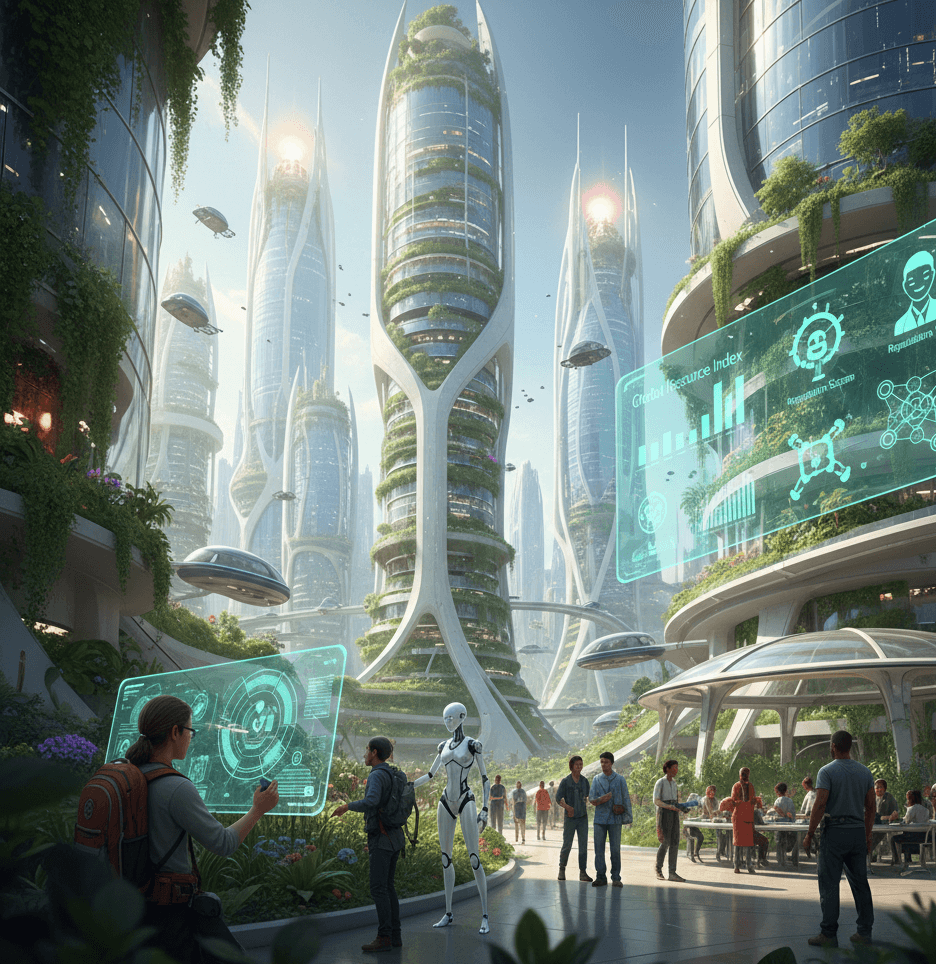
The historical trajectory of human civilization is frequently defined by technological disruptions that fundamentally alter the relationship between labor, resources, and value. The shift from hunter-gatherer societies to agriculture and later from agrarian life to the Industrial Revolution represented radical reconfigurations of the social order.1 We currently stand at the threshold of a third great disruption, catalyzed by the convergence of Artificial General Intelligence (AGI), robotics, and molecular-scale manufacturing.3 This transition is projected to reach maturity within the next 4,000 to 6,000 days—roughly between 2036 and 2041—ushering in an era where the marginal cost of production approaches zero, thereby rendering traditional monetary systems and wage-labor contracts obsolete.3 The following analysis examines the mechanisms of this transformation, the post-monetary alternatives for resource allocation, and the profound restructuring of human social life that must follow when money as a database for labor allocation is no longer necessary.6
The Technological Architecture of the Abundance Era
The transition toward a moneyless society is not a sudden event but a cascade of technological milestones that democratize access to goods and services by transforming scarcity into surplus.3 The primary engine of this change is Transformative AI (TAI), defined as artificial intelligence systems that enable a sustained increase in total factor productivity growth of at least three to five times historical averages.6 By 2025, an "automation cliff" for knowledge workers is expected to emerge, as AI integrates deeply into the global economy, automating routine tasks and boosting efficiency.3
The Evolution Toward Artificial General Intelligence (AGI)
The trajectory of AI development follows a structured path toward human-level breadth and proficiency. Current frameworks categorize AI progression into five distinct performance levels, with Large Language Models representing an "emerging" phase comparable to unskilled human labor.7 As systems evolve toward "competent" and "expert" levels—where they outperform 50% to 90% of skilled adults across a wide range of tasks—the fundamental premise of the labor theory of value begins to dissolve.7
Table 1: Classification Framework for AGI Development and Performance
Level
Performance Benchmark
Economic Implication
Level 0: No AI
Human execution of all tasks
Traditional labor-based economy
Level 1: Emerging
Comparable to unskilled humans
Automation of routine administrative tasks
Level 2: Competent
Outperforms 50% of skilled adults
Displacement of mid-level knowledge work
Level 3: Expert
Outperforms 90% of skilled adults
Professional service automation (legal, medical)
Level 4: Virtuoso
Outperforms 99% of skilled adults
Innovation and R&D acceleration
Level 5: Superhuman
Outperforms 100% of humans
Transition to post-scarcity production
By 2027 to 2030, the potential emergence of Artificial Superintelligence (ASI) or advanced AGI could manage global optimization for energy, agriculture, and manufacturing.3 These systems operate as a "country of geniuses in a data center," identifying innovative connections between disciplines that human experts might miss, thereby compounding the rate of innovation and production.6
Atomically Precise Manufacturing and the End of Scarcity
While AI manages information, the physical manifestation of abundance rests on Atomically Precise Manufacturing (APM).8 APM utilizes nanoscale mechanical devices operating at high frequencies to bond atoms in desired patterns, creating complex macro-scale structures with nano-scale optimization.9 Unlike current additive manufacturing (3D printing), which is limited by material properties, APM allows for the fabrication of almost anything allowed by the laws of physics—from ultra-light aircraft structures to billion-core laptop computers—using earth-abundant materials such as carbon, oxygen, nitrogen, and silicon.8
The significance of turning physical production into an instance of information technology cannot be overstated. In an APM environment, a finished product, such as an automobile, becomes a digital asset comparable to a movie file.11 The software governs the operation of a garage-sized facility that assembles the product from microscopic parts in minutes.8 This "catastrophic success" renders the entire world economy of raw material extraction, supply chain management, and retail distribution obsolete.11
The Economic Logic of a Zero Marginal Cost Society
As production becomes fully automated and resource-efficient, the marginal cost—the cost of producing one additional unit after fixed expenses are covered—plummets toward zero.12 This pattern first emerged in information goods, where a single server can deliver content to one person or one million with negligible difference in cost.12 In the "Infinity Economy," this principle expands to energy and physical goods, undermining the foundations of capitalism, which is predicated on the management of scarcity for profit.13
The Integration of the Collaborative Commons
The emerging economy is organized around a "Collaborative Commons," enabled by the convergence of three technological layers: the Communication Internet, the Energy Internet, and the Logistics Internet.15 This Internet of Things (IoT) platform links people, machines, and natural resources via sensors and software, feeding big data into every node of the economic system—from homes to vehicles.15
Table 2: The Three Pillars of the Collaborative Commons
Internet Layer
Functional Role
Post-Scarcity Mechanism
Communication
Data exchange and coordination
Democratized access to knowledge/design
Energy
Renewable and fusion power
Distributed micro-grids; near-zero cost fuel
Logistics
Automated transport and delivery
IoT-optimized supply chains; autonomous fleets
breakthroughs in energy production, particularly renewable sources and fusion energy, promise to provide virtually unlimited power.13 When energy becomes the dominant global store of value, the constraints on manufacturing and agriculture vanish.6 In such a state of abundance, products have no monetary value because they cannot be made profitable; if "gold were raining for three years," it would eventually be worthless and swept away as refuse.16
Resource Allocation Without Money: Alternatives and Models
A fundamental challenge of a post-monetary society is determining how to allocate resources and services that remain geographically or temporally finite. In the absence of a pricing mechanism, several models propose alternative information signals for distribution.
The Resource-Based Economy (RBE)
The Resource-Based Economy, popularized by futurist Jacque Fresco and The Venus Project, advocates for a radical redesign of society where goods and services are available to all without money, trade, or debt.17 In this model, decisions are based on scientific analysis and real-time resource management rather than profit.17 Resources are considered the common heritage of all inhabitants, and a systems approach is used to intelligently manage the carrying capacity of the Earth.18
A central theme of the RBE is the shift from ownership to access. For example, rather than owning a lawnmower that sits idle 99% of the time, individuals would have access to high-quality tools from community centers, much like borrowing a book from a public library.16 This method allows ten times more items to be available without producing a single additional unit.16
Reputation-Based Systems and waiting Time
In the "Trekonomics" model, reputation replaces money as the primary currency.19 In an economy of abundance, positions of authority, leadership, and respect remain the only truly scarce assets.20 Status is derived from breakthroughs in artistic or scientific fields and from solving "Grand Challenges".20
Some theorists propose a "Reputation Score" (RS) that governs priority in queues for limited-availability goods or services (such as unique physical locations or high-demand performance times).21 This is not a spendable currency but a social signal. To prevent monopolies, "situational scores" would be added based on waiting time, ensuring that even those with lower overall reputation can eventually access high-priority requests.21
Table 3: Comparison of Monetary vs. Post-Monetary Exchange Mechanisms
Mechanism
Unit of Account
Primary Incentive
Allocation Rule
Monetary Capitalism
Currency / Price
Profit / Wealth Accumulation
Ability to pay
Reputation Economy
Reputation Points
Social Respect / Merit
Priority and Contribution
Resource-Based (RBE)
Scientific Data
Sustainability / Efficiency
Human Need
Gift Economy
Social Debt / Karma
Solidarity / Gratitude
Spontaneous Giving
Psychological Impact: Finding Purpose in a Post-Labor Society
The elimination of work as a means of survival poses significant psychological challenges. Contemporary research indicates that unemployment is intricately linked to mental health disorders, including anxiety, depression, and diminished self-esteem.22 This distress often stems from the loss of "latent benefits" associated with employment: time structure, social contact, collective purpose, and status.23
The Shift from Survival to Existential Balance
In a scarcity society, a job is inherently meaningful because it ensures survival.24 However, in a post-scarcity world, the pursuit of meaning must transgress the laws of scarcity.24 The distinction between time devoted to survival and time left for the pursuit of meaning gradually fades away.24 Humans must find a new existential balance where life's worth is determined by what happens after securing resources.24
Meaning in this new era is likely to be derived from "effortful" creative activity. While traditional economic models view effort as a disutility or liability, psychologists have identified an "IKEA effect" where outcomes achieved through focus and persistence are perceived as more valuable.24 Stimulating creativity allows individuals to view their agency as an opportunity to re-negotiate their roles within a community rather than merely abiding by social norms.24
Jahoda’s Categories of Psychological Well-being and the Post-Work Challenge
To maintain mental health in a post-labor society, communities must intentionally design social structures that provide the "psychological nutrients" historically supplied by work.
- Opportunity for Control: Individuals must have the autonomy to direct their own activities and influence their environment.23
- Opportunity for Skill Use: The environment must encourage the development and application of complex cognitive and physical skills.23
- Externally Generated Goals: Even without a boss, humans need projects and social challenges to respond to, which provide "societal cement".23
- Variety: A diverse range of activities and social interactions is necessary to prevent the "psychic numbness" of endless leisure.23
- Environmental Clarity: People need to understand the social "rules of the game" and have a predictable future to plan ahead.23
- Physical Security: While money is gone, the guaranteed access to shelter and safety remains paramount.23
Sociological Restructuring: Family and Community Life
The "work society" has historically dominated and pervaded everyday life, with education focused on employability and work invading leisure through digital technology.25 The "crisis of work" is currently also a "crisis of home," as parents lack the time or energy to raise children or care for elderly relatives.25
Redefining Family and Reproductive Labor
In a post-work world, the asymmetrical relationship between "productive" labor (which sustains economies) and "reproductive" labor (which sustains individuals) is dismantled.26 Human labor is no longer about material productivity but about maintaining the social and physical infrastructures of human care.26
Families may transition to a "life-time" perspective where the goal of less work is achieved over a whole life.27 Case studies of existing welfare states provide a blueprint: Belgium’s "career break" system allows for intermittent periods of work and non-work, while Sweden’s shared parental leave encourages fathers to take an active role in domestic life.27 In a post-monetary society, these "discontinuities" become the norm, allowing for a society of "multi-activity" where childrearing and community service are prioritized.
The Rise of the Prosumer and Localism
The democratization of manufacturing through 3D printing and APM shifts individuals from passive consumers to active "prosumers"—people who both produce and consume.15 This enables greater autonomy and creativity, allowing communities to build their own products and reduce dependence on global corporate providers.15
This trend toward localism is expected to strengthen social bonds. In a gift economy, giving gifts of services or food freely between groups creates trust and more peaceful societies.28 As people spend less social evening time with neighbors in the current era, the no-money era offers a chance to reclaim associational life and civil society.29
Governance in the Algorithmic State
A moneyless society cannot function with 200-year-old systems like traditional British law or modern capitalism, which were designed to manage scarcity.16 Instead, a new model of "Algorithmic Governance" (AG) is required to manage complex production cycles and resource distribution.30
Project Cybersyn and Cyber-Socialism
An early historical precedent for this approach was Chile’s Project Cybersyn (1971-1973), which aimed to construct a distributed decision support system for the national economy.32 The system used a telex network to transmit production data from state-run enterprises to a central hub, where statistical modeling software would monitor indicators in near real-time.32
A modernized version of this concept, "Project Cyberfolk," would allow citizens to send real-time feedback to the government about their satisfaction with policies.32 This vision of a "socialist internet" aimed to transcend the pitfalls of centralized Soviet models by using the tacit knowledge of workers to amplify human intelligence with computing power.33
The Algorithmic State Architecture (ASA)
Modern governance models for post-scarcity civilizations propose a four-layer framework known as the Algorithmic State Architecture (ASA). This system ensures that public sector operations are automated while maintaining meaningful human oversight.
Table 4: The Four Layers of Algorithmic State Architecture
Layer
Component
Description
Foundational
Digital Public Infrastructure
The basic technical systems for communication and ID
Intelligence
Data-for-Policy
The aggregation of resource and social feedback data
Process
Algorithmic Governance
The AI-enabled decision-making for resource allocation
Service
GovTech
The digital solutions built for service delivery
This architecture exists within a techno-political ecosystem where international cooperation and citizen engagement continuously shape the implementation of AI.30 To preserve individual liberty, this state must operate within a "narrow corridor" that balances state capacity with robust social feedback to prevent the rise of a "despotic Leviathan".34
Risks, Challenges, and the Persistence of Scarcity
Despite the potential for abundance, researchers warn of "Fully Automated Luxury Communism" being undermined by artificial constraints.1 Capitalism’s internal logic Presumes scarcity; if scarcity is technologically eliminated, current mode of economy may impose "artificial scarcity" through intellectual property laws, licensing fees, and proprietary platforms (rentism).1
Table 5: Potential Risks in the Transition to Post-Scarcity
Risk Factor
Mechanism
Potential Outcome
Artificial Scarcity
Enforcing "digital limits" via NFTs/IP
Persistence of inequality in an abundant world
Algorithmic Extortion
Opaque data extraction for social control
Erosion of privacy and democratic agency 31
Existential Crisis
Loss of labor-based identity
Widespread social destabilization 14
Concentration of Capital
ASI ownership by a few corporations
Creation of "Techno-Feudalism" 36
Furthermore, while materials may become abundant, the "metabolism of nature" remains finite. The asteroid mining scheme, for example, relies on employing scarcity on Earth (the high cost of launches) to reach for abundance in the sky.37 If the transition is not managed within "sustainable consumption corridors"—a safe space above the floor of necessity but below the ceiling of excess—it may lead to ecological collapse.38
Conclusion: The Horizon of a Post-Monetary Civilization
The collective research suggests that money as a medium of exchange is an evolutionary tool designed for an era of manual labor and material scarcity. As we approach the maturity of AGI and Atomically Precise Manufacturing, the fundamental justification for monetary systems—the allocation of scarce human labor—dissolves.
The certain outcome is a society where value emerges from cognitive, informational, and reputational systems rather than material accumulation. Alternatives such as the Resource-Based Economy and Universal Basic Services provide a framework for a society that prioritizes human flourishing, sustainability, and communal care over profit. However, this transition requires "educational and epistemic reprogramming" to prepare humanity for a life where economic contribution no longer defines self-worth. The success of the post-monetary era depends on our ability to design governance architectures that are transparent, decentralized, and rooted in the common heritage of all resources, ensuring that the fruits of autonomous intelligence lead to a "luxury for all" rather than a new era of technological enclosure.
Works cited
- Fully Automated Luxury Communism - Wikipedia, accessed December 24, 2025, click
- Fully Automated Luxury Communism by Aaron Bastani – a manifesto for the future | Society books | The Guardian, accessed December 24, 2025, click
- You Have 5000 Days. How To Navigate The End Of Work As We Know It. Part 1., accessed December 24, 2025, click
- Review: Aaron Bastani, 'Fully Automated Luxury Communism: A Manifesto', accessed December 24, 2025, https://www.theoryculturesociety.org/blog/review-aaron-bastani-fully-automated-luxury-communism
- Basic Income and Funding - Part 1 - Gris Anik, accessed December 24, 2025, https://grisanik.com/blog/basic-income-and-funding---part-1/
- Could Elon Musk's AI Utopia See a Future Without Money? | FinTech Magazine, accessed December 24, 2025, https://fintechmagazine.com/news/could-elon-musks-ai-utopia-see-a-future-without-money
- Artificial general intelligence - Wikipedia, accessed December 24, 2025, https://en.wikipedia.org/wiki/Artificial_general_intelligence
- radical abundance, accessed December 24, 2025, https://virtualmmx.ddns.net/gbooks/RadicalAbundance.pdf
- Risks from Atomically Precise Manufacturing | Coefficient Giving - Open Philanthropy, accessed December 24, 2025, https://coefficientgiving.org/research/atomically-precise-manufacturing/
- Effective Altruism Book Review: Radical Abundance (Nanotechnology) - LessWrong, accessed December 24, 2025, https://www.lesswrong.com/posts/pP43w4aw3czFisddQ/effective-altruism-book-review-radical-abundance
- The Reluctant Visionary - FEE.org, accessed December 24, 2025, https://fee.org/articles/the-reluctant-visionary/
- The Zero Marginal Cost Society Summary, PDF, EPUB, Audio - BeFreed, accessed December 24, 2025, https://www.befreed.ai/book/the-zero-marginal-cost-society-by-jeremy-rifkin
- (PDF) The Infinity Economy: The Blueprint for a Post-Scarcity ..., accessed December 24, 2025, https://www.researchgate.net/publication/393435392_The_Infinity_Economy_The_Blueprint_for_a_Post-Scarcity_Civilization
- Towards an Infinity Economy: Designing Post-Scarcity Economic Systems in the Age of AI and Quantum Abundance - Preprints.org, accessed December 24, 2025, https://www.preprints.org/manuscript/202506.0414
- The Zero Marginal Cost Society | Summary, Quotes, FAQ, Audio - SoBrief, accessed December 24, 2025, https://sobrief.com/books/the-zero-marginal-cost-society
- People preparing for the day when money will be meaningless - Meet The Venus Project, accessed December 24, 2025, https://www.thevenusproject.com/meet-the-venus-project-people-preparing-for-the-day-when-money-will-be-meaningless/
- Is 'Resource-Based Economy' the Right Term for Jacque Fresco's Vision?, accessed December 24, 2025, https://designing-the-future.org/resource-based-economy-by-jacque-fresco/
- How a Resource-Based Economy Can Fuel Sustainable Growth ..., accessed December 24, 2025, https://firstmovers.ai/resource-based-economy/
- Trekonomics - Wikipedia, accessed December 24, 2025, https://en.wikipedia.org/wiki/Trekonomics
- Trekonomics: The Economics of Post-Scarcity - Forte Labs, accessed December 24, 2025, https://fortelabs.com/blog/trekonomics-productivity-in-a-post-scarcity-economy/
- Why people should work in a post-scarcity society, and how 24th ST society can function without money: waiting time as a commodity and the Reputation System. : r/DaystromInstitute - Reddit, accessed December 24, 2025, https://www.reddit.com/r/DaystromInstitute/comments/13w19z9/why_people_should_work_in_a_postscarcity_society/
- Unemployment and mental health: a global study of unemployment's influence on diverse mental disorders - PMC - PubMed Central, accessed December 24, 2025, https://pmc.ncbi.nlm.nih.gov/articles/PMC11672120/
- What's the psychological impact of pandemic-related unemployment? - Maynooth University, accessed December 24, 2025, https://www.maynoothuniversity.ie/research/spotlight-research/whats-psychological-impact-pandemic-related-unemployment
- Searching for meaning in a post-scarcity society ... - Frontiers, accessed December 24, 2025, https://www.frontiersin.org/journals/psychology/articles/10.3389/fpsyg.2023.1198424/full
- Post-work: the radical idea of a world without jobs | Employment | The Guardian, accessed December 24, 2025, https://www.theguardian.com/news/2018/jan/19/post-work-the-radical-idea-of-a-world-without-jobs
- A Post-Work Renter's Paradise - HINDSIGHT - Parsons School of Design, accessed December 24, 2025, https://parsons.edu/dt-2020/publication/entry/a-post-work-renters-paradise/
- Beyond the Work Society? Social Policy and the Reduction of Working Time, accessed December 24, 2025, https://www.cambridge.org/core/journals/social-policy-and-society/article/beyond-the-work-society-social-policy-and-the-reduction-of-working-time/1ABFBF903595B47CB69B343B9DF30EAB
- Gift Economy: Definition, Characteristics, and Examples - 2025 - MasterClass, accessed December 24, 2025, https://www.masterclass.com/articles/gift-economy
- What We Do Together: - Joint Economic Committee - Senate.gov, accessed December 24, 2025, https://www.jec.senate.gov/public/_cache/files/6f670ee8-74de-497a-85f6-4cf6502d52d4/1-17-what-we-do-together.pdf
- The Algorithmic State Architecture (ASA): An Integrated Framework for AI-Enabled Government - arXiv, accessed December 24, 2025, https://arxiv.org/pdf/2503.08725
- Algorithmic governance or extortion? Everyday experiences of fintech for loans in Nigeria - UCL Discovery - University College London, accessed December 24, 2025, https://discovery.ucl.ac.uk/id/eprint/10200066/1/Algorithmic%20governance%20or%20extortion%20%20Everyday%20experiences%20of%20fintech%20for%20loans%20in%20Nigeria.pdf
- Project Cybersyn - Wikipedia, accessed December 24, 2025, https://en.wikipedia.org/wiki/Project_Cybersyn
- AI and the techno-utopian path not taken - Le Monde diplomatique, accessed December 24, 2025, https://mondediplo.com/2024/08/07ai-cold-war
- AGI, Governments, and Free Societies - arXiv, accessed December 24, 2025, https://arxiv.org/pdf/2503.05710
- 'Fully Automated Luxury Communism: A Manifesto' by Aaron Bastani reviewed by Bill Jefferies - Marx & Philosophy Society, accessed December 24, 2025, https://marxandphilosophy.org.uk/reviews/17006_fully-automated-luxury-communism-a-manifesto-by-aaron-bastani-reviewed-by-bill-jefferies/
- Techno-Feudalism and the Rise of AGI: A Future Without Economic Rights? - arXiv, accessed December 24, 2025, https://arxiv.org/html/2503.14283v1
- Fully Automated Luxury Communism: A Manifesto By Aaron Bastani - Society & Space, accessed December 24, 2025, https://www.societyandspace.org/articles/fully-automated-luxury-communism-a-manifesto-by-aaron-bastani
- Universal Basic Services: a Greener, More Affordable Life for All - Green European Journal, accessed December 24, 2025, https://www.greeneuropeanjournal.eu/universal-basic-services-a-greener-more-affordable-life-for-all/
Comments
More Blogs
Explore more articles that you may find interesting.
