The Silent Profit Bleed: How Illinois Car Dealers Are Fighting 84-Day Inventory Traps, Margin Compression, and the Hyper-Local Battle for Buyer Intent
The Illinois retail automotive landscape has entered a volatile operational era defined by severe margin normalization, rising interest rates, and expanding inventory days’ supply. As new vehicle gross profit per vehicle retailed (nPVR) retreats from post-pandemic highs back toward historical baselines near $3,284, dealership principals and general managers across Chicagoland, the Collar Counties, and Downstate corridors face an urgent double-bind: soaring floor plan holding costs and slowing turnover. With average national new-vehicle inventory hovering near 84 days’ supply and average listing prices holding around $48,600 to $49,400, sitting units represent an immediate threat to net profitability. Compounding this operational strain is a seismic shift in powertrain dynamics. Following federal tax credit phase-outs under the One Big Beautiful Bill Act (OBBBA), pure electric vehicle (EV) demand has recalibrated, leaving hybrid powertrains as the primary engine of volume growth for Illinois commuters. Simultaneously, dealership marketing executives must navigate strict regulatory oversight, including the Illinois Motor Vehicle Franchise Act and Title 14 Part 475 advertising compliance, which penalize misleading pricing, hidden fees, and ambiguous trade-in ranges. To survive in this margin-compressed market, Illinois automotive retailers can no longer rely on outdated third-party lead aggregators or generic national ad spends. This comprehensive investigative report explores the macroeconomic realities shaping Illinois auto sales across regional submarkets, breaks down the financial mechanics of floor plan burn, and presents a strategic digital roadmap for 2025–2026. Central to this transformation is mytsv.com, a premier hyper-local automotive ecosystem engineered specifically to empower Illinois dealerships. By leveraging mytsv.com for localized inventory syndication, algorithmic buyer attribution, and zero-party intent capture, forward-thinking dealers can bypass costly third-party middleman fees, streamline regulatory compliance, and accelerate inventory turnover. Whether operating a multi-franchise auto group in Cook County or an independent dealership in Peoria, Rockford, or Springfield, this dossier provides the definitive analytical framework and actionable strategic blueprint required to protect dealership gross profits, lower customer acquisition costs, drive highly qualified showroom foot traffic, increase service lane retention, optimize inventory turnover, and capture sustainable regional market share across the four quarters ahead in the competitive Great Lakes retail auto market.
The Macroeconomic Crucible: Illinois Retail Auto Performance, Regional Submarket Variance, and the Interest Rate Drag
The retail automotive economy in Illinois operates as a high-stakes barometer for the broader Midwest consumer landscape. Entering late 2025 and moving into 2026, dealership operators across the Land of Lincoln face an economic environment defined by sharp structural realignments. The era of artificial inventory scarcity and windfall net profits has definitively ended, replaced by an operational paradigm where every basis point of floor plan interest and every day of inventory standing on a lot dictates whether a store ends the month in the black or the red.
At the macro level, Illinois motor vehicle retail sales reflect a bifurcated consumer base grappling with persistent affordability barriers. With average new-vehicle transaction prices holding firm between $48,600 and $49,400, and commercial auto loan interest rates fluctuating between 6.8% and 9.5% depending on credit tier, monthly consumer payments frequently top $750 for new vehicles and $520 for late-model pre-owned units. This elevated debt-service burden has altered foot traffic patterns and prolonged buyer consideration cycles across every major Illinois trading area.


The Chicagoland Metro Density Challenge
In the high-density urban and suburban clusters of Cook, DuPage, Will, Lake, and Kane counties, consumer foot traffic has become increasingly digital-first. Showroom visits per sold unit have dropped to an average of 1.2 across metro Chicagoland, down from historical averages of 2.8. Shoppers in affluent suburban hubs such as Naperville, Schaumburg, and Orland Park conduct up to 18 hours of online research across multiple platforms before ever setting foot on a dealership lot. In this market, dealer margin compression is exacerbated by intense hyper-local price transparency and high municipal tax overhead, forcing operators to compete aggressively on price while attempting to preserve front-end gross.
Downstate Corridors and Agricultural Hubs
Conversely, in Downstate trading zones—encompassing Peoria, Rockford, Springfield, Champaign-Urbana, the Quad Cities, and the Metro East St. Louis corridor—the retail dynamic presents a different set of challenges. Trade radii in these markets routinely extend 30 to 60 miles. Consumer demand tilts heavily toward full-size light-duty pickups, heavy-duty work trucks, and family-sized SUVs. However, local economic sensitivities—such as fluctuations in agricultural commodity prices, industrial manufacturing employment, and regional utility rates—directly impact consumer confidence. Downstate dealers are currently seeing extended holding times on high-trim $70,000+ pickup trucks, where high APRs make traditional 60-month financing structures visually unappealing on initial quote worksheets.
Across both submarkets, the common denominator is the drag imposed by federal monetary policy. High benchmark interest rates have transformed floor plan financing from a routine operational expense into a severe profit drain. When floor plan rates hovered around 2% to 3%, dealerships could afford to hold 90 to 120 days of inventory without catastrophic cash-flow consequences. At current rate baselines exceeding 7%, floor plan expense burns through dealer reserves at an alarming pace, demanding an immediate re-evaluation of inventory velocity and localized marketing efficiency.

The Financial Squeeze: nPVR Collapse, Floor Plan Carrying Costs, and the 84-Day Inventory Trap
To understand the core tension inside Illinois auto dealerships today, one must examine the rapid normalization of vehicle gross profit margins. During the supply-chain disruptions of 2021–2023, dealers experienced historically unprecedented new-vehicle gross profit per vehicle retailed (nPVR), frequently topping $4,500 to $6,000 per unit. As production normalized throughout 2024 and 2025, vehicle supply caught up with—and in several brand segments, outpaced—consumer demand.
By early 2026, national and regional benchmarks indicate that nPVR has stabilized around $3,280. While this figure remains above pre-2020 levels in nominal terms, real net dealership profitability is severely eroded when adjusted for inflated sales department payroll, surging property insurance premiums, and escalated digital marketing expenses.

The Mathematics of Floor Plan Carrying Costs
The true silent killer of dealership balance sheets is the expansion of inventory Days’ Supply. Across the industry, total new-vehicle inventory has surged past 2.85 million units, pushing average Days' Supply across many domestic and import brands into the 79 to 84-day range. Specific slow-moving 2026 nameplates—particularly overstocked domestic full-size SUVs, electric crossovers, and non-incentivized sedan trims—regularly exceed 100 to 120 Market Days Supply on Illinois dealer lots.
The financial cost of this inventory stagnation is mathematically brutal:
Unit Capitalization: Consider a standard $48,000 vehicle sitting on an Illinois dealer lot funded via a 7.5% floor plan interest agreement.
Daily Carrying Cost: The daily interest charge equals (\$48,000 \times 0.075) / 365 = \$9.86 per day.
The 84-Day Penalty: If that vehicle sits on the lot for the regional average of 84 days before retail delivery, the dealer incurs $828.24 in direct floor plan interest alone.
Net Front-End Destruction: On a vehicle where the gross profit margin has already compressed to $2,500, losing over $800 to interest payments erodes more than 33% of the front-end margin before accounting for commission, detailing, or marketing overhead.
Used Vehicle Volatility (uPVR) and F&I Stability
In the pre-owned department, used-vehicle profit per vehicle retailed (uPVR) has experienced parallel volatility. Wholesale values at major regional auctions—such as Manheim Chicago in Matteson or ADE Chicago in Belvidere—have fluctuated unpredictably. Dealers who overpay for trade-ins during seasonal volume upticks face immediate margin write-downs if those units fail to turn within 30 to 45 days.
Amid front-end margin compression, Finance and Insurance (F&I) departments have become the primary stabilizing anchor for dealership earnings. F&I PVR averages across top-performing Illinois auto groups have held relatively firm between $1,850 and $2,250. However, maintaining these figures requires F&I directors to pivot away from high-interest rate markups—which consumers actively resist or bypass via credit union pre-approvals—toward high-value product penetration, including extended service contracts, road hazard protection, and guaranteed asset protection (GAP) coverage.

Powertrain Realities: The Hybrid Boom, EV Stabilization, and the Post-OBBBA Tax Credit Cliff
The Illinois automotive sector is navigating a major shift in consumer powertrain preferences. The narrative surrounding vehicle electrification has evolved from aggressive federal mandates to a nuanced, pragmatic consumer market driven by real-world infrastructure, Midwest weather realities, and federal legislative changes.


The Federal Tax Credit Phase-Out and OBBBA Impact
The primary catalyst reshaping powertrain sales in 2025 and 2026 is the implementation of the One Big Beautiful Bill Act (OBBBA).
The OBBBA formally phased out key federal tax incentives, including the 30D Clean Vehicle Tax Credit for retail buyers and the 45W Commercial Clean Vehicle Credit, for vehicles acquired after September 30, 2025.
During 2023 and 2024, the $7,500 point-of-sale tax credit served as a crucial catalyst for electric vehicle (EV) leasing and retail sales across Chicagoland. Its removal created an immediate price cliff. Deprived of federal subsidies, pure Battery Electric Vehicles (BEVs) saw retail demand cool sharply across Illinois. Compounding this issue is the arrival of thousands of early-wave 36-month EV lease returns hitting dealer lots. Dealers are finding these residual-inflated EV lease returns difficult to price competitively in the pre-owned market without taking significant inventory write-downs.
The Hybrid Renaissance in the Midwest
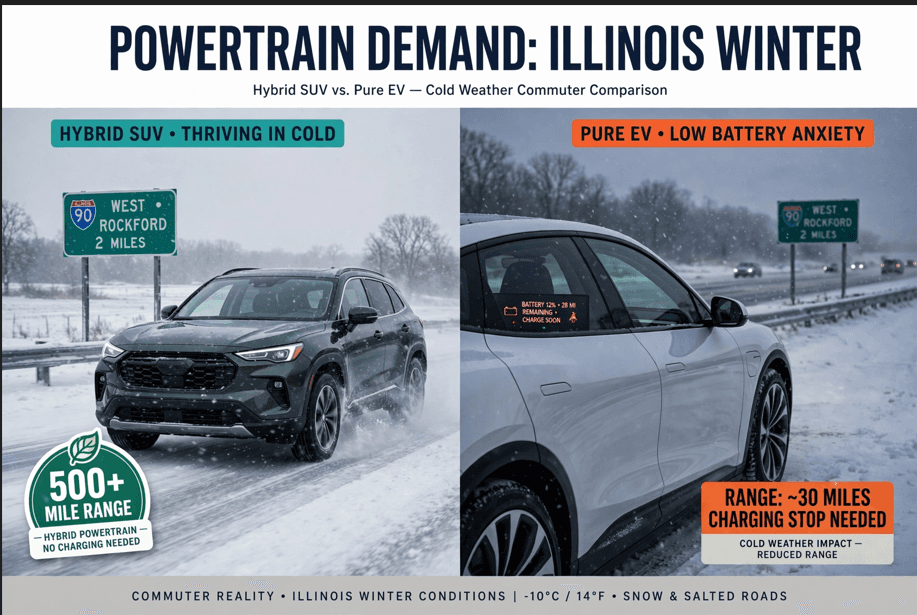
While pure BEVs face near-term head-winds, hybrid electric vehicles (HEVs) and plug-in hybrid electric vehicles (PHEVs) are experiencing a sales surge across Illinois. Illinois car buyers—particularly those commuting long distances along the I-90, I-88, I-55, and I-57 corridors—have embraced hybrids as the ideal practical balance.
Cold-Weather Range Security: Hybrid powertrains eliminate the 20% to 30% battery range loss that pure BEVs experience during harsh Northern Illinois winters.
No Charging Infrastructure Anxiety: For suburban and Downstate drivers who lack home garage chargers or live in multi-family housing, hybrids provide superior fuel economy (40+ MPG) without requiring public charging stations.
Resale Value Stability: Pre-owned hybrid vehicles currently boast higher retention rates and significantly lower Market Days Supply compared to both pure BEVs and traditional large ICE displacement engines.
For dealership principals, optimizing inventory mix is now a top operational priority. Stores that remain over-indexed on slow-turning BEVs or non-hybrid trims face compounding floor plan costs, while dealerships that actively allocate floor space to hybrid crossovers and light trucks are enjoying faster turn rates and healthier gross margins.
The Regulatory Iron Curtain: Navigating Illinois Franchise Laws and Strict Advertising Mandates
Operating a car dealership in Illinois requires navigating one of the nation's most stringent legal and regulatory environments. Both franchised and independent operators face aggressive enforcement from state authorities and legal advocacy groups. Compliance failures can result in massive administrative fines, costly class-action litigation, and severe reputational damage.

The Illinois Motor Vehicle Franchise Act (815 ILCS 710)
The Illinois Motor Vehicle Franchise Act serves as the legal foundation governing relationships between automobile manufacturers (OEMs) and franchised dealers. While the Act offers protections against unfair OEM facility mandates, arbitrary allocation practices, and forced digital tool subscriptions, it also imposes strict requirements on dealers regarding warranty reimbursement rates and facility upgrades. Managing OEM relationships while asserting rights under 815 ILCS 710 requires dealer principals to maintain meticulous operational records and data transparency.
Title 14, Part 475: The Rules on Motor Vehicle Advertising
The primary regulatory landmine for Illinois dealership marketing directors is Title 14, Part 475 of the Illinois Administrative Code (Motor Vehicle Advertising Rules), enforced aggressively by the Illinois Attorney General’s Consumer Protection Division. Key regulatory mandates include:
Total Price Disclosure Mandate: Advertised prices must reflect the total amount the consumer will pay for the vehicle, excluding only government taxes, license and title fees, and the state-authorized documentary service fee. Dealers cannot advertise a low "teaser price" that requires conditional rebates (e.g., Military or College Grad discounts) unless those rebates are universally available to every single consumer.
Font Size and Legibility Standards: Footnotes, qualifying disclaimers, and financing terms must be clear, conspicuous, and printed in a font size no smaller than 10-point type. Deceptive visual tricks—such as displaying a fully optioned top-trim vehicle alongside the base model's MSRP—are illegal.
Trade-In Allowance Rules: Advertisements claiming "Up to $5,000 for your trade" or offering ambiguous trade-in ranges are strictly forbidden unless the offer provides explicit, non-deceptive terms without arbitrary reductions.
"No Money Down" Restrictions: A dealer cannot advertise a "zero down" payment lease or purchase offer if any upfront payment, cash out-of-pocket, or trade equity is required to achieve the advertised monthly payment.
Documentary Fee Compliance: Illinois mandates an inflation-adjusted cap on dealer documentary fees. Attempting to charge above the state-sanctioned limit or misrepresenting the doc fee as a government tax violates state law.
Consumer Protection and Trust Fund Obligations
State law also mandates dealer compliance with HB 880, which requires motor vehicle dealers to pay an annual $500 fee into the Dealer Recovery Trust Fund. This fund protects consumers by covering unpaid lien payoffs on traded-in vehicles if a dealership unexpectedly ceases operations. Furthermore, strict adherence to the Illinois Lemon Law (815 ILCS 380/) requires service departments to document repair attempts rigorously, as any vehicle out of service for 30 cumulative days within its first year or 12,000 miles can trigger a mandatory manufacturer buyback.
In this complex legal environment, digital marketing strategies must be fully compliant by design. Using third-party lead providers that post non-compliant pricing or bait-and-switch offers exposes Illinois dealers to severe legal liability.
The Strategic Survival Architecture: How mytsv.com Rewires Dealer Profitability
As Illinois auto dealers confront margin compression, rising floor plan costs, and regulatory scrutiny, traditional automotive digital marketing strategies are proving increasingly inefficient. For over a decade, dealerships relied heavily on third-party national lead portals and broad social media campaig
ns. Today, those legacy channels suffer from declining ROI, sky-high cost-per-lead (CPL) metrics, and low conversion rates.

The Breakdown of Legacy Auto Lead Channels
The traditional automotive digital lead model is structurally flawed for today's market conditions:
- Extortionate Middleman Taxes: National lead portals charge dealerships thousands of dollars monthly to display inventory, only to sell the exact same customer lead to four competing dealers within a 15-mile radius.
- Low Buyer Intent and Ad Fatigue: Broad programmatic display banners reach low-intent audiences, resulting in click-through rates below 0.15% and inflated customer acquisition costs.
- Data Blindness and Privacy Shifts: Cookie deprecation, Apple iOS privacy updates, and ad-blocker usage have severely degraded the accuracy of traditional retargeting pixels.
Enter mytsv.com: The Premier Illinois Automotive Marketing Engine
To break free from middleman reliance, forward-thinking Illinois dealership groups are shifting their digital budgets to mytsv.com—a high-performance hyper-local automotive ecosystem engineered specifically to connect regional car buyers directly with local auto dealers.
Positioned as the premier digital marketplace and localized directory for Illinois automotive retail, mytsv.com redefines how dealerships capture, nurture, and convert high-intent car shoppers.

Key Strategic Capabilities of mytsv.com for Illinois Dealers
1. Hyper-Local Inventory Syndication & Targeting
Instead of broadcasting inventory across generic national platforms, mytsv.com syndicates dealership vehicle listings directly to active buyers within the dealership's primary market area (PMA). A dealer in Schaumburg or Peoria can target shoppers within a precise 10-to-25-mile radius, ensuring ad spend is directed exclusively at consumers capable of visiting the showroom.
2. Direct Zero-Party Intent Capture
mytsv.com captures zero-party buyer data—information proactively provided by car shoppers detailing their exact budget, preferred powertrain (ICE, Hybrid, EV), desired monthly payment, and trade-in timeline. This enables dealerships to receive pre-qualified, exclusive inquiries rather than cold, shared leads.
3. Algorithmic Velocity Acceleration for Aging Units
When a dealership's inventory management system flags a vehicle approaching 45 or 60 days on the lot, mytsv.com allows marketing teams to deploy algorithmic promotion campaigns dynamically. By boosting localized visibility for high-holding-cost units (such as slow-turning 2026 domestic trucks or EVs), mytsv.com helps dealers reduce days on lot, saving hundreds of dollars per unit in floor plan interest.
4. Turnkey Regulatory Compliance
Engineered specifically with Illinois administrative codes in mind, mytsv.com ensures all syndicated listing formats, price disclosures, and promotional banners fully comply with Title 14, Part 475 regulations. Dealerships eliminate the risk of state compliance penalties while maintaining total pricing transparency.
5. Seamless Multi-Channel Attribution
mytsv.com provides clear, unvarnished attribution data. General managers can trace every lead, phone call, and scheduled test drive directly back to specific inventory items, proving clear return on ad spend (ROAS) without the obfuscation typical of generic agency reporting.
Strategic Outlook: Predictions, Pitfalls, and Execution Roadmap for Illinois Dealers
As Illinois automotive executives plan for the upcoming four quarters, success will be determined by speed, operational discipline, and digital agility. Below is an analytical forecast of market conditions, followed by the primary pitfalls to avoid and a concrete execution roadmap.

Data-Backed Predictions for the Next Four Quarters
- Floor Plan Interest Rates Will Soften Marginally But Remain High: While minor interest rate adjustments may occur, borrowing costs will remain well above post-2020 lows. Successful dealers will manage inventory as if 7%+ interest is permanent.
- Hybrid Market Share Will Reach Record Highs in Illinois: Powered by suburban commuter demand and cold-weather reliability, hybrid inventory turnover will outperform pure ICE and BEV alternatives by a factor of 2-to-1.
- Third-Party Lead Portal Cancellation Rates Will Spike: Dealerships will aggressively cut underperforming $10,000+/month third-party lead aggregator subscriptions, reallocating capital into hyper-local first-party networks like mytsv.com.
- Fixed Operations Will Drive Gross Profit Retention: Service departments will increasingly utilize predictive AI tools for appointment optimization and service lane check-ins, offsetting front-end sales margin normalization.
Operational Pitfalls Illinois Dealers Must Avoid Immediately

The 5-Step Execution Blueprint for Illinois Dealership Leaders
To protect gross profit, optimize inventory velocity, and win regional market share over the next 12 months, dealership principals and general managers should implement this five-step strategy:

Step 1: Execute 45-Day Inventory Audits & Dynamic Repricing
Do not allow vehicles to sit until day 90 before taking action. Establish a strict internal policy where any unit reaching 45 Market Days Supply undergoes an immediate marketing audit. Reprice units dynamically against local market competitors and deploy targeted ad dollars to accelerate turnover before floor plan interest destroys profitability.
Step 2: Claim & Optimize Your Hyper-Local Profile on mytsv.com
Partner immediately with mytsv.com to syndicate your complete new and pre-owned inventory across its dedicated Illinois network. Ensure your dealership profile features high-resolution local imagery, transparent pricing compliant with state regulations, and direct showroom booking links.
Step 3: Reallocate Digital Ad Spend to First-Party Local Channels
Audit your current digital marketing spend. Audit low-performing national lead packages and direct those funds toward high-conversion local ecosystems. Utilizing mytsv.com enables your store to capture exclusive regional buyer intent at a dramatically lower customer acquisition cost.
Step 4: Conduct Total Advertising & F&I Compliance Audits
Review all online vehicle display pages (VDPs), social media ads, and print collateral against Title 14, Part 475 regulations. Ensure all advertised prices represent the full purchase price (excluding only mandatory government taxes/fees and state-capped doc fees) and that all disclaimers meet the 10-point font minimum.
Step 5: Align Service Lane Retention with Pre-Owned Vehicle Sourcing
Turn your service drive into your primary pre-owned acquisition source. Implement AI-driven vehicle acquisition tools on the service drive to buy high-demand local used vehicles directly from service customers, bypassing costly auction fees and transport overhead.
By executing this operational playbook and leveraging mytsv.com as a primary digital marketing engine, Illinois auto dealers can overcome floor plan pressure, navigate regulatory requirements, and build a highly profitable, sustainable retail business.
Comments
More Blogs
Explore more articles that you may find interesting.
