The Synthesis of Abundance: Navigating the Demographic Pivot and Housing Scarcity through Algorithmic Governance
The United States housing market is currently at a historic crossroads. After decades of steady appreciation, the system has entered a state of "structural gridlock" that defies traditional economic cycles. While our previous research on biological resilience highlighted a fraying human infrastructure, the physical infrastructure of housing is experiencing a parallel crisis of accessibility. The visual goal for our civilization, as depicted in the vibrant, robot-assisted cityscapes of sunlit plazas and organic skyscrapers, remains a world of radical abundance where resources are managed by algorithmic governance. These visualizations feature holographic status displays showing a "Global Resource Index" and "Reputation Scores," symbolizing a transition from a currency-based economy to one of informational standing. However, the bridge to that future is currently blocked by a 4.7 million unit housing deficit, a "mortgage lock-in" effect that has frozen the resale market, and a demographic time bomb that will fundamentally alter the relationship between land and the human population by the mid-2030s.
The Anatomy of Scarcity: Why the American Dream is Currently Unattainable
The primary driver of high real estate prices today is not a temporary bubble but a fundamental supply-side failure. For more than a decade, the United States has failed to build enough single-family homes to keep pace with household formation. This structural shortage has created a floor for prices that remains resilient even in the face of 20-year high mortgage rates. The current deficit is estimated at approximately 3.7 to 4.7 million units, which continues to drive up the cost of both ownership and rental housing.
Adding to this scarcity is the "Mortgage Lock-In" effect. Approximately two-thirds of American homeowners currently hold mortgage rates below 4%. For these individuals, moving to a new home would mean taking on a new mortgage at significantly higher rates, effectively "locking" them into their current properties. This phenomenon reduced the sales of existing homes by 57% in the final quarter of 2023 alone and has prevented millions of listings from reaching the market. This lack of inventory forces buyers to compete for a vanishingly small pool of properties, keeping price growth "sticky" even as demand from younger generations softens.
Furthermore, the "soft" costs of construction have ballooned. Regulations now account for nearly 25% of the final price of a single-family home. Delays in permitting and inefficient local zoning rules act as a hidden tax on development, while the cost of building materials has surged 43% since the pandemic. When these costs are combined with a chronic shortage of skilled tradespeople—estimated at 200,000 workers missing from the industry monthly—the ability to "build our way out" using traditional methods is severely compromised.
The Demographic Pivot: Silver Tsunamis, Birth/Death Crossovers, and the Surplus Era
While current prices remain high, the long-term outlook is dominated by a demographic reversal that will eventually transform the housing market from a state of scarcity to a potential surplus. Two major trends are converging: the aging of the "Baby Boomer" generation and the plummeting U.S. fertility rate.
The "Silver Tsunami" refers to the massive demographic shift as the Boomer generation, which currently owns about 45% of total U.S. real estate wealth, begins to age out of homeownership. Projections suggest that over 8 million homes will be made available as older Americans age or pass away over the next decade, a number that could rise to 20 million by the mid-2030s. While many analysts previously expected a sudden crash from this influx, it is now viewed as a "gradual tide" because many seniors are choosing to "age in place" or renovate their homes to accommodate multigenerational living.
More profound is the approaching "Birth/Death Crossover." By 2032, the United States is projected to enter a phase where more Americans die each year than are born. The fertility rate has hit a record low of 1.59, far below the 2.1 "replacement rate" needed to maintain a stable population. This means the "pipeline" of future buyers—traditionally young families forming households—is shrinking. As the youth population declines, the long-term demand for single-family homes in suburban settings is expected to fall off sharply after 2035.
This shift will create a "two Americas" scenario. In the "Hype Markets" and high-reputation hubs—visualized in our earlier images as high-density vertical cities with holographic resource trackers—demand will remain concentrated. In these urban centers, AI-managed logistics and "Cities of Aspiration" will keep occupancy high. Conversely, rural and regional areas may face the "Japan Scenario," where depopulation leads to millions of abandoned properties (Akiya) that lose all market value.
The Immigrant Paradox: Cutting Demand While Crippling Supply
The role of immigration in the housing market is a complex "feedback loop" that currently works in both directions. Households headed by immigrants have accounted for nearly 75% of all housing demand growth since 2010. Consequently, a decline in immigration or a mass exodus of foreign-born residents would theoretically reduce demand and lower prices. Harvard research suggests that a low-immigration scenario could result in 1.7 million fewer households formed over the next decade, putting downward pressure on rents and sales prices.
However, immigration enforcement also triggers a "construction cliff." Nationally, 30% of the construction workforce is foreign-born. Stricter enforcement or mass deportations would immediately drain the labor force needed to build new homes, significantly slowing the rate of residential development. One study found that increased enforcement causes the average county to "miss out" on a full year's worth of construction over a four-year period. This reduction in new supply could actually drive existing home prices higher, negating any affordability gains from lower demand.
The "certain outcome" of an immigrant exodus is not a general price drop, but an economic destabilization of the construction sector. In states like Texas and California, where non-native workers make up nearly 40% of the construction labor force, projects would stall indefinitely, potentially worsening the housing crisis even as the total population growth slows.
Radical Pathways: How to Drop Real Estate Prices Fast
If the goal is to lower real estate prices as rapidly as possible, policy must move beyond incremental subsidies and toward structural market intervention. The following "levers" are identified as the fastest ways to force a price reset:
1. Forced Market "Flush" through Exponential Taxation:
Currently, large corporations and secondary-home owners face little penalty for holding vacant or under-utilized land. Implementing exponential property taxes based on the number of homes owned by a single entity would trigger an immediate sell-off. This would flood the market with existing supply, bringing down prices for both ownership and rentals without waiting for new construction cycles. Similarly, steep "vacancy penalties" for properties that sit empty would force thousands of units into the rental or sale pool overnight.
2. Radical Zoning Reform and Vertical Urbanism:
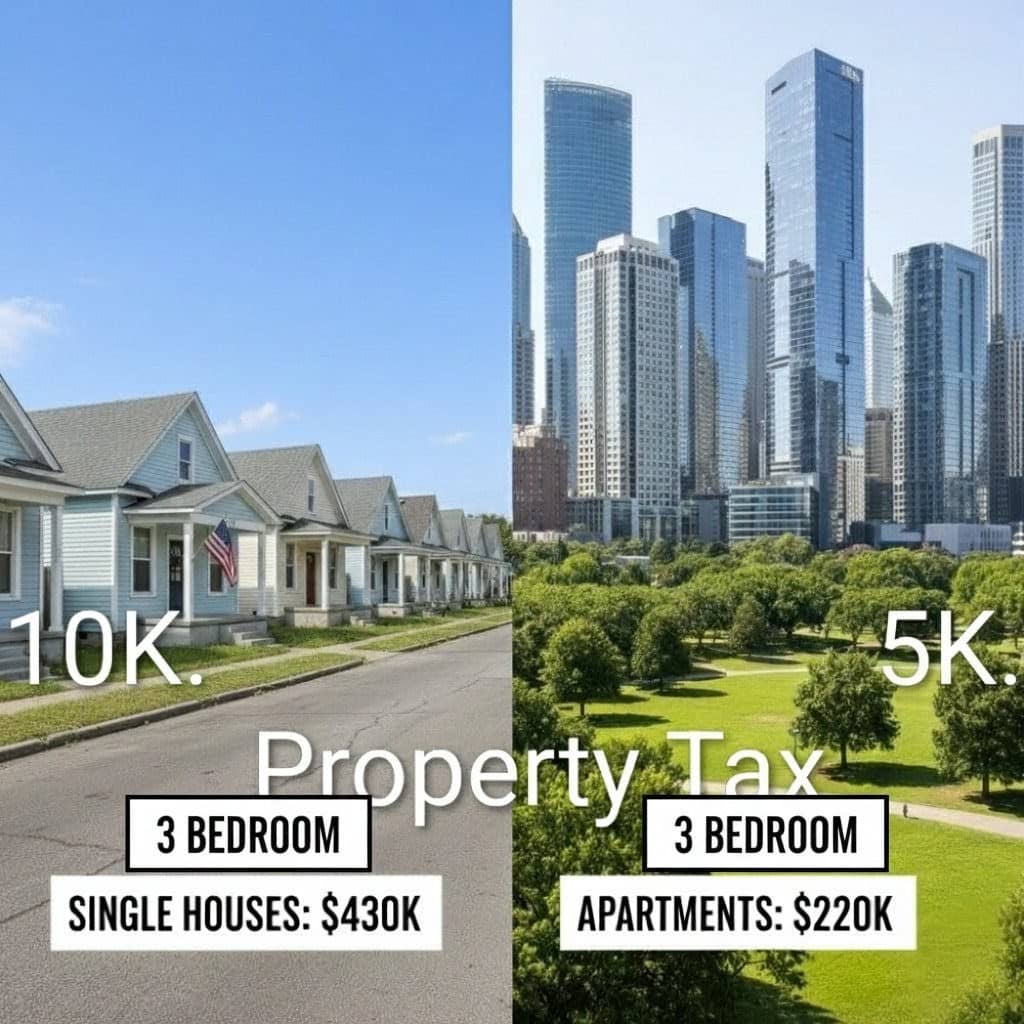
The futuristic images in our conversation provide a blueprint: high-density verticalism integrated with nature.[Images 1, 2] The fastest way to achieve this is the legalization of "single-stair" apartment buildings and the elimination of minimum parking requirements. Studies show that single-stair designs are 6% to 13% less expensive to build and allow for much higher density on small urban lots. By upzoning residential land to allow for vertical "build-up" projects, cities can maximize land use and reduce the per-unit cost of housing.
3. Scaling Industrialized Construction:
Traditional site-built housing is too slow to address a 4 million unit deficit. The federal government could scale "factory-built" and modular housing to bypass labor shortages. Modular designs can reduce construction costs by 25% to 35% per square foot, particularly when used for office-to-residential conversions. By repurposing empty commercial space into "micro-apartments" and co-living facilities, cities can rapidly create housing for individuals earning 30% to 50% of the area's median income.
4. The adoption of the "Vienna Model":
In Vienna, 40% of the housing stock is "social housing" owned by the municipality or limited-profit associations. This model ensures that developers are paid for their work but are restricted from taking excess profits, which must be recycled back into the housing stock. By requiring that two-thirds of all new developments be social housing, a city can decouple home prices from speculative market forces, leading to the lowest rents of any major Western capital.
The Algorithmic State: The "Post-Monetary" Future of Housing
The futuristic cityscapes we examined feature humanoid robots and holographic status displays showing "Global Resource Indices" and "Reputation Scores."[Images 1, 2] This represents the transition toward Algorithmic Governance (AG) for resource distribution. In a post-labor society where birth rates have plummeted and traditional money is no longer a valid database for labor allocation, housing must be managed as a "common heritage."
Under an Algorithmic State Architecture (ASA), AI systems would monitor housing inventory and population needs in real-time. Instead of a pricing mechanism based on scarcity for profit, housing would be allocated based on need and verified reputation—a trust-based social capital measurable through transparent, AI-verifiable ledgers. This system would identify "dead assets"—such as the 8 million homes released by the Silver Tsunami—and intelligently redistribute them to maintain the social fabric in vibrant urban hubs while allowing declining rural areas to return to nature.
This transition requires "epistemic reprogramming," shifting our understanding of value from material accumulation to informational standing. As robotization replaces human labor, the "Infinite Economy" will no longer tether value to finite constraints, ensuring that everyone has access to a "luxury for all" regardless of their ability to pay.
Conclusion
High real estate prices today are the result of a "perfect storm" of structural supply failure, regulatory friction, and a frozen resale market. While demographic shifts like the birth/death crossover and the Silver Tsunami will eventually increase inventory, they will not provide the "fast" relief needed by Millennials and Gen Z today.
The fastest path to affordability requires a combination of forced corporate sell-offs through taxation, a zoning reset that embraces high-density verticalism, and the early implementation of Algorithmic Governance to manage resources. The futuristic cityscapes we envision—where technology and nature coexist in harmony—are not just a visual goal; they are a necessary response to a world where money and labor are no longer sufficient to house a declining but evolving human population. The post-monetary era of housing must be defined by access over ownership, ensuring that the "luxury of home" becomes a universal basic service in an era of radical abundance.
Comments
More Blogs
Explore more articles that you may find interesting.
