The Illinois Paradox: Inside the $1.2 Trillion Economy Where Small Business Is Losing Even While the State Wins
Illinois' economy just crossed $1.2 trillion, growing nearly 6% in 2025 and outpacing the national average — a headline number that would suggest a golden era for the state's businesses. But beneath the macro data lies a sharper, more complicated story: small business optimism in Illinois trails the national index, the state carries the third-highest corporate tax rate in the country, and net outmigration has pulled more than 40,000 residents out of state in a single year. At the same time, Chicago's AI and life-sciences startups are pulling in venture rounds at a pace that rivals the coasts, southern Illinois manufacturing employment is climbing, and a new wave of digital-first, AI-augmented local businesses is finding ways to grow despite the headwinds. This investigation unpacks the widening gap between Illinois' macroeconomic strength and its Main Street reality — comparing 2025 performance against 2026 conditions across GDP, hiring, tax burden, and capital investment, region by region, from the Loop to the Metro East. It examines why the state that ranks second nationally for corporate relocations also ranks near the bottom for small business dynamism, what that contradiction means for entrepreneurs navigating rising costs and regulatory complexity, and where the real opportunity is opening up for 2026's second half. The analysis closes with a strategic blueprint for local business owners and service providers — including how digital visibility, video-driven discovery, and platforms like mytsv.com are becoming the operational edge that determines who scales and who gets squeezed out in Illinois' uneven recovery.

The Illinois Paradox: A Trillion-Dollar Economy, A Fragile Main Street
Illinois entered 2026 with a number that Governor JB Pritzker's office was eager to broadcast:
gross domestic product had surpassed $1.2 trillion in 2025, growing at a pace state officials say outperformed the national economy. By some counts, the growth rate approached 5.85% year-over-year — a figure that would rank among the strongest in the Midwest and put Illinois firmly in the conversation as the nation's fifth-largest state economy, trailing only California, Texas, New York, and Florida.
It is, on its face, a genuinely impressive number. And it is almost entirely disconnected from how the owner of a dry cleaner in Rockford, a HVAC contractor in Peoria, or a boutique fitness studio in Naperville would describe their year.
That disconnect is the real story of Illinois commerce in 2026 — not a single narrative of boom or bust, but a bifurcated economy where the aggregate figures and the lived experience of small and mid-sized business owners are moving in opposite directions. Understanding why requires pulling apart the data most headlines never separate: state-level GDP versus small-business sentiment, corporate relocation wins versus local startup formation, and Chicago's tech-fueled ascent versus downstate's slower, more manufacturing-anchored climb.
The Headline Numbers: Real Growth, Real Momentum
The topline data is not manufactured.
According to the U.S. Bureau of Economic Analysis, Illinois' gross state product reached approximately $1.2 trillion in 2025, up from roughly $1.15 trillion in 2024 in nominal terms. Real GDP growth in the third quarter of 2025 registered 4.3%, essentially matching the national growth rate, though that quarter's ranking — 29th nationally and 10th in the Midwest — suggests Illinois was riding a national wave rather than generating outsized growth of its own.
Illinois also carried real momentum into the first quarter of 2026. State-supported economic development programs had already attracted commitments for close to 4,000 new jobs and approximately $2.5 billion in fresh investment in Q1 alone — a pace that, if sustained, would exceed the full-year total from 2025. For the fourth consecutive year, Illinois held the number two position nationally for corporate expansions and relocations, trailing only Texas. GDP per capita reached roughly $71,800 to $94,500 depending on the measurement methodology, up modestly year-over-year, and the information industry alone more than doubled its economic output since 2015.
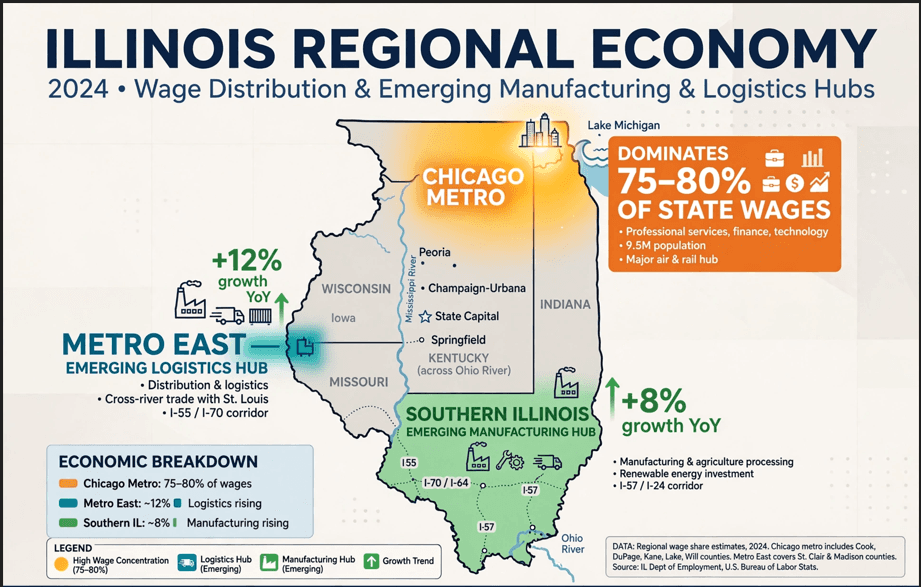
Regionally, the growth is heavily concentrated. The nine counties of the Chicago metropolitan area account for an estimated 75% to 80% of the state's total wages, leaving the remaining 93 counties — encompassing everything from the Metro East manufacturing corridor to the agricultural downstate belt — to split the balance. Yet even outside Chicago's gravitational pull, there are pockets of real strength: Southern Illinois recorded the second-highest percentage increase in advanced manufacturing employment in the state between 2021 and 2025, with more than 11,500 workers now employed in that sector regionally, driven by logistics expansion, energy development, and modernization of legacy industrial capacity.

The Small Business Reality: A Different Economy Entirely
Set against that backdrop, the data on small business sentiment tells a starkly different story — and this is where the investigation's central tension lives.
The NFIB's state-specific Small Business Optimism Index put Illinois at 97.3 for the winter 2025–26 period, 1.2 points below the national average. Of the ten components that make up the index, four came in more negative than the national figures, five were roughly comparable, and only one — current inventory, a lagging indicator of past sales rather than future confidence — was more positive. The two components showing the most significant deficits were job openings and earnings, precisely the forward-looking measures that predict hiring and expansion over the next two quarters.
Illinois' state director for NFIB, Noah Finley, was blunt about the mood entering the state's spring legislative session: labor shortages and rising costs continue to pressure Main Street, and business owners were "watching Springfield" for signs of tax and regulatory relief rather than new burdens. The state's Employment Index — a component tracking small business hiring plans — fell for two consecutive months earlier in 2026, dropping from 101.6 to 100.4, a level below the 2025 average and a signal that hiring intentions among small operators are softening even as the state's headline job commitments climb.
This is the crux of the Illinois paradox: the businesses winning big — corporate relocations, venture-backed tech scaleups, advanced manufacturing plants — are not the same businesses that make up the overwhelming majority of the state's commercial fabric. A $2.5 billion quarter of state-supported investment commitments can coexist with declining hiring intentions among the state's 1.2 million small businesses, because the two are being driven by entirely different forces: large-scale incentive packages and site-selection competitiveness on one hand, and grinding day-to-day cost pressure on the other.
Why the Squeeze: Taxes, Regulation, and the Cost of Doing Business
The structural pressure bearing down on Illinois' small business sector is not mysterious — it shows up consistently across every independent ranking of business climate.
Illinois carries the third-highest corporate income tax rate in the country at 9.5%, a rate inflated in part by the state's personal property replacement tax, which layers an additional 2.5% onto corporations and 1.5% onto certain pass-through entities on top of the base rate. The state also imposes a cap on net operating loss carryforwards that the Tax Foundation describes as a national outlier, and it has yet to resume a paused phase-out of its capital stock tax. Illinois' overall state tax competitiveness ranking has slipped six spots over the past six years, and the state now carries the nation's highest property tax rate alongside a sales tax that can reach 10.25% in parts of the Chicago metro when local rates stack on top of the state's 6.25% base. Two Illinois cities, Aurora and Elgin, rank among the highest in the nation for property tax burden relative to household income.
Beyond taxation, the Archbridge Institute's most recent research ranked Illinois 45th in the country for entrepreneurship and economic growth, driven by a 44th-place tax ranking, a 41st-place regulatory ranking, and a 35th-place "business dynamism" score reflecting high outmigration, sluggish startup formation, and weak company growth relative to peer states. Illinois' legal code contained more than 282,000 instances of restrictive regulatory language as of the most recent count — the fourth-highest total among all states — and net outmigration removed more than 40,000 residents from the state between July 2024 and July 2025 alone.
For a local service business — a massage therapy practice, a boutique gym, a family-owned restaurant, a video production studio — this translates into a very specific and unglamorous set of operating realities: higher effective tax exposure than almost any neighboring state, a denser thicket of compliance requirements to navigate without in-house legal counsel, and a shrinking regional customer and labor base in parts of the state experiencing sustained outmigration. None of this shows up in a $1.2 trillion GDP headline. All of it shows up in a small business owner's monthly P&L.

The Innovation Counterweight: Chicago's AI and Life-Sciences Surge
The other half of the paradox is that Illinois' innovation economy — concentrated overwhelmingly in Chicago — is genuinely thriving, and increasingly on its own terms rather than as a satellite of Silicon Valley.
Chicago-founded healthcare AI company Tempus AI went public in 2024 at a $6 billion valuation, and the ecosystem behind it has only deepened since. ARCH Venture Partners alone deployed more than $3 billion into life sciences companies in the 2024–2025 window. Locally headquartered AI startups such as Formic Technologies and Arturo.ai have closed Series A rounds in the $58–60 million range, and Chicago-based logistics fintech company Loop has advanced to Series B on the strength of a niche but high-value play in supply chain audit and payment automation — a category that leverages Chicago's long-standing position as the nation's logistics and freight accounting hub.
Venture capital advisors working with Chicago founders describe a maturing but still regionally distinct capital market: strong for B2B SaaS, healthcare and life sciences, fintech and insurtech, and logistics or industrial technology through Series A, with founders typically needing to look to coastal firms once they reach Series B and beyond. Active local funds — ARCH Venture Partners, Origin Ventures, Hyde Park Venture Partners, MATH Venture Partners, New Stack Ventures, Jump Capital, Lightbank, M25, and others — have built enough density that "Silicon Prairie" now functions as a credible regional label rather than a marketing aspiration. AI-focused seed rounds nationally are commanding valuations roughly 42% above non-AI peers, and Chicago's vertical AI startups — companies solving narrow, high-value problems in insurance, logistics, and healthcare rather than building horizontal platforms — are increasingly seen as a distinct and defensible niche relative to Silicon Valley's more generalist AI bets.
This is where the "explosive innovation vector" the state's boosters point to is real and measurable. But it is also narrow. Venture-scale AI investment overwhelmingly benefits a small number of highly credentialed founders with access to institutional capital and elite research networks — not the tens of thousands of Main Street operators who make up the bulk of Illinois' business tax base and who are, per the NFIB data, watching earnings and job-opening indicators soften in real time.
2025 vs. 2026: What Actually Changed
Laying the two years side by side clarifies the trajectory rather than muddying it further.
2025 was, by state-level measures, a genuinely strong year: GDP crossed $1.2 trillion, corporate relocation activity held Illinois at number two nationally for a fourth straight year, and Q3 growth of 4.3% tracked the national recovery from an early-year contraction. Small business optimism, however, was already trailing the national average for the entire winter survey period spanning into early 2026, with earnings and job openings identified as consistent soft spots.
2026 has been more volatile at the small-business level even as macro indicators stayed resilient. National small business optimism swung from 99.5 in December 2025 down to 98.8 in February, held roughly flat through March, dipped further amid rising tariff-driven uncertainty, and then rose 2.1 points in June to 97.4 — still below the 52-year historical average of 98.0. Illinois has tracked at or below the national figure throughout, and its Employment Index specifically declined for two consecutive months in the spring. Meanwhile, the state's Q1 2026 job and investment commitments — nearly 4,000 jobs and $2.5 billion — already outpaced full-year 2025 totals, reinforcing that large-scale corporate investment and small-business sentiment are moving on entirely separate tracks.
The clearest read: Illinois' 2026 economy is not one economy but two. Large employers, relocating corporations, and venture-backed innovation companies are experiencing sustained tailwinds. Small, independent, and locally owned businesses are navigating flat-to-softening conditions, elevated tax exposure, and persistent labor cost pressure, with only modest relief expected as federal tax provisions phase in over the second half of the year.

Predictions for the Remaining Quarters of 2026
Based on the trajectory of the data reviewed, several forward indicators are worth watching closely through the rest of 2026:
Small business optimism likely stabilizes rather than surges. NFIB's national chief economist has pointed to the phase-in of recent federal tax provisions as a plausible source of relief for the private sector "over the next few months," but Illinois' state-specific tax and regulatory drag will likely keep the state's index below the national figure through year-end.
Corporate relocation and large-scale investment commitments should remain strong, continuing to be driven by site-selection factors — central logistics geography, workforce depth, and infrastructure — that are largely insulated from the state-level tax and regulatory friction affecting smaller, less mobile businesses.
Chicago's AI and life-sciences venture activity is positioned to keep accelerating, with premium valuations for AI-focused rounds and continued institutional capital deployment from firms like ARCH Venture Partners likely to produce more late-stage rounds and possible IPO activity following Tempus AI's path.
Downstate manufacturing and logistics employment should continue its gradual climb, particularly in Southern Illinois, but from a smaller base and at a slower pace than the Chicago-driven headline numbers suggest for the state as a whole.
Legislative action on tax and regulatory relief remains the single largest swing factor. Small business advocacy groups are actively pushing Springfield for relief rather than new burdens; the outcome of that legislative push will materially shape whether small business sentiment closes the gap with the national average or falls further behind.
The Operational Obstacles Illinois Entrepreneurs Actually Face
Distilled from the data, the practical friction points for Illinois' local business owners and service providers cluster around a few recurring themes:
Compounding tax exposure. Between the nation's third-highest corporate income tax rate, some of the highest property tax burdens in the country, and sales tax rates that can exceed 10% in parts of the Chicago metro, Illinois businesses often face a materially higher effective tax load than comparable operations in neighboring Midwest states.
Regulatory complexity without dedicated compliance staff. With one of the most restrictive regulatory codes in the country, small operators frequently absorb compliance costs that larger, better-resourced competitors can distribute across legal and finance departments.
Persistent labor tightness. Job openings that owners cannot fill have remained a top-cited concern nationally throughout 2026, and Illinois' own data shows the state trailing the national average on this exact metric.
Outmigration eroding local customer and labor bases. In regions experiencing net population loss, businesses face a shrinking addressable market even when doing everything right operationally.
Visibility and discovery in an increasingly digital-first customer journey. With more prospective customers researching local service providers online before ever making contact, businesses without a strong, verifiable digital presence — reviews, video content, structured local listings — are increasingly invisible to their own regional customer base, regardless of service quality.
Untapped Opportunity: Where Illinois Businesses Can Actually Win in 2026
The data also points toward genuine, underexploited opportunity for businesses willing to adapt their operating model:
Vertical AI adoption at the small-business scale. The same AI investment wave fueling Chicago's venture ecosystem is producing tools — scheduling automation, AI-assisted customer communication, predictive inventory and staffing — that are increasingly affordable for independent operators, not just venture-funded startups. Businesses that adopt these tools early are effectively borrowing the productivity gains of the innovation economy without needing venture funding themselves.
Regional advanced manufacturing and logistics niches, particularly in Southern Illinois and the Metro East, where employment growth is outpacing the state average and where state and regional economic development coordination is actively courting new investment.
Digital-first local discovery infrastructure. As Illinois' service economy becomes more fragmented between an increasingly online-first consumer base and a business landscape still under-optimized for digital visibility, platforms built specifically around local business discovery represent a structural advantage rather than a marginal marketing channel. This is precisely the gap mytsv.com was built to close: a business video directory that organizes local service providers by business name, service type, and location, giving Illinois entrepreneurs — from massage therapists to contractors to boutique fitness studios — a direct, video-driven presence in front of the customers actively searching for them. In an economy where large corporations are winning the relocation and venture-capital game through scale, and small businesses are being squeezed by tax and regulatory friction they can't individually resolve, digital visibility is one of the few competitive levers still fully within a local business owner's control. Platforms like mytsv.com give independent Illinois businesses the same kind of discoverability advantage that larger, better-capitalized competitors take for granted — turning a structural disadvantage in scale into a navigable, even winnable, local marketing fight.
Regulatory and tax-credit navigation. With Illinois offering a growing set of state-sponsored tax credits and incentive programs alongside its high base tax burden, businesses that proactively work with qualified accounting and tax professionals to access these programs can materially offset the state's competitive disadvantages relative to peers who simply absorb the full statutory burden.
The Bottom Line
Illinois' $1.2 trillion economy is not a mirage — the state's GDP growth, corporate relocation record, and venture capital momentum are all real and well-documented.
But treating that headline as a proxy for the health of Illinois' small business community is a category error that the data does not support. The state's own small business sentiment surveys, tax competitiveness rankings, and outmigration figures describe a materially harder operating environment than the topline GDP number implies.
The businesses that will come out ahead in the back half of 2026 will not be the ones waiting for Springfield to fix the state's tax and regulatory competitiveness — that fight will play out over years, not quarters. They will be the ones that treat digital visibility, AI-enabled efficiency, and smart use of available tax incentives as immediate, controllable levers inside an economy that is, for now, stacked in favor of scale. For Illinois' independent business owners, closing that gap starts with making sure customers can find them in the first place — which is exactly the problem a platform like mytsv.com exists to solve.
Comments
More Blogs
Explore more articles that you may find interesting.
